
WASHINGTON, July 10 — The numbers, as ever, tell a brutal technical story. An estimated 30 million bison roamed the North American plains in 1800. By 1890, fewer than 1,000 remained.
The transcontinental railroad did not merely bisect the continent; it bisected the last great bison herds, turning a living ecosystem into a corridor for industrial expansion. The detail that matters is that the railroad cut directly through Native American hunting grounds, accelerating the displacement of tribes including the Sioux, Cheyenne, and Arapaho with mechanical efficiency.
The Union Pacific’s construction crews operated under a constant threat of attack from tribes defending their lands. These were not random skirmishes but organised resistance to an existential encroachment. The 1866 Fetterman Fight and the 1868 Battle of Washita stand as documented flashpoints in a wider conflict that the railroad itself made inevitable.
The technical reality is that the railroad gave the U.S. Army something it had lacked in earlier campaigns: rapid deployment. Troops and supplies could be moved in days rather than weeks, shifting the strategic calculus of the Indian Wars of the 1860s and 1870s decisively in favour of federal forces.
The Treaty That Couldn’t Hold
The 1868 Treaty of Fort Laramie was, under the hood, a political response to the chaos the railroad was generating. It established the Great Sioux Reservation, a designated territory intended to confine tribes and clear the path for further rail expansion. The treaty was a classic piece of nineteenth-century American statecraft: legal in form, coercive in function.
It did not halt the railroad, nor did it halt the bison slaughter. What it did was create a legal framework for displacement that the U.S. government would later disregard as settlement pressures mounted.
By 1890, the railroad had enabled the settlement of millions of acres of former tribal lands. The mechanism was straightforward: the rail lines brought settlers, the settlers needed land, and the land was occupied by tribes whose military resistance had been systematically broken. The bison slaughter was not incidental to this process; it was a deliberate tactic.
Without the bison, the plains tribes lost their primary food source, their shelter materials, and their economic base. The railroad made the slaughter logistically feasible by providing transport for commercial hunters and a direct line to eastern markets for hides and bones.
The Engineering of Conquest
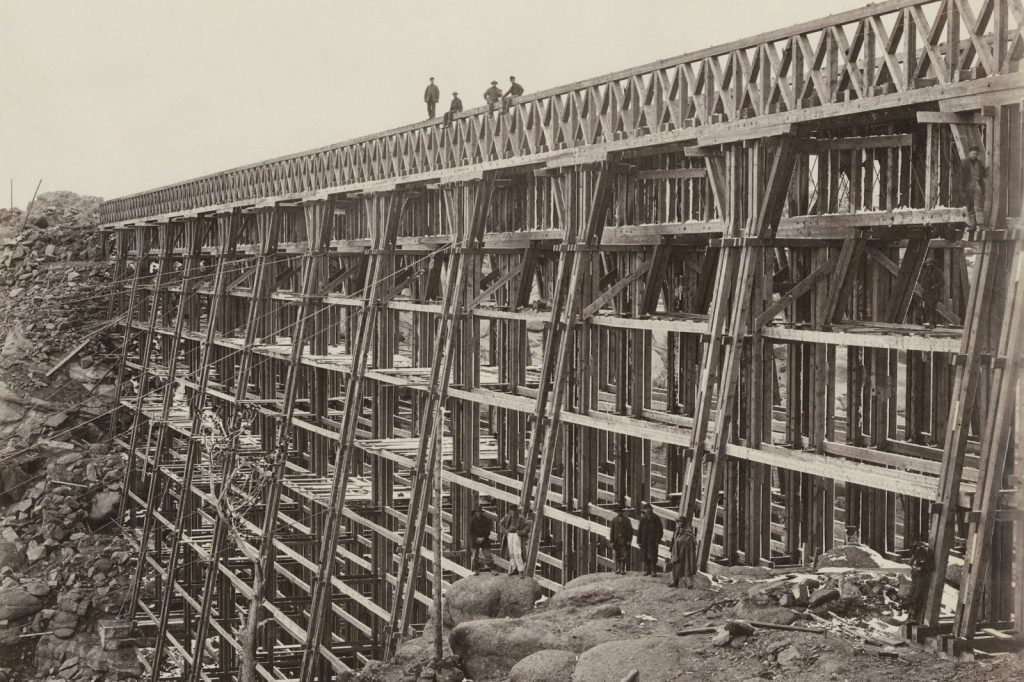
The transcontinental railroad is often celebrated in American history as an engineering triumph, and technically it was. But the same engineering that connected the Atlantic and Pacific oceans also connected the U.S. Army to the heart of the Plains. The railroad depots became supply hubs for military campaigns.
The telegraph lines that ran alongside the tracks allowed for coordinated troop movements across vast distances. What looked like infrastructure was also, in operational terms, a weapon system.
Wry observation: the railroad barons who financed the Union Pacific and Central Pacific were not, for the most part, interested in warfare. They were interested in land grants and freight revenue. But the federal government, which provided those land grants and loan guarantees, understood perfectly well that the railroad would serve as an instrument of Indian removal.
The 1862 Pacific Railroad Act, which authorised the project, was passed during the Civil War, when the federal government was simultaneously fighting to preserve the Union and planning the dispossession of the tribes who stood in the way of continental consolidation. The Fetterman Fight of 1866, in which a detachment of U.S. cavalry was wiped out by Lakota, Cheyenne, and Arapaho warriors, was a direct consequence of the army’s attempt to protect railroad survey parties and construction crews along the Bozeman Trail.
The Battle of Washita in 1868, in which Lieutenant Colonel George Armstrong Custer attacked a Cheyenne village, was a punitive expedition intended to demonstrate that the railroad corridor would be secured by force. The pattern is consistent: the railroad advanced, the tribes resisted, and the army retaliated.
What to Watch Next
The legacy of this displacement is not merely historical. The legal and territorial framework established by the 1868 Treaty of Fort Laramie continues to shape disputes over land rights, resource extraction, and tribal sovereignty on the Northern Plains. The question of whether the U.S. government honoured its treaty obligations—and the answer, on the evidence, is that it did not—remains a live issue in federal courts and in the politics of states like South Dakota and Montana.
The railroad itself is now largely a freight corridor, but the pattern of settlement it enabled is baked into the property maps and demographic realities of the American West. The bison have not returned.
The tribes have not recovered their lands. The railroad, as ever, did exactly what it was designed to do.
{“@context”: “https://schema.org”, “@type”: “NewsArticle”, “headline”: “Transcontinental Railroad Accelerated Native American Displacement”, “description”: “WASHINGTON, July 10 — The numbers, as ever, tell a brutal technical story. An estimated 30 million bison roamed the North American plains in 1800….”, “datePublished”: “2026-07-10T09:30:00+00:00”, “author”: {“@type”: “Person”, “name”: “Sebastian Smith”}, “publisher”: {“@type”: “Organization”, “name”: “InfoPulse Today”, “url”: “https://newsfeed.infopulsetoday.com/”}}




