
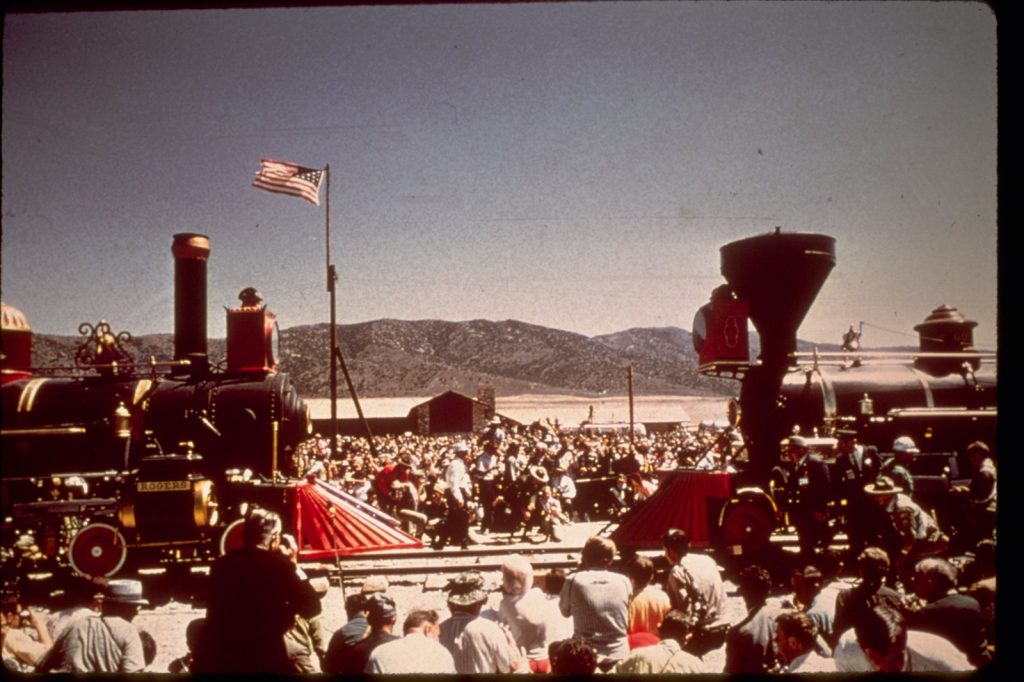
The transcontinental railroad, a marvel of 19th-century engineering and federal ambition, was designed to bind the Atlantic and Pacific coasts into a single economic and political entity. Yet its completion in 1869 set in motion a chain of events that accelerated the displacement of Native American tribes, intensified decades of armed conflict on the Great Plains, and pushed the American bison to the brink of extinction, fundamentally reshaping the nation’s interior.
The idea of spanning the continent by rail had been debated for decades before the Civil War, stalled by disputes over slavery, regional rivalries, and financing. The Pacific Railway Acts of 1862 and 1864 broke the logjam, authorizing federal land grants and loans to two private companies: the Central Pacific, building east from California, and the Union Pacific, building west from the Missouri River.
Construction began in earnest after the war ended. Thousands of Irish immigrants, Civil War veterans, Mormon workers, and Chinese laborers joined the effort. The Central Pacific relied heavily on Chinese immigrants, who blasted tunnels through the Sierra Nevada and laid track under brutal conditions.
On May 10, 1869, the two lines met at Promontory Summit in Utah Territory, linking the nation coast to coast for the first time.
Disruption and War on the Plains
The railroad’s arrival did not occur in a vacuum. For decades, the U.S. government’s policy of westward expansion had clashed with the sovereignty of Indigenous nations. The new rail line sliced through the traditional territories of the Sioux, Cheyenne, Arapaho, Shoshone, and other tribes, cutting across hunting grounds and migration routes that had sustained their way of life for generations.
The tracks drew waves of settlers, miners, and hide hunters, escalating competition for land and resources. Tensions that had simmered for years erupted into open warfare.
The most famous confrontation of this era was the Great Sioux War of 1876–1877. On June 25–26, 1876, along the Little Bighorn River in present-day Montana, Lakota and Cheyenne warriors under the leadership of Sitting Bull and Crazy Horse defeated the 7th Cavalry Regiment commanded by Lt. Col. George Armstrong Custer. The battle was a striking tactical victory for the tribes, but it did not alter the strategic calculus.
The railroad gave the U.S. Army a decisive advantage: it could now transport troops, artillery, and supplies to the frontier in days rather than weeks. Forts were established along the rail corridor, and the military launched sustained campaigns that gradually confined Plains tribes to reservations.
The Bison’s Demise and the Tribes’ Fate
The railroad also accelerated an ecological catastrophe that proved as devastating as any military defeat. The Great Plains once teemed with American bison; early 19th-century estimates placed the population between 30 million and 60 million animals.
The railroad opened the region to commercial hunting on an industrial scale. Hide hunters shot bison by the thousands, shipping their pelts east to supply railroad workers and a growing urban market. The U.S. government did not merely allow this slaughter—it actively encouraged it as a means of undermining the tribes that depended on the bison for food, clothing, and shelter.
By the 1890s, fewer than 1,000 bison remained across the entire continent. For the Plains nations, the consequences were direct and devastating.
With the bison gone, their economic and subsistence base collapsed. Starvation and disease followed. The same railroad that had carried settlers and soldiers now became an instrument of forced relocation, as tribes were moved onto reservations far from their ancestral lands.
The combination of rapid military mobility and the destruction of the bison herd left the tribes with no viable alternative but to submit. The transcontinental railroad stands as both a monument to human ingenuity and a reminder of the costs borne by those who stood in the path of expansion.
It connected the nation, opened vast regions to settlement and commerce, and became the backbone of a continental transportation network. Yet its legacy is inseparable from the displacement of Indigenous peoples and the near-eradication of a keystone species. For readers today, the railroad remains a defining moment in the country’s history and in the long, still-unfolding story of federal-Indigenous relations.




