
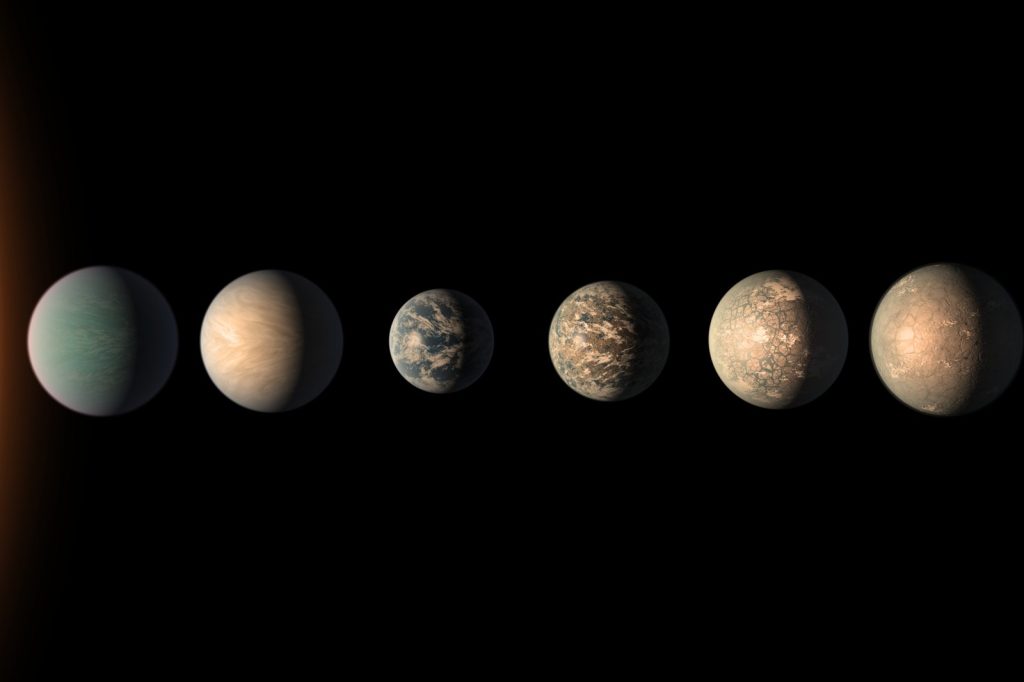
ROME, July 17 — The TRAPPIST-1 system, an ultra-cool red dwarf star 40.66 light-years from Earth in the constellation Aquarius, continues to yield a puzzle that defies easy optimism. The claim is that up to four of its seven known terrestrial planets sit at distances where temperatures may allow liquid water. The catch is that no atmosphere has been confirmed on any of them, and for planet b, the evidence has ruled one out entirely.
The mechanics here are straightforward enough. The star, discovered in 1999 by astronomer John Gizis and colleagues during a survey of nearby ultra-cool dwarf stars and published in 2000, is a dim, ancient object.
Its surface temperature is about 2,566 K, its radius is slightly larger than Jupiter’s, and its mass is about 9% of the Sun’s. At an estimated 7.6 billion years old, it is older than our own Solar System. The seven planets, all comparable in mass to Earth, orbit in a single plane with circular periods ranging from 1.5 to 19 days.
That flat alignment is what allows detection: each planet passes in front of the star, dimming its apparent magnitude for telescopes on Earth. Follow the science, and the picture grows complicated.
The planets designated d, e, f, and g orbit at distances where temperatures may allow liquid water. That is the headline. On closer reading, however, the planets have low densities, which suggests they may consist of large amounts of volatile material.
And the star itself, an ultra-cool red dwarf, presents a radiation environment where it is unclear whether it would permit atmospheres. The discovery team, led by Belgian astronomer Michaël Gillon of the University of Liege, has not found evidence of an atmosphere on any planet so far.
The discovery chain
The system’s first two terrestrial planets were identified in 2016 using the TRAPPIST–South telescope at La Silla Observatory in Chile, along with other telescopes. Further analysis in 2017 brought the total to seven. The observational firepower behind this work is considerable: the Spitzer Space Telescope, TRAPPIST–South, TRAPPIST–North at Oukaïmeden Observatory in Morocco, the South African Astronomical Observatory, the Liverpool Telescopes, the William Herschel Telescopes in Spain, the Himalayan Chandra Telescope, the United Kingdom Infrared Telescope, and the Very Large Telescope.
All seven planets are likely tidally locked. That means one side is in permanent day, the other in permanent night — a condition that would fundamentally shape any potential climate or biology.
The star’s own age, 7.6 billion years, means the system has had ample time for geological or atmospheric evolution. Whether that evolution has produced anything hospitable remains an open question.
What to watch next
The system’s appearance in popular culture reflects its grip on the public imagination. But for the research community, the next step is clear: find an atmosphere. The star is also known as 2MASS J23062928−0502285 or SPECULOOS-1, and it is close enough — 40.66 light-years — that future telescopes may be able to probe the chemical composition of any atmosphere that exists.
The catch is that, so far, the evidence points toward bare rock.




