
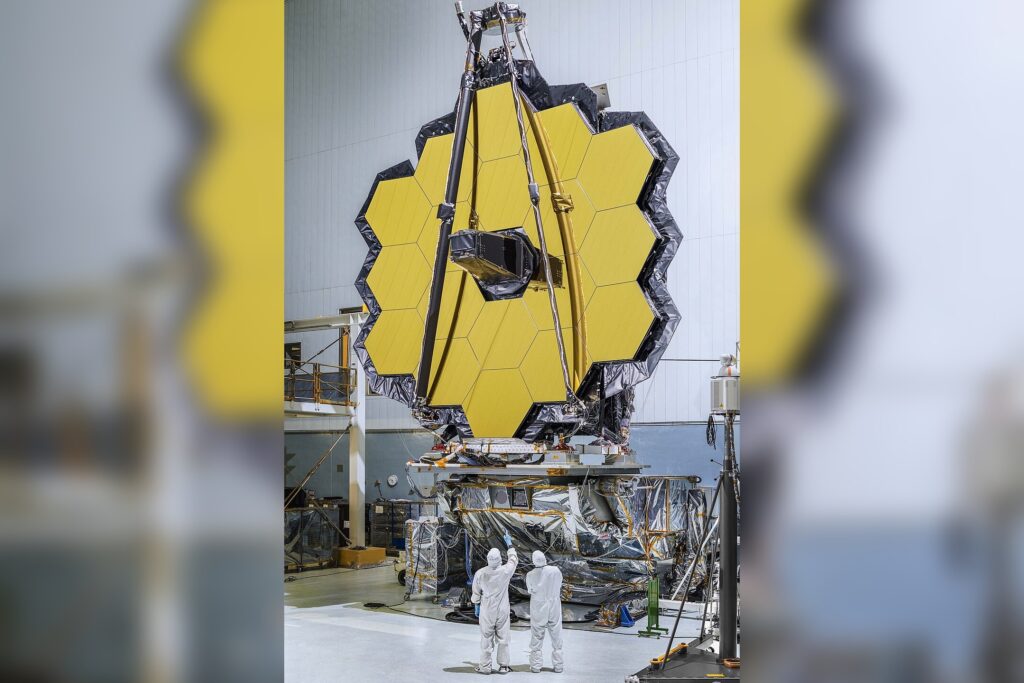
BALTIMORE, July 17 — The James Webb Space Telescope, the largest telescope in space, continues to deliver data that is reshaping humanity’s understanding of the universe, officials confirmed today. Launched on 25 December 2021 from Kourou, French Guiana aboard an Ariane 5 rocket, the telescope reached its operational station in January 2022. That position is a solar orbit near the Sun–Earth L2 Lagrange point, approximately 1.5 million kilometers from Earth.
Its first image was released on 11 July 2022. The telescope’s design and development were led by NASA, in partnership with the European Space Agency and the Canadian Space Agency.
The NASA Goddard Space Flight Center managed development, while the Space Telescope Science Institute in Baltimore operates the observatory. The primary contractor was Northrop Grumman. What sets JWST apart is its scale and capability.
It is the largest telescope in space, with a 6.5-meter-diameter gold-coated beryllium primary mirror composed of 18 separate hexagonal mirrors. The total collecting area is 25.4 square meters, over six times larger than the Hubble Space Telescope’s 2.4-meter mirror.
The instrument observes a lower frequency range than Hubble, from long-wavelength visible light through mid-infrared, spanning 0.6 to 28.5 micrometers. To prevent interference from its own infrared radiation, the telescope must be kept below 50 Kelvin.
Atmospheric reconnaissance
JWST is equipped with high-resolution and high-sensitivity instruments that enable detailed atmospheric characterization of potentially habitable exoplanets. The key technique employed is transmission spectroscopy. This method analyzes starlight that has been filtered through a planet’s atmosphere during a transit—when the planet passes in front of its host star.
By breaking down that filtered light, scientists can identify chemical signatures such as water, methane, carbon dioxide, and other molecules. The record shows this approach allows researchers to determine not just atmospheric composition, but also temperature and pressure conditions on distant worlds.
This capability represents a qualitative leap forward from previous observatories. The strategic context is clear: the telescope’s ability to probe exoplanet atmospheres directly addresses one of the most consequential questions in modern science—whether conditions suitable for life exist beyond our solar system.
A long road to orbit
Initial designs for what would become JWST began in 1996. Two concept studies were commissioned in 1999 for a potential 2007 launch, with a budget of $1 billion at that time. The program, however, experienced well-documented cost overruns and delays.
A redesign followed in 2005. Construction was completed in 2016, after which exhaustive testing began.
The total cost of the program reached $10 billion. The telescope’s journey from concept to launch spanned more than two decades, reflecting both the technical ambition of the project and the complexities inherent in building and testing the most advanced space observatory ever attempted. For the moment, JWST remains in its operational orbit, its instruments cold and stable, continuing to gather data that officials say will keep astronomers busy for years.
The next phase of exoplanet atmospheric studies is expected to yield further insights into the composition and potential habitability of worlds light-years away.




