
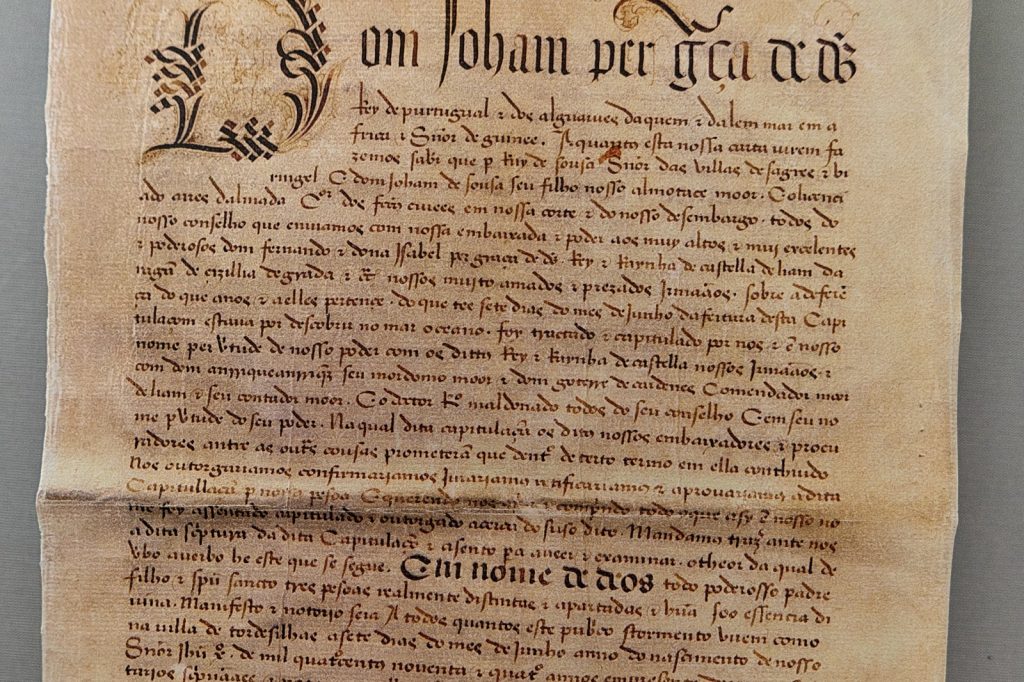
LISBON, July 8 — A treaty signed 532 years ago this week continues to shape the political map of South America, yet the mechanics of how it worked — and who it excluded — are worth revisiting. The Treaty of Tordesillas, signed on June 7, 1494, between Spain and Portugal, divided the newly discovered lands outside Europe along a meridian 370 leagues west of the Cape Verde islands.
The catch: this was a bilateral deal between two kingdoms, blessed by the Pope, but never recognised by the other European powers that would soon challenge it. The line itself was established by Pope Alexander VI.
Spain got rights to lands west of the meridian; Portugal got the east. The trigger was Columbus’s 1492 voyage and the disputes that followed over who owned what in the Atlantic. On closer reading, the treaty was less a global settlement and more a real-estate carve-up between two Catholic monarchies that assumed they could decide the fate of entire continents without consulting anyone else.
The practical effect was stark. Portugal gained control over Africa, Asia, and Brazil — which Pedro Álvares Cabral would discover in 1500, six years after the treaty was signed.
Spain claimed the Americas. The treaty was ratified by both kingdoms and later by the Pope, giving it the veneer of divine and royal authority. But the fatal flaw was obvious: England and France never signed on.
They had no intention of respecting a line drawn by a pope who had no jurisdiction over their crowns.
The mechanics of exclusion
The treaty remained in effect until the 18th century, which is a remarkably long run for a document that was essentially unenforceable outside the signatories’ own navies. It shaped colonial boundaries in South America in ways that are still visible today. Brazil’s bulge into the continent, for instance, is a direct consequence of the Portuguese claim staked under Tordesillas.
The line gave Portugal a foothold in the New World that Spain could not later dislodge, because the treaty itself had sanctioned it. But the mechanics here are worth dissecting.
The treaty did not create a physical barrier. It created a legal claim that each kingdom had to enforce with ships, soldiers, and settlers. Spain could not patrol the entire line; Portugal could not either.
The treaty worked only as long as both sides chose to respect it, and as long as no third party with superior firepower decided to ignore it. That is not a recipe for permanence, yet it held for centuries.
Follow the money
The economic logic is clear. Spain wanted the gold and silver of the Americas. Portugal wanted the spice trade of Africa and Asia, and later the sugar and gold of Brazil.
The treaty gave each a monopoly over their respective zones, at least on paper. The Pope’s blessing added moral weight, but the real enforcement came from the treasure fleets and the fortresses built along the coasts.
The treaty was not recognised by other European powers like England and France. That is the key sentence in the source material. Those powers would later carve out their own colonies in the Americas and Asia, often at the expense of Spain and Portugal.
The Treaty of Tordesillas did not stop the English from settling Virginia or the French from claiming Quebec. It only governed how the two Iberian kingdoms divided the spoils between themselves.
What to watch
The treaty’s legacy is most visible today in South America, where Portuguese-speaking Brazil sits surrounded by Spanish-speaking neighbours. That linguistic and cultural boundary is a direct result of the 1494 line. The treaty was eventually superseded by later agreements in the 18th century, but its basic shape survived. The question now is whether any modern disputes over maritime boundaries or resource rights in the South Atlantic will revive arguments about who owns what — and whether a 532-year-old treaty still carries any weight beyond the history books.
{“@context”: “https://schema.org”, “@type”: “NewsArticle”, “headline”: “Treaty of Tordesillas split world between Spain and Portugal”, “description”: “LISBON, July 8 — A treaty signed 532 years ago this week continues to shape the political map of South America, yet the mechanics of…”, “datePublished”: “2026-07-08T09:30:00+00:00”, “author”: {“@type”: “Person”, “name”: “Beatrice Ferrari”}, “publisher”: {“@type”: “Organization”, “name”: “InfoPulse Today”, “url”: “https://newsfeed.infopulsetoday.com/”}}




