
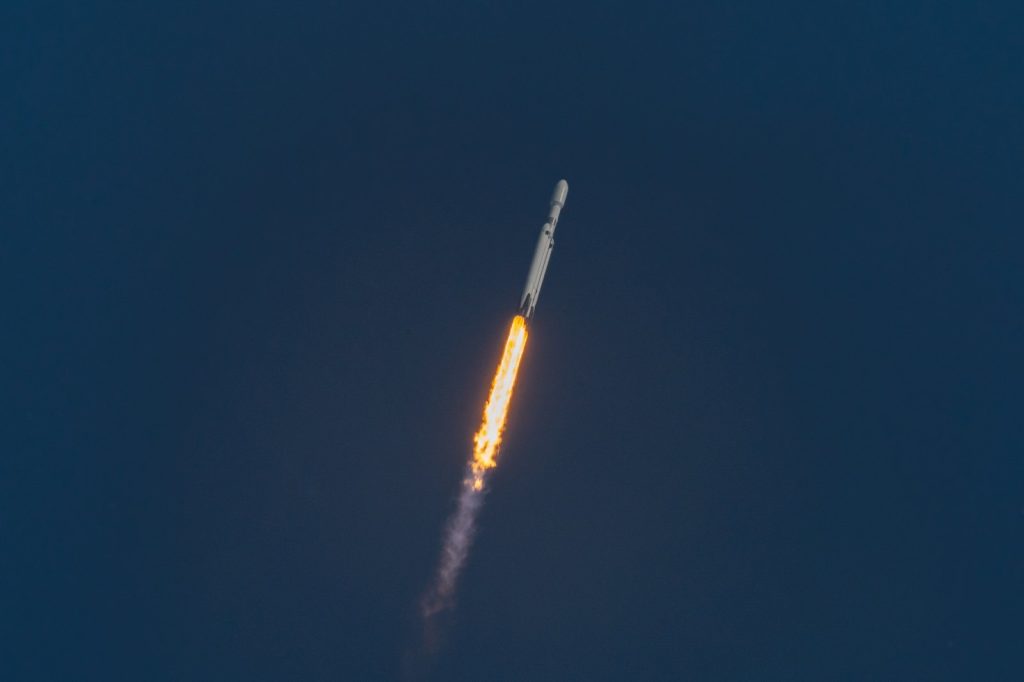
Boeing was caught holding Lockheed Martin’s proprietary documents in 2003, and the Air Force answered by moving seven launches from Boeing’s Delta IV to Lockheed’s Atlas V. That one decision tells you a lot about how the National Security Space Launch program, the Pentagon’s route to orbit for its most valuable satellites, came to be run.
NSSL assures access to space for Defense Department and other government payloads. The Space Force’s Space Systems Command manages it through the Assured Access to Space Directorate, in partnership with the National Reconnaissance Office.
From EELV to a two-company race
The Air Force began the program in 1994 as the Evolved Expendable Launch Vehicle effort, after many years of government-funded studies. It was meant to replace older rockets, including the Delta II, Atlas II and Titan IV, with vehicles built on standardized fairings, liquid core stages, upper stages and solid boosters. Two goals ran through it: cheaper launches, and guaranteed national access to space.
Four contractors bid at the start: Lockheed Martin, Boeing, McDonnell Douglas and Alliant Techsystems. In October 1998 the Air Force made its first two launch services awards, known as Buy 1. With two development agreements, the total came to more than $3 billion. Boeing got 19 of the 28 launches and $1.38 billion. Lockheed Martin got the other nine, worth $650 million. Each company also received $500 million for the final phase.
Boeing built the Delta IV around Common Booster Cores. Lockheed built the Atlas V on a Common Core Booster with a Centaur upper stage. Both flew for the first time in 2002, carrying two commercial satellites, Eutelsat 33B on the Delta IV and Eutelsat 8 West C on the Atlas V.
Scandal, a merger and SpaceX
After the 2003 document affair, the two companies agreed to form United Launch Alliance, a joint venture in which each holds 50 percent. The aim was to end the litigation and the competition for a limited market.
Competition came back through a different door. In December 2012 the Defense Department reopened the market, authorizing a block buy of up to 36 boosters from ULA and setting aside 14 more to be bought competitively from 2015. SpaceX signed for two proving flights to support certification of the Falcon 9 v1.1 and Falcon Heavy. In April 2014 it sued the Air Force, arguing that the Russian-built RD-180 engines on the Atlas V violated sanctions against the Russian government. The two sides settled in January 2015 by opening more launches to bidding. The Falcon 9 was certified that May, and in 2016 SpaceX won a GPS Block III launch.
On 1 March 2019 the program took its current name, to reflect the growing commercial market and the potential for reusable rockets. Lower-value payloads, such as those of the Space Test Program, are awarded by other methods.
The fleet now
Four vehicles were certified for NSSL launches as of 2019: Atlas V, Delta IV Heavy, Falcon 9 and Falcon Heavy. Delta IV Medium retired in August 2019 and Delta IV Heavy flew its last mission in April 2024. ULA announced in August 2021 that Atlas V would be retired, with all 29 remaining launches sold; its last NSSL launch took place on 30 July 2024.
In August 2020 the Space Force chose SpaceX and ULA’s Vulcan Centaur to supply military launches for 2022 to 2027. Vulcan Centaur finished its two certification flights on 8 January and 4 October 2024 and launched its first NSSL mission in August 2025. Blue Origin and Northrop Grumman, which had received $500 million and $792 million in development funding in 2018, got no second-phase money. Northrop cancelled its OmegA rocket in 2020. The Air Force and Space Force plan to fly the next-generation NSSL vehicles until at least 2030.




