
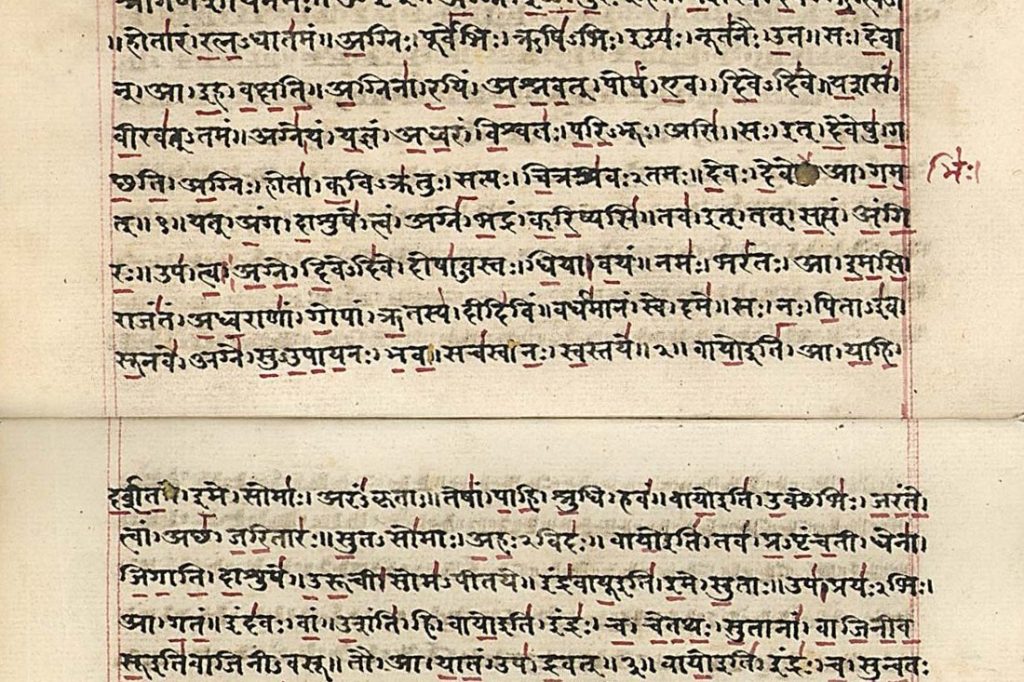
NEW DELHI, July 19 — When historians look back at the Vedic Age, they see more than just hymns and social structures. They see the earliest recorded examples of agricultural technology, metallurgy, and astronomical calculations — a burst of human ingenuity that, according to the historical record, laid the foundation for a well-organized scientific tradition. Now, that same ancient knowledge is being re-examined for a very modern purpose: reshaping how Indian students learn science and technology.
The Vedic Age followed the Indus Valley period. Its people were farmers and metalworkers, but also systematic observers of the sky.
They developed seasonal crop planning and used celestial observations for weather forecasting. These are not relics of a distant past. They are sustainable practices — practical, low-impact methods of working with natural cycles — that remain relevant today.
For families in rural India, this is not an abstraction. Many farmers still time their planting by the stars, relying on knowledge passed down through generations.
The difference is that now, educators are looking to formalize that wisdom.
From Ancient Fields to Modern Classrooms
India’s National Education Policy 2020, known as NEP 2020, encourages the integration of traditional knowledge into STEM curricula. The idea is to show students that science is not a Western import but a long-standing human endeavor, one that flourished on this subcontinent thousands of years ago. What this means for classrooms is a shift in how subjects like astronomy and agriculture are taught.
Instead of beginning with telescopes and chemical fertilizers, students might start with a question: How did ancient farmers predict the monsoon? The answer lies in the Vedic Age’s astronomical calculations, which tracked the movement of the sun and stars with enough precision to plan harvests.
The source material is clear: the Vedic Age produced the earliest examples of astronomical calculations. Those calculations were not abstract — they were tied directly to survival. Knowing when to plant, when to expect rain, when to harvest — that is science in service of life.
And it was sustainable by necessity, because there were no synthetic inputs to fall back on.
Science Rooted in Observation
The Vedic Age also saw advances in metallurgy. Bronze and later iron tools allowed for more efficient farming. But the technological leap was accompanied by a deeper understanding of natural systems.
Crop rotation, fallowing, the selection of hardy seed varieties — these practices emerged from close observation over centuries. For educators, this offers a powerful narrative: science is not just about formulas and lab reports.
It is about pattern recognition, trial and error, and a respect for the limits of the land. That lesson, embedded in the Vedic Age’s agricultural technology, is as relevant today as ever. The people behind the breakthrough are, in many cases, anonymous.
No specific names or texts from this period survive in the historical record. But the general characterization of the Vedic Age as a time of foundational scientific progress is well established.
That progress, the source notes, later laid the foundation for a well-organized scientific tradition.
A Curriculum for the Future
Integrating this historical knowledge into STEM curricula under NEP 2020 is not about nostalgia. It is about showing students that sustainable practices — seasonal crop planning, celestial observation for weather forecasting — are not inventions of the modern environmental movement. They are part of the human story, refined over millennia.
For families, this means their children may learn science in a way that feels connected to their own heritage. For patients — and here the connection is metaphorical — the health of the planet depends on understanding how past civilizations managed resources without depleting them.
Clean air, clean water, and healthy soil are not new ideals. They are the legacy of sustainable agriculture that began in the Vedic Age. As India moves forward with NEP 2020, educators and policymakers will decide how to weave these ancient innovations into modern classrooms.
The challenge is to ensure that the sustainable wisdom of the Vedic Age informs the next generation of scientists and citizens — not as a footnote, but as a starting point for discovery.




