
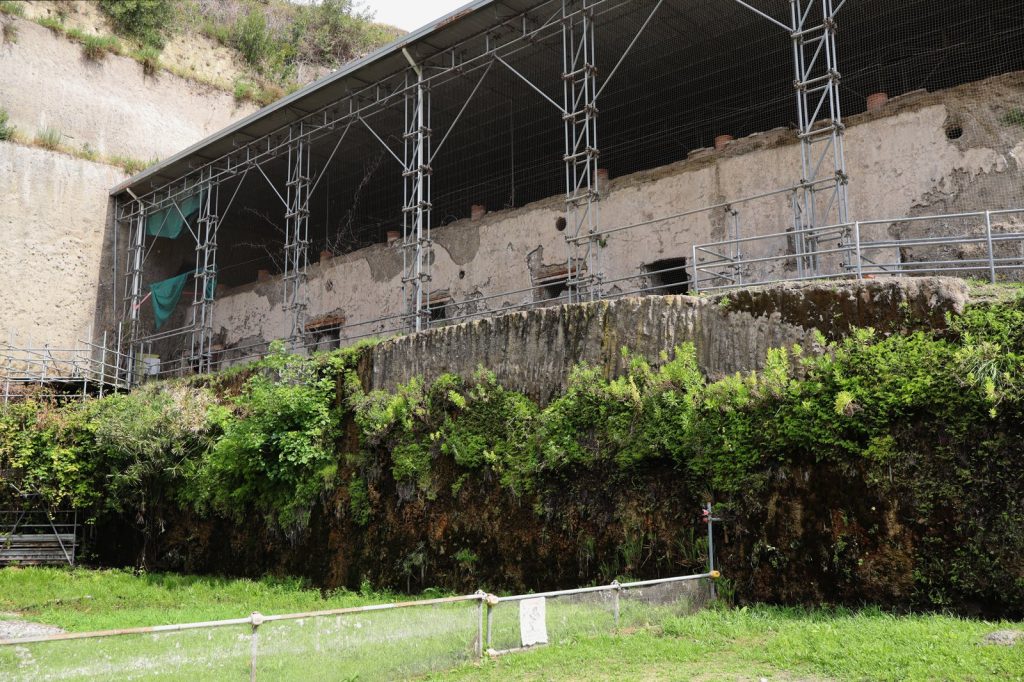
Against the backdrop of the Bay of Naples, the story has always begun with destruction. When Vesuvius blew in 79 C.E., ash sealed a vast library at Herculaneum, carbonizing its hundreds of papyrus scrolls and, by a strange mercy, preserving them. Found again in the 1750s in a lavish villa perhaps owned by Julius Caesar’s father-in-law, the scrolls defeated every generation that touched them: opened by hand, they crumbled, and by the 20th century scholars had stopped trying. What is at stake now, after a public competition married imaging to artificial intelligence, is the recovery of a lost classical library without unrolling a single page.
The mechanics of the change are worth recalling. Brent Seales, the University of Kentucky computer scientist, had worked since the early 2000s on virtually unwrapping damaged texts, imaging papyrus bundles with technology akin to CT scanners and stitching the layers back together. In 2023, joining two Silicon Valley investors, he launched the Vesuvius Challenge, a prize competition built on X-ray scans of two scrolls and machine-learning models trained to spot where ink settled on the page. The prizes did their work. One student took $40,000 for deciphering a single word, “purple”; contestants went on to recover 2,000 Greek characters from a single scroll, a $700,000 award, and the title of another, worth $60,000.
Now all surviving text of a single scroll has been recovered for the first time. The segment of PHerc. 1667, nearly five feet long, holds roughly 20 columns of Greek philosophy, readable for the first time in almost 2,000 years. The scroll argues about the nature of knowledge, distinguishing good from evil and championing reason over impulse, ideas central to Stoicism; it references Aristocreon, nephew of the Stoic Chrysippus, and by handwriting may date between the second and third centuries B.C.E., among the oldest in the library. “What survives today is only a small portion of the original scroll,” said Federica Nicolardi, the challenge’s lead papyrologist, noting that 19th-century researchers destroyed outer layers and later efforts in the 1960s and ’80s added damage, shrinking the scroll from 1.9 inches in diameter to less than 0.8.
The wider picture extends past one manuscript. The team also identified a title in PHerc. 139, On Gods, Book 8, a Philodemus work proving a treatise historians knew had more than one book, and deciphered more than 70 columns of PHerc. 172, part of Philodemus’ On Vices. The villa held some 1,800 fragments, the only such collection to survive from the Greco-Roman world. Seales calls the moment seminal, saying it is “only a matter of time until we read all of the scrolls.” A fresh $1 million prize awaits whoever reads the next scroll in full.
Sources
- Vesuvius Challenge — Reading the Herculaneum Scrolls with AI
- You Could Win $1 Million by Deciphering These Ancient Roman Scrolls
- Scientists Have Deciphered the Surviving Fragments of a 2,000-Year-Old Philosophical Treatise Frozen in Time by Mount Vesuvius' Eruption – Smithsonian Magazine




