
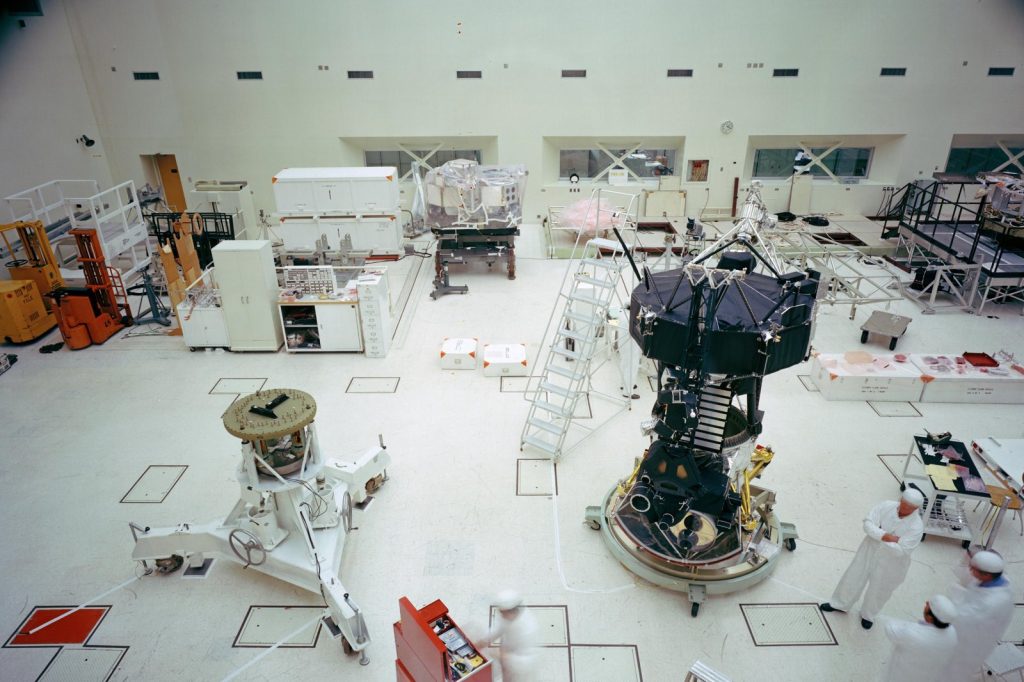
On December 13, 2023, the long‑running Voyager 1 spacecraft stopped sending data back to Earth, marking a pause in its steady stream of information that has flowed for more than four decades. The interruption stems from a technical glitch, although the probe remains able to receive commands from mission controllers. Voyager 1 was launched by NASA on September 5, 1977, as part of the Voyager program designed to investigate the outer Solar System and the region beyond the Sun’s heliosphere.
It lifted off just sixteen days after its twin, Voyager 2, and has since relied on the NASA Deep Space Network for both transmitting scientific measurements and receiving routine instructions. Despite the current communications issue, the spacecraft continues to hold the record as the most distant human‑made object from our planet.
Its present location is 172.59 astronomical units away, which equals roughly 25.8 billion kilometers or 16.0 billion miles. This extraordinary distance has allowed Voyager 1 to deliver unprecedented insights into the far reaches of our solar system and the interstellar environment. Throughout its journey, the probe has conducted notable flybys of Jupiter, Saturn, and Saturn’s moon Titan.
Those encounters produced a wealth of data about the atmospheres, magnetic fields, and moons of the giant planets, deepening understanding of how such systems form and evolve. The instrument suite aboard Voyager 1 was specifically tailored to study the outer heliosphere, the outer magnetosphere, the solar wind, and cosmic rays, offering a unique viewpoint on the interaction between solar emissions and the interstellar medium.
Mission scientists anticipate that Voyager 1 will soon cross into interstellar space, a realm never before explored by a human‑made object. The spacecraft is expected to reach a distance of one light‑day from Earth in the near future, a milestone that would further extend its role as a pioneer of deep‑space exploration. The recent loss of telemetry underscores the inherent challenges of operating hardware that has been active for nearly half a century in the harsh conditions of space.
Engineers and scientists are now drawing on the extensive knowledge base accumulated over the Voyager program’s history to diagnose and remedy the issue, while maintaining the spacecraft’s ability to accept uplinked commands. The Voyager program’s legacy extends beyond the twin probes.
Its successes have paved the way for subsequent missions such as New Horizons, which continues to explore the Kuiper Belt and the outer fringes of the Solar System. The enduring story of Voyager 1 serves as a reminder of the importance of pushing the boundaries of human knowledge, illustrating how curiosity and ingenuity can drive exploration far beyond familiar horizons. As the world awaits updates on the restoration of data flow, the spacecraft’s achievements remain a source of inspiration for future generations of researchers, engineers, and explorers.
The ongoing effort to resolve the technical difficulty highlights the perseverance required in space endeavors and reinforces the idea that the next great discovery may be just beyond the current frontier.




