
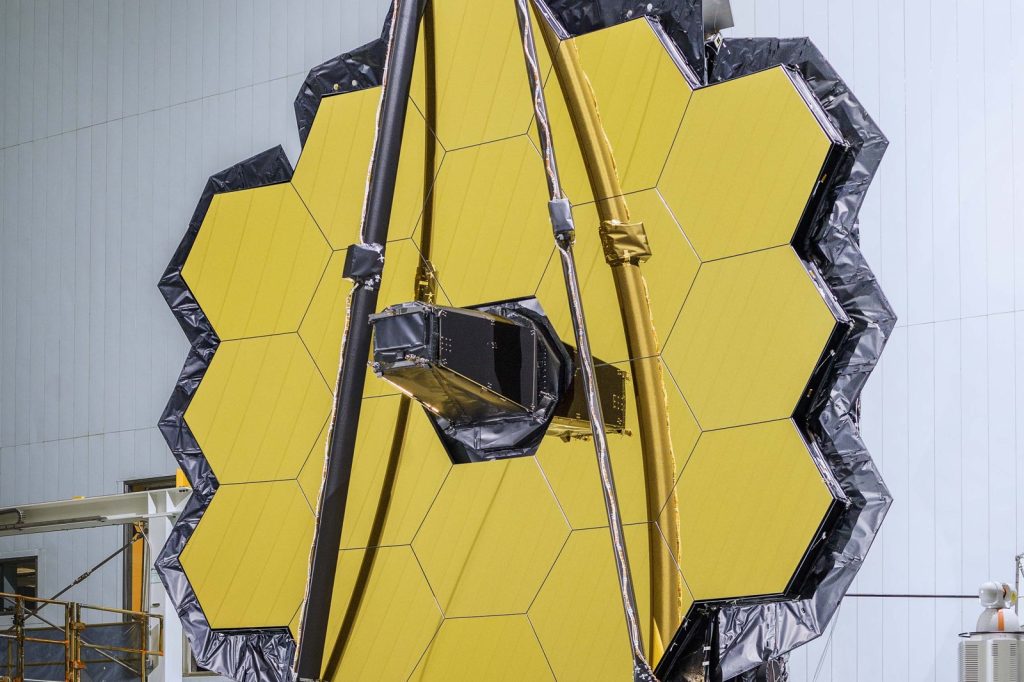
NASA announced on 31 May 2023 that the James Webb Space Telescope has identified signatures of water in the atmosphere of the exoplanet WASP‑18b. The planet, which orbits a star beyond our solar system, is a gas giant with a mass roughly ten times that of Jupiter, making it one of the most massive planets known outside the Solar System.
The detection was made possible by Webb’s highly sensitive spectroscopic instruments, which can isolate faint molecular signals from distant worlds. By analyzing the planet’s infrared spectrum, scientists observed the characteristic absorption features of water vapor, confirming its presence despite the extreme temperatures expected on such a hot, massive world. While the environment on WASP‑18b is unlikely to be hospitable to life as we understand it, the discovery marks a notable step in the broader quest to locate water beyond Earth.
Water is a key ingredient in planetary formation models, and finding it on a planet of this scale provides valuable data for theories about how giant planets acquire and retain volatile compounds. Launched in 2021, the James Webb Space Telescope has already contributed to a series of high‑impact findings across astronomy.
Its ability to capture detailed spectra from exoplanetary atmospheres showcases its role as a transformative tool for space science. The water‑vapor signal from WASP‑18b underscores Webb’s capacity to probe the chemical makeup of worlds that were previously beyond the reach of observation. NASA, the United States federal agency responsible for the nation’s civilian space program, has a history dating back to its 1958 establishment of advancing human knowledge of space.
Over more than six decades, the agency has overseen milestones from early crewed missions to the deployment of sophisticated observatories like Webb. The agency highlighted the WASP‑18b result as an illustration of its ongoing commitment to exploring the unknown and inspiring future scientists and engineers.
The implications of detecting water on a planet of this size extend into several scientific domains. In astrobiology, the finding adds to the inventory of water‑bearing worlds, informing assessments of where life‑supporting conditions might arise. In planetary science, it offers a case study for how massive gas giants evolve and interact with their host stars, especially regarding atmospheric composition under intense stellar radiation.
Researchers will continue to monitor WASP‑18b and similar exoplanets, using Webb and forthcoming instruments to refine measurements of atmospheric constituents. Further analysis may reveal additional molecules, such as carbon‑based gases, that together paint a more complete picture of the planet’s chemistry and its formation history.
The discovery reinforces the notion that water is a common component of planetary systems throughout the galaxy, even in environments vastly different from Earth’s. As the James Webb Space Telescope proceeds with its observation schedule, scientists anticipate more breakthroughs that will deepen our understanding of the cosmos and potentially identify worlds with conditions more amenable to life.




