
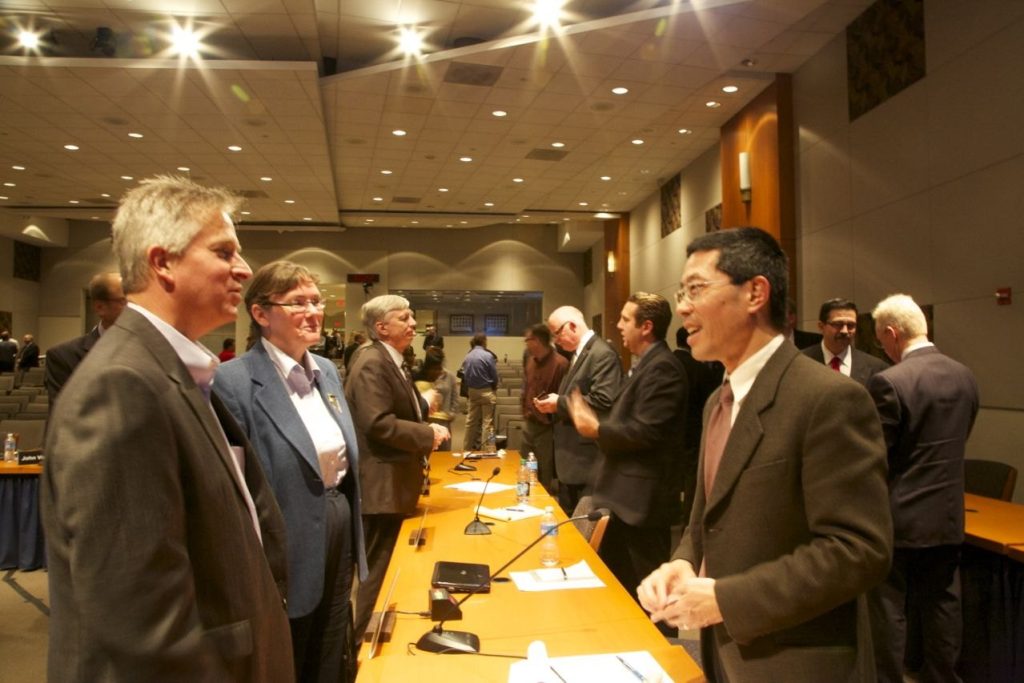
“If this approach works, it could be a game-changer,” Yet-Ming Chiang told Ted Wiley over coffee in early 2017. Wiley, the president and chief operating officer of Form Energy, had gone to hear about a battery that could run on sulfur instead of lithium. He walked out ready to build a company around it.
Chiang, an MIT professor and co-founder of battery company A123, was experimenting with rechargeable batteries made from sulfur, a byproduct of oil and gas refining. His early lab results suggested the cells could store energy for many days at about a tenth of the cost of lithium-ion batteries. He and Marco Ferrara, an MIT PhD and energy storage modeling expert, had concluded that renewable plants with this storage could replace fossil fuels on the grid.
From two rivals to one company
Wiley began working nights and weekends to spin the technology out of the lab. He helped recruit Ferrara and Billy Woodford, one of Chiang’s top former students who had spent years developing advanced lithium-ion batteries. The group called itself Baseload Renewables and argued that renewable energy could provide baseload power, not just supplement the grid. “We don’t even describe what we are making as a battery,” Woodford said. “We call it a bi-directional power plant, that can send energy out and also take it in and store it when needed.”
Baseload raised a seed round from The Engine in August 2017. It invited Mateo Jaramillo, a former Tesla executive, to a launch event. Jaramillo had been building his own multi-day storage company, Verse Energy, and had a term sheet in hand. He flew to Boston anyway. “Together, we had a stronger overall team and two viable technology paths,” Jaramillo said. “If both of them look great and have strong market fit, then guess what? We’ll go do both of these things.” The five founders merged the efforts into Form Energy.
How iron-air batteries work
Form’s current technology is iron-air chemistry. When an iron-air battery discharges, iron metal combines with oxygen to form rust, releasing electrons as electricity. Charging reverses the process, turning rust back into iron and releasing oxygen. The chemistry itself is not new, but Form is trying to commercialize it at grid scale. Think of an iron-air battery as a marathon runner and a lithium-ion battery as a sprinter: the iron version stores energy for up to 100 hours.
Form says it has demonstrated iron-air batteries can be built at one-tenth the cost of lithium-ion batteries. The primary materials are cheap and abundant. That cost difference could let utilities store renewable power for days, not just hours, and avoid burning fossil fuels when wind or solar output dips. “If we want to power the world mainly with renewables we need to find a way to overcome that variability, so we have energy when we need it,” Wiley said.
MIT Technology Review reported in October 2024 that Form had finished its new factory in West Virginia but had not yet shipped batteries to customers. The company was running production trials and had significant orders from utilities around the US, though it had not deployed any commercial systems. Some experts doubted it could scale up and hit its cost targets, and no well-defined market for long-duration storage existed yet.
There is also an efficiency tradeoff. Put 100 units of charge into an iron-air battery and you get 50 to 70 back. A lithium-ion battery returns 90 to 95. That means iron-air will not replace lithium-ion; Form acknowledges the two could operate side by side.
As of October 2024, Form had raised $820 million. Its leaders called it an electrochemical solutions company with projects aimed at decarbonizing steel and iron production, but the near-term focus remained iron-air batteries. With the factory complete and production trials underway, the company planned storage facilities in seven states. In early August 2024, it announced an 85-megawatt battery project in Maine, which would provide more storage than any other battery installation on Earth.
Sources
- 2024 Climate Tech Companies to Watch: Form Energy and its iron batteries | MIT Technology Review
- Form Energy | Engine Ventures




