
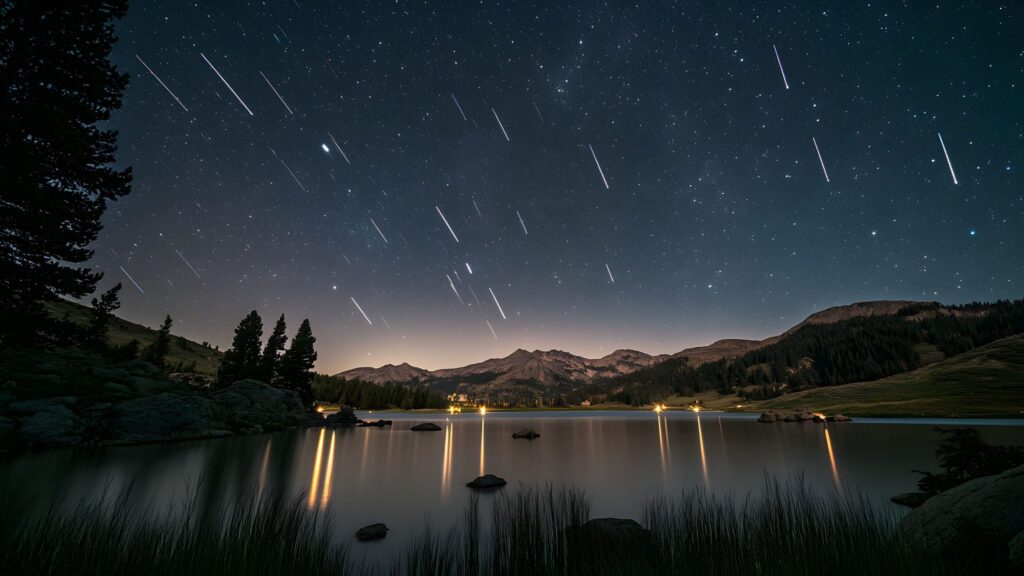
The dial reads thirty meteors an hour. That is the forecast for the next twenty-four hours.
Solar longitude two hundred twenty-four point four seven zero one degrees. The red vertical line on the flux plots marks it. This is where Earth sits right now.
Five showers are active. Southern Taurids. Orionids. Leonids. Northern Taurids. Andromedids. Global Meteor Network cameras feed data to a NASA-Western University collaboration.
ZHR means Zenithal Hourly Rate. It is the count a single observer would log in one hour under perfect skies with the radiant overhead. It is not what you will see.
During the Perseid peak the ZHR hits about one hundred. You might catch one Perseid a minute. A full moon cuts that in half. A radiant below thirty degrees drops it further.
An average observer notices a real increase only when the ZHR climbs above fifty. The needle enters the green.
Three showers put on a reliable annual show with ZHR above one hundred. The Perseids in mid-August. The Geminids in mid-December. The Quadrantids in early January.
The data update once per day globally. Released under CC BY 4.0. The collection was backed by NASA’s Meteoroid Environment Office under agreement 80NSSC21M0073 with Western University’s Meteor Physics Group.
Actual activity may fall below or exceed predictions. Meteor showers can have unexpected outbursts.




