
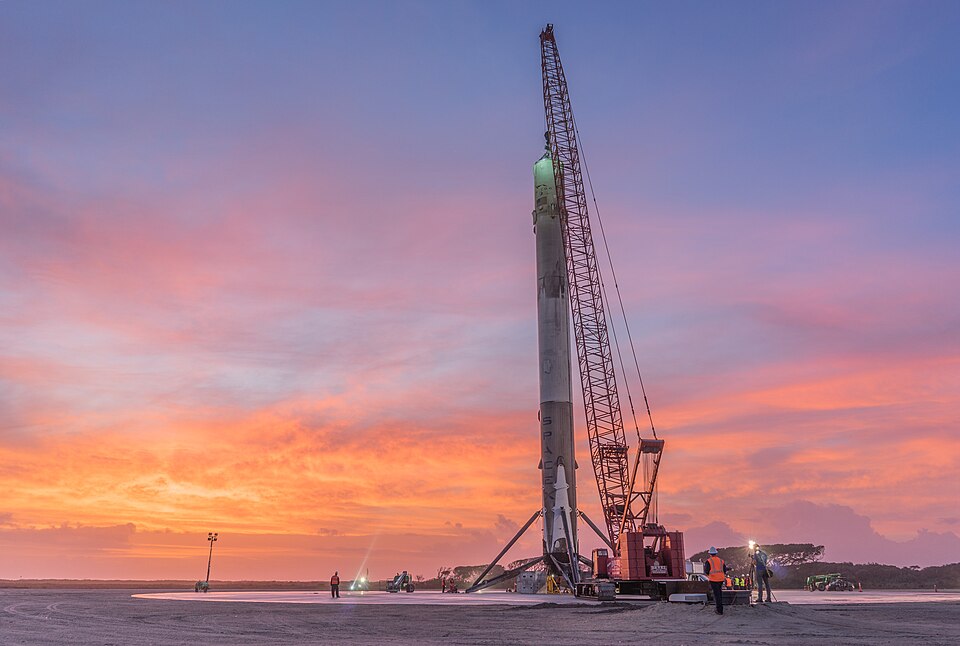
WASHINGTON, July 21 — The Space Force’s $30bn launch procurement is the industrial-policy engine powering a commercial rocket market that hit $12bn globally in 2023. Under the hood, the procurement’s scale — a ceiling rather than a set spend — is forcing companies to bet on reusable hardware and new manufacturing methods while the Pentagon secures what it calls assured access to space. SpaceX’s Falcon 9, certified for national security launches since 2015, established the reusable-first-stage template with its first landing in 2015.
The company has since flown dozens of NSSL missions, proving the model works at high cadence. Now Blue Origin’s New Glenn — a heavy-lift vehicle with a reusable first stage — is gunning for the same Lane 2 missions.
The detail that matters: New Glenn uses Blue Origin’s BE-4 methane engine, which also powers ULA’s Vulcan rocket. ULA has sunk over $1bn into Vulcan development, partly paid for by government money. And then there is Relativity Space’s Terran R, built via additive manufacturing, promising a different cost curve entirely.
As ever, the two-provider rule — dating to the 2000s — is the structural spine. The NSSL program must have at least two certified providers at all times to maintain assured access.
That policy alone keeps money flowing to at least two houses, no matter the quarterly headlines.
Economic ripple effects
The $30bn ceiling does not just fund rockets; it provides the long-term demand certainty that lets companies amortise development costs across years. The multiplier effect is estimated at 2.5:1. At Cape Canaveral Space Force Station, that means 14 active launch pads and over 10,000 direct jobs.
Vandenberg Space Force Base handles the polar side of the business. The jobs created are not just on the launch pads — they stretch into manufacturing, engineering and logistics across the United States.
SpaceX’s valuation hit $180bn in 2023, partly a reflection of those government contracts. But the real story is the competitive pressure: if New Glenn and Terran R deliver, the Space Force will have three or four credible providers. That would be a first in the post-Shuttle era.
What to watch next
The procurement is not static. Each company is racing to hit certification milestones for the next generation of heavy launchers. The Pentagon’s money is the fuel; the technical reality of reusability and additive manufacturing is the gearbox.
Watch for the next round of Lane 2 mission awards — those will show whether the new entrants are genuinely ready for national security work, or whether Falcon 9 remains the default workhorse.
Sources
{“@context”: “https://schema.org”, “@type”: “NewsArticle”, “headline”: “$30B Space Launch Procurement Boosts Commercial Rocket Innovation”, “description”: “WASHINGTON, July 21 — The Space Force’s $30bn launch procurement is the industrial-policy engine powering a commercial rocket market that hit $12bn globally in 2023….”, “datePublished”: “2026-07-21T09:30:00+00:00”, “author”: {“@type”: “Person”, “name”: “Sebastian Smith”}, “publisher”: {“@type”: “Organization”, “name”: “InfoPulse Today”, “url”: “https://newsfeed.2bme.xyz/”}, “citation”: [{“@type”: “CreativeWork”, “url”: “https://en.wikipedia.org/wiki/Private_spaceflight”}]}




