
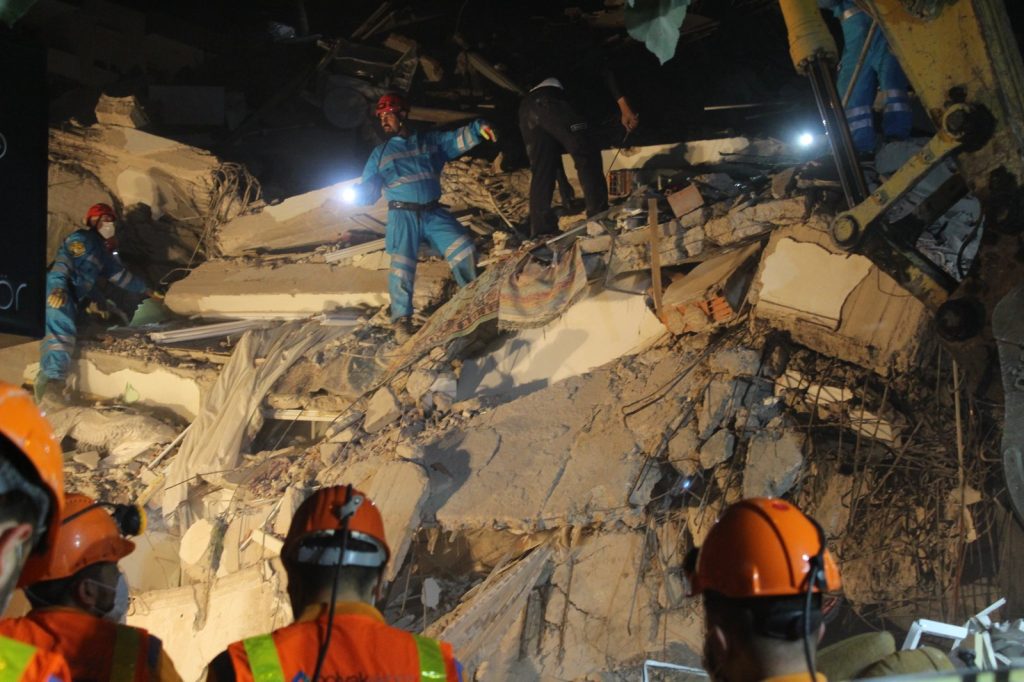
The February 6 earthquake sequence that tore through southern Turkey and northern Syria was not a single, random rupture. It was a geological chain reaction. The initial 7.8-magnitude shock, centered 37 kilometers west-northwest of Gaziantep, was a shallow strike-slip event.
That means the earth didn’t just shake; it sheared sideways along a fault line. The force was extreme.
The Mercalli intensity hit XII — the top of the scale — around the epicenter and in Antakya. That classification means total destruction. The first quake struck at 04:17 local time.
People were asleep. Buildings that had stood for decades folded in seconds.
Then, nine hours later, a second major earthquake hit. Magnitude 7.7. Its epicenter was 95 kilometers north-northwest of the first.
This was not an aftershock. It was a separate rupture on a different fault segment. The seismic sequence involved the Dead Sea Transform, the East Anatolian Fault, and the Sürgü–Çardak fault.
Three major fault systems, all unloading stress in one day. The scale is hard to grasp.
This 7.8 quake is the largest to hit Turkey since the 1939 Erzincan earthquake, which also measured 7.8. That makes it jointly the second-strongest in the nation’s recorded history. It is also one of the most powerful earthquakes ever recorded in the Levant — the region that includes Syria, Lebanon, and Jordan.
The ground shook in Egypt. It was felt along the Black Sea coast of Turkey.
The energy traveled hundreds of kilometers. What followed was a long, grinding disaster. In the three months after the initial quakes, more than 30,000 aftershocks rattled the region.
The ground never really settled. Rescue teams faced a nightmare. Roads were damaged.
Winter storms rolled in. Communications went down.
Getting to the worst-hit areas was a slow, dangerous crawl. The number of dead and injured is catastrophic, though precise counts remain difficult as the situation continues to unfold. This is what happens when a strike-slip fault lets go near a densely populated area.
The geology was known. The East Anatolian Fault is a known boundary between the Arabian and Anatolian tectonic plates.
The Dead Sea Transform is a major strike-slip feature. The forces building up were inevitable. The release was not.
The international response is now the central question. The United States, under President Biden, is expected to play a significant role in providing aid and assistance. But delivering that aid is not simple.
The region is politically fractured. Northern Syria is a patchwork of control.
Turkey is a sovereign state with its own logistics. The winter storms do not care about borders. The damaged roads do not care about diplomatic agreements.
The aftershocks will continue. The rebuilding will take years.
The 1939 Erzincan earthquake reshaped parts of Turkey. This one will too. The geological record is clear: these faults will rupture again.
The question is whether the buildings and the response systems will be ready when they do. Right now, the answer is no.




