
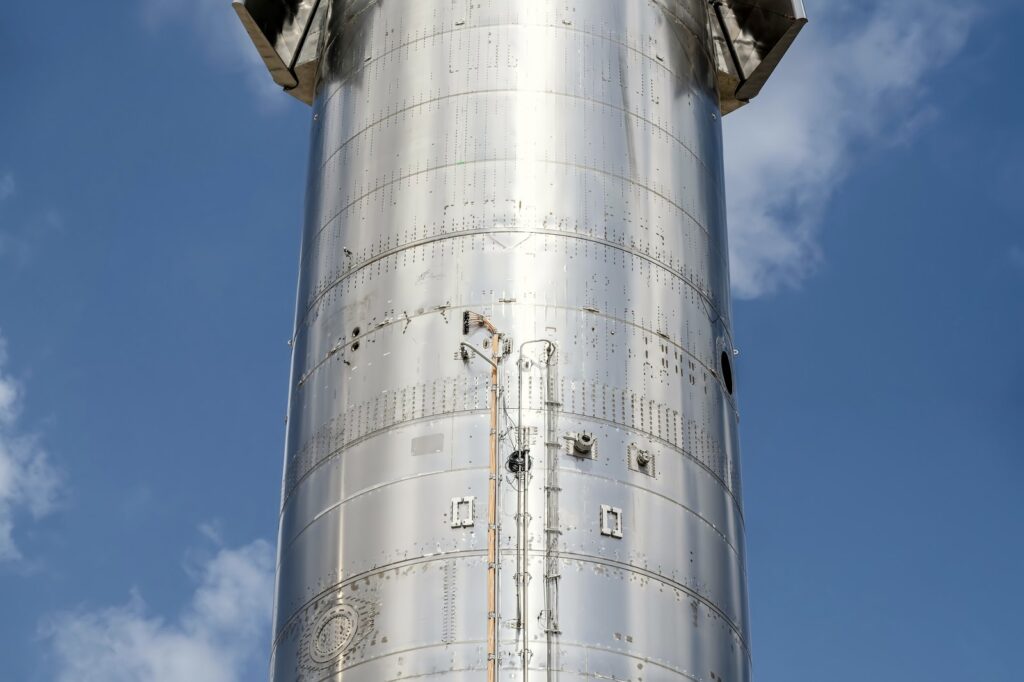
Background: From Carbon Fiber Concepts to Stainless Steel Hardware
SpaceX began developing concepts for a super heavy-lift reusable launch vehicle as early as 2005, though active development of Starship did not start until 2018. The initial 2016 design, called the Interplanetary Transport System, used carbon fiber but proved impractical. This led to a shift to stainless steel for both the Super Heavy booster and Starship upper stage, which began testing in 2019 with short hops from the Texas launch site. The change in material improved durability and heat resistance during reentry, supporting the goal of full reusability. Development followed an iterative approach involving numerous prototype vehicles and test flights, with several setbacks including the failure of the first four Block 2 upper stages in 2025.
History: Iterative Development and a Market-First Outlook
Starship’s development has been marked by rapid prototyping and learning from failures. The full stack — Super Heavy booster with Ship upper stage — first flew in April 2023 and failed within minutes. Three subsequent flights reached space but ended with the upper stage lost during reentry. In June 2024, SpaceX conducted a propellant transfer test inside a single Ship, a critical capability for future Moon and Mars missions. By October 2024, the launch tower’s mechanical arms caught a returning Super Heavy booster for the first time. After a booster catch in January 2025, a series of Ship failures occurred, including an upper stage explosion during ground testing that June. A clean flight in August 2025 broke the streak, and by October 2025, SpaceX flew the last of the older design. The first Starship V3 launched in May 2026, followed by another in July, and Flight 14 on September 28, 2026.
Analysts note a shift in SpaceX’s outlook from vision-first to market-first. According to Matija Renčelj of the European Space Policy Institute, the rocket is now seen primarily as a business tool. “The rocket is the means, not the end,” Renčelj said, adding that its main role is reducing Starlink deployment costs. This perspective contrasts with earlier ambitions to use Starship for crewed Mars missions, which have been deprioritized in favor of near-term commercial applications.
How It Works: Mechanical Arm Catch System Replaces Landing Legs
Instead of using landing legs like the Falcon 9, SpaceX has adopted a design featuring giant mechanical arms on the launch tower to catch the Super Heavy booster before it touches the ground. This approach reduces the vehicle’s weight by eliminating landing legs, allowing for greater payload capacity, more fuel, or larger crews. The system enables faster turnaround by avoiding the need to transport the booster to a separate facility for inspection and refurbishment. SpaceX states the ultimate goal is to achieve airline-like operations, with multiple launches of the same first-stage booster per day. The catch system also supports rapid reusability, a key factor in lowering launch costs through high flight rates.
The Numbers: Flight 14 Success, Starlink V3 Deployment, and Airline-Like Ambitions
As of September 28, 2026, Starship has launched 14 times, with 9 successful flights and 5 failures. Flight 14 marked the first time the vehicle reached orbit, lofting the initial members of the next-generation Starlink V3 constellation. SpaceX currently operates more than 11,000 Starlink broadband satellites, nearly all launched by Falcon 9. The Starlink V3 satellites are bigger and heavier than earlier models, requiring Starship’s heavy-lift capacity. The constellation is planned to eventually include 100,000 spacecraft if development proceeds as intended. NASA selected Starship as the first astronaut lander for the Artemis lunar missions in 2021. A docking test is scheduled as part of Artemis III in 2027, with a crewed lunar landing planned for 2028.
What It Means Now: Economic Opportunities and Debris Management Challenges
However, such a high flight rate raises concerns about orbital debris management. Each launch adds potential debris from upper stages, fairings, or failed components, increasing collision risks in low Earth orbit. While Starship’s design aims for full reusability — including heat shield tiles similar to the Space Shuttle for atmospheric reentry — the sheer volume of flights could strain current debris mitigation practices. Effective debris management will depend on reliable reentry, active deorbiting of non-reusable components, and improved space traffic coordination. Without these measures, the benefits of low-cost access to space could be offset by heightened risks to operational satellites and future missions.
Design Evolution: From Carbon Fiber Dreams to Stainless Steel Reality
SpaceX’s journey began with concepts as early as 2005, but active development did not commence until 2018. The initial 2016 design, known as the Interplanetary Transport System (ITS), utilized carbon fiber materials. However, this approach proved impractical for the harsh conditions of spaceflight and reentry. Consequently, SpaceX pivoted to stainless steel for both the Super Heavy booster and the Starship upper stage, initiating testing in 2019 with short hops from their Texas launch site.
This material shift was critical for improving durability and heat resistance during atmospheric reentry, directly supporting the goal of full vehicle reusability. The bodies of these rocket stages are constructed by stacking and welding stainless steel cylinders, each standing 1.83 meters tall with a thickness of 3.97 millimeters. This manufacturing method allows both stages to return to the launch site and land vertically at the tower for potential reuse.
The vehicle’s mass when stacked and fully fueled is approximately 5,300 tons, with a diameter of 9 meters and a height of 124.4 meters. Both stages are powered by Raptor engines burning liquid methane and liquid oxygen. While SpaceX initially expressed ambitions to use Starship for crewed missions to Mars, the plan was revised to prioritize returning humans to the Moon under NASA’s Artemis program. Despite these strategic shifts, the stainless steel architecture remains central to reducing launch costs through mass production and reuse of both stages.
Sources
- SpaceX Starship
- SpaceX's Starship just turned 10 years old. When will it go to Mars?
- Why SpaceX Wants To Catch Starship Instead Of Giving It Landing Legs – BGR
Photo: Lars Plougmann from United States (CC BY-SA 2.0)




