How JWST Sees 12.5 Billion-Year-Old Supernovae via Infrared Optics
Astronomers using the James Webb Space Telescope have identified a supernova that erupted just days after its ignition, dating back to when the universe was less than one-tenth of its current age.
The Technology Behind Deep Space Vision
The ability to peer into the early cosmos relies on specific technological choices made during the telescope’s design. The U.S. National Aeronautics and Space Administration led the project with partners from the European Space Agency and the Canadian Space Agency, launching the instrument on an Ariane 5 rocket in December 2021.
The primary mirror consists of 18 hexagonal segments made of gold-plated beryllium, creating a light-collecting area about six times that of the Hubble Space Telescope. This massive aperture allows the instrument to view objects too old, distant, or faint for previous telescopes.
To prevent its own heat from interfering with collected light, the telescope must be kept extremely cold below 50 K using a five-layer sunshield that protects it from warming by the Sun, Earth, and Moon. Unlike Hubble, which observes near ultraviolet, visible, and near infrared spectra, Webb observes a lower frequency range from long-wavelength visible light through mid-infrared.
The telescope orbits at Lagrange point 2, about 1.5 million kilometers from Earth in the opposite direction of the Sun. This location allows it to observe distant objects without interference from solar glare or thermal radiation.
Detecting Ancient Explosions Through Redshift
The science behind detecting ancient supernovae involves a phenomenon called cosmological redshift. As light travels across billions of years, the expansion of the universe stretches the light waves, shifting them from visible blue or green light into the infrared spectrum.
Webb’s instruments are specifically designed to observe this longer-wavelength infrared spectrum. When Webb detects these shifted wavelengths, researchers can calculate how far back in time they are looking. In the case of the 12.5 billion-year-old supernova, the light has stretched so significantly that it appears as infrared radiation to our instruments.
The telescope identified heat signatures of specific gas clouds and analyzed their metal content to understand these ancient events. The metals detected—elements heavier than hydrogen or helium forged in stellar explosions—provide clues about how Earth obtained its share of heavy elements.
What Researchers Found
Researchers shared observations showing that the Milky Way’s supermassive black hole is surrounded by a surprising trove of heavy metals, likely from supernovas. While this recent study focused on our galaxy, the same optical principles allow Webb to detect ancient events in distant galaxies.
The findings suggest that understanding how metals are distributed around supermassive black holes can help explain processes that supplied Earth with many of these elements. The presence of these metals influences how quickly gases cool and whether they can be drawn into a black hole.
These discoveries advance our understanding of both the early universe’s star formation history and the chemical evolution of our own galaxy, revealing how the ingredients for life were forged in ancient stellar explosions.
The Mirror That Sees The Invisible
The primary mirror of the James Webb Space Telescope is a marvel of precision engineering, comprising 18 hexagonal segments made of gold-plated beryllium that together form a 6.5-meter-diameter surface. This gold coating is essential, as it reflects infrared light with minimal absorption, allowing the telescope to capture the faint heat signatures from the universe’s earliest moments. With a light-collecting area approximately six times greater than Hubble’s, Webb can gather sufficient photons from objects whose light has traveled for billions of years. The mirror’s design compensates for the longer wavelengths of infrared light, ensuring that the resolution remains high enough to distinguish distant structures despite the physical limitations of wave physics.
To function, the telescope must maintain a temperature below 50 Kelvin, a feat achieved by a five-layer sunshield the size of a tennis court. This shield blocks heat from the Sun, Earth, and Moon, creating a passive cooling environment that allows the instruments to detect the faint infrared radiation from ancient celestial events. Unlike Hubble, which operates near the Sun-Earth L2 point but observes shorter wavelengths, Webb’s mid-infrared capability requires this extreme thermal stability to prevent the telescope’s own heat from overwhelming the cosmic signals it seeks. This combination of a massive, cold-optics design and a stable orbital position enables the detection of the redshifted light from events like the 12.5 billion-year-old supernova AT 2026abck.
Observing Without Gravitational Lenses
The discovery of the supernova named AT 2026abck represents a rare occurrence because it was observed without the aid of gravitational lensing. This phenomenon, predicted by Einstein, involves the gravity of a massive object bending and magnifying light emitted from distant sources. The researchers noted that spotting such an ancient event at this incredible distance is extremely rare, requiring specific alignment and timing.
To make this discovery, the team observed the exact same tiny patch of sky repeatedly with the James Webb Space Telescope. This method relies on the telescope’s ability to view objects too old, distant, or faint for previous instruments like the Hubble Space Telescope. The expansion of the universe has stretched the light waves from this explosion, shifting them from visible blue or green light into the infrared spectrum.
Webb’s instruments are specifically designed to observe this longer-wavelength infrared spectrum, allowing it to detect heat signatures from objects whose light has traveled for billions of years. In the case of AT 2026abck, the distance between us has effectively ballooned sixfold due to cosmic expansion. The telescope’s massive aperture allows it to gather sufficient photons from these ancient events, distinguishing distant structures despite the physical limitations of wave physics.
The primary mirror consists of 18 hexagonal segments made of gold-plated beryllium, creating a light-collecting area about six times that of Hubble. This design compensates for the longer wavelengths of infrared light, ensuring high resolution remains possible. The telescope orbits at Lagrange point 2, about 1.5 million kilometers from Earth in the opposite direction of the Sun, enabling observation without interference from solar glare or thermal radiation.
Sources
- James Webb telescope discovers a 12.5 billion-year-old supernova erupting near the dawn of time
- James Webb Space Telescope
- James Webb telescope discovers a surprise around our galaxy's black hole
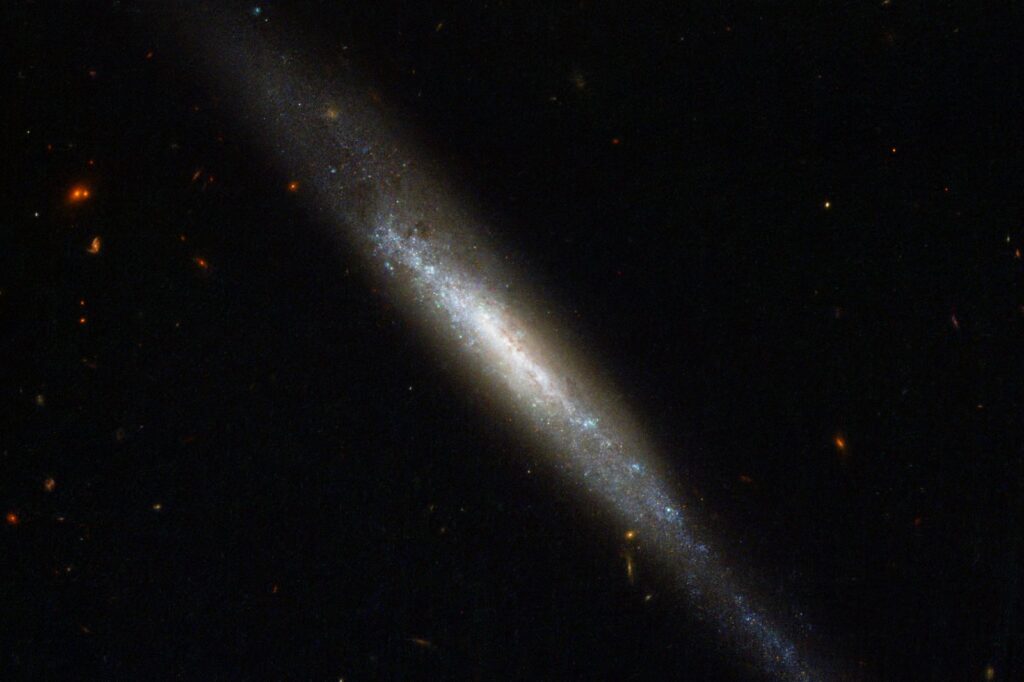
Photo: ESA/Hubble & NASA (CC BY 4.0)