How Martian Moons Exploration Will Use MEGANE and Advanced Samplers to Uncover Phobos’s Secrets
The Origin Question
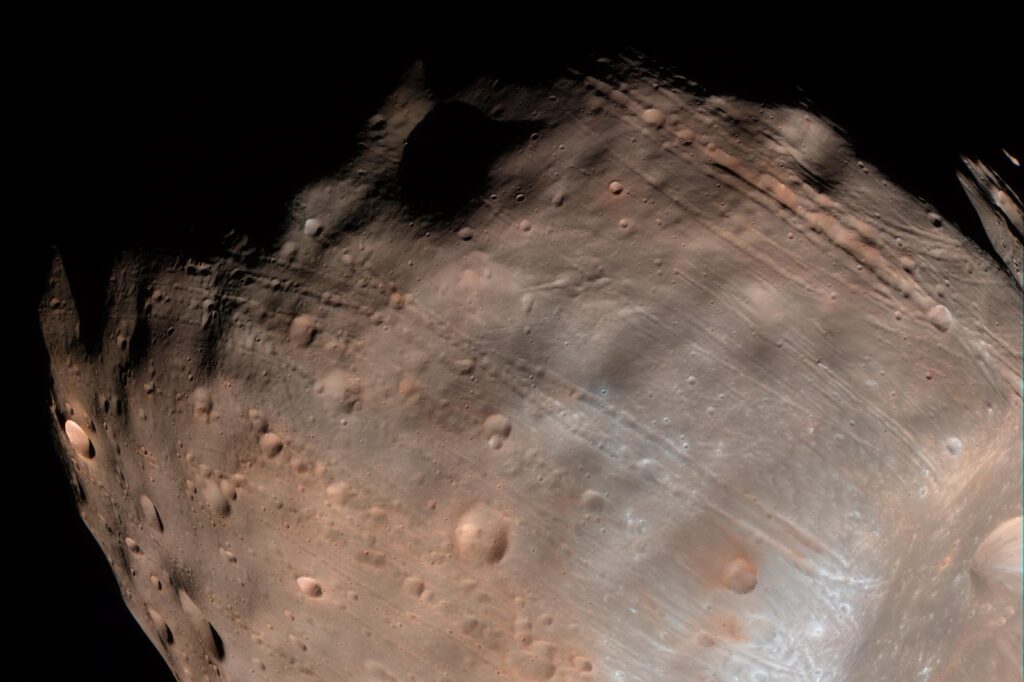
Phobos hangs over Mars like a pale, irregular sentinel. Its origin has divided scientists for decades. Some argue the moon is a captured asteroid, snatched by the Red Planet’s gravity long ago. Others believe it is a fragment of Mars itself, blasted into orbit by a colossal impact billions of years past. The Martian Moons eXploration mission, known as MMX, arrives at Phobos to settle that debate. Scheduled to arrive at Mars next summer, the spacecraft will orbit Phobos, collect material from its surface, and return a sample to Earth by 2030. It will be the first mission ever to bring back material from a Martian moon.
Seeing With Radiation
Before the sampler touches soil, MEGANE will map the moon’s chemistry from orbit. The instrument, developed by the Johns Hopkins Applied Physics Laboratory in collaboration with Lawrence Livermore National Laboratory, works by measuring the energies of neutrons and gamma rays emitted from Phobos’s surface. Every element emits radiation at a characteristic energy. By analyzing those energies, MEGANE will reveal the elemental composition of the moon’s surface without landing. This data will help pinpoint whether Phobos shares the chemical fingerprint of Mars or resembles a foreign asteroid. The instrument’s ability to “see” composition from a distance is a critical step before any sample is gathered.
Touching the Surface
Once MEGANE has identified promising areas, the spacecraft will descend toward Phobos’s rugged terrain. The sample-collection mechanism is designed to acquire material from the moon’s surface. The mission profile calls for the collection of roughly 10 grams of surface material. This sample will be sealed inside a return capsule and sent back to Earth. The return is targeted for 2030, making MMX the world’s first Martian moon sample return mission and the first spacecraft to orbit Phobos. The relatively small amount of material requested reflects the moon’s low gravity and the precision required to retrieve uncontaminated samples.
An International Eye
MMX is a collaborative endeavour. The mission is led by the Japan Aerospace Exploration Agency, with NASA providing the MEGANE instrument. The European Space Agency, the French space agency CNES, and the German Aerospace Center DLR are also involved. European scientists appointed by ESA are directly involved in the mission science team. They will conduct their own specific research projects, including planning the science observations to be made, analysing the data collected by MMX’s onboard instruments, and studying the samples brought back from Phobos. This international partnership ensures that the origins of Phobos will be examined from multiple perspectives, with data and samples distributed among the contributing agencies.
The Origin Debate
Scientists remain divided on whether Phobos and Deimos are captured asteroids or impact remnants. According to NASA Science, scientists suspect the asteroid-sized bodies either are remnants of an ancient collision between Mars and a large impactor or are themselves asteroids captured by Mars’ gravity. The MMX mission aims to characterize and determine the origin of Mars’ moons. JAXA’s Yasuhiro Kawakatsu stated that MMX will unravel the origin of the Martian moons, aiming to shed light on the formation and evolution of the Martian sphere. MEGANE will map the moon’s chemistry from orbit to help peg the likely origin, distinguishing between a Martian fragment and a foreign asteroid.
The debate over Phobos’s origin is central to the mission’s objectives. As noted in the ESA coverage of the launch, MMX is designed to collect samples from Phobos to return them to Earth, positioning this as a milestone to shed light on the origin of the moons. European scientists appointed by ESA are directly involved in the mission science team, conducting research projects to analyze the data and samples. The outcome of MMX’s analysis will provide definitive evidence to resolve whether the moons are captured asteroids or fragments of Mars itself.
MEGANE’s Dual Detection Technique
MEGANE employs a sophisticated dual-detector system to map Phobos’s chemistry from orbit. According to NASA Science, the instrument uses a gamma-ray spectrometer to detect gamma rays emitted from the surface, which reveal the presence of specific elements through their unique energy signatures. Simultaneously, a neutron spectrometer measures neutrons generated when cosmic rays strike the surface; the energies and fluxes of these neutrons provide additional clues about the soil’s composition, particularly for elements like hydrogen. By combining data from both detectors, MEGANE creates a detailed elemental map that distinguishes between a Martian origin and a captured asteroid. This capability allows scientists to identify mineralogical signatures before the spacecraft even descends to the surface.
The instrument’s development relied on heritage from previous space explorers. MEGANE was developed by the Johns Hopkins Applied Physics Laboratory in Laurel, Maryland, in collaboration with colleagues from Lawrence Livermore National Laboratory in California. This partnership combined expertise in gamma-ray detection and neutron measurement to create a tool suited for the harsh environment of deep space. The technique builds on decades of orbital geology research, adapting established radiation-detection methods for the specific conditions at Mars’s moons. The resulting data will be crucial for guiding the sample-collection phase of the mission.
Sample Collection And The Return Trajectory
The spacecraft will descend toward Phobos’s surface to gather material using a sampler designed for the moon’s low-gravity environment. According to JAXA’s pre-launch briefing, the mission profile specifies the collection of roughly 10 grams of surface material. This sample will be sealed inside a return capsule aboard the MMX spacecraft. The return of this capsule to Earth is targeted for 2030, which will make MMX the world’s first Martian moon sample return mission. The relatively small collection amount reflects the challenges of operating in Phobos’s weak gravitational field and the precision required to retrieve uncontaminated samples.
Upon return to Earth, the sample capsule will undergo preliminary analysis before being distributed to research teams globally. As noted in ESA’s coverage of the mission, European scientists appointed by ESA are directly involved in the mission science team and will conduct their own specific research projects, including analysing the samples brought back from Phobos. This international collaboration ensures that the returned material will be studied by a wide range of experts, leveraging the diverse scientific expertise of the contributing agencies to maximize the scientific return from the 2030 delivery.
Sources
- [Note Exclusive] H3 Rocket Flight 15 to Launch the Day After Tomorrow at Dawn; MMX to Unravel the Origin of Martian Moons, Aiming for Phobos Sample Return by 2030|相模経済新聞
- MMX – NASA Science
- MMX lifts off to Mars’s moon Phobos
Photo: NASA/JPL-Caltech/University of Arizona (Public domain)