
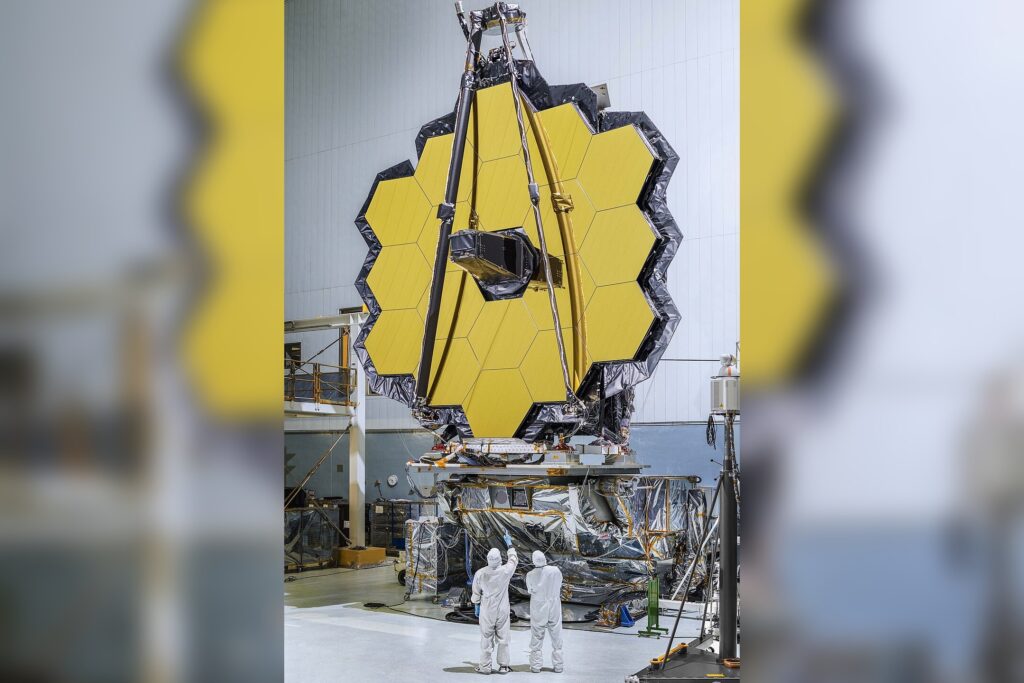
BALTIMORE, Aug. 3 — The record from the James Webb Space Telescope now shows galaxies whose light has been stretched to a redshift greater than 10, a measurement that places their origin roughly 480 million years after the Big Bang. That period corresponds to about 3.5% of the universe’s current age of 13.8 billion years.
The milestone did not arrive in a single image. On the timeline, it is the product of JWST’s four primary instruments — the Near Infrared Camera, the Near Infrared Spectrograph, the Mid-Infrared Instrument, and the Near Infrared Imager and Slitless Spectrograph — supported by a Fine Guidance Sensor for precision pointing. Built to observe in the infrared, the observatory is capturing light that has traveled for more than 13 billion years, stretched by the expansion of space itself.
The record before Webb
To understand what the new data represents, the previous mark matters. According to the astronomical record, the highest redshift galaxy confirmed before JWST was GN-z11, observed by the Hubble Space Telescope at a redshift of 11.09. Hubble’s reach, however, was limited. Its instruments were not designed for the deep infrared wavelengths that carry light from the earliest galaxies, and it had effectively hit a wall.
JWST’s sensitivity and resolution in that part of the spectrum changed the calculus. According to the record, the observatory has now identified galaxies with redshifts greater than 10, a threshold that moves the field into territory Hubble could not meaningfully probe. The light from these galaxies left their sources just a few hundred million years after the universe began — a sliver of cosmic time in which the first structures were assembling.
What the early galaxies show
The findings go beyond record-keeping. According to the data, these early galaxies were more luminous, more massive, and more evolved than current cosmological models predicted. The discrepancy is significant enough that it challenges established theories of galaxy formation and evolution. In plain terms, the universe appears to have assembled large, bright structures faster than the models said it should.
Sources familiar with the observations describe the results as a pressure point in the field. The standard picture of galaxy growth — steady accumulation of mass through mergers and gas accretion — does not easily account for the apparent maturity of these objects at such an early epoch. Whether the models need revision, or whether some process accelerated early star formation, remains an open question.
The reionization question
The high-redshift catalog also bears on one of the least understood phases in cosmic history: reionization. In the early universe, neutral hydrogen gas pervaded space. According to the record, the first stars and galaxies ionized that gas, a process that fundamentally changed the character of the intergalactic medium. The same distant galaxies now being cataloged are likely the agents of that transformation.
By capturing their light in the infrared, JWST offers a direct view of the era in which that ionization occurred. The observations illuminate not just when reionization happened, but the nature of the objects that drove it — their brightness, their mass, and their rate of formation.
The next phase of analysis, according to the record, will focus on spectroscopy of these high-redshift candidates. NIRSpec and the other instruments are positioned to refine the redshift measurements and characterize the physical properties of the galaxies themselves. The record so far is preliminary in the sense that the catalog is still being built. But the trajectory is clear: the threshold of redshift 10 has been crossed, and the universe’s earliest chapters are now open to direct observation.
Sources
{“@context”: “https://schema.org”, “@type”: “NewsArticle”, “headline”: “JWST’s Infrared Instruments Detect Early Galaxies with Redshifts”, “description”: “BALTIMORE, Aug. 3 — The record from the James Webb Space Telescope now shows galaxies whose light has been stretched to a redshift greater than…”, “datePublished”: “2026-08-03T09:30:00+00:00”, “author”: {“@type”: “Person”, “name”: “Ariel Antonio”}, “publisher”: {“@type”: “Organization”, “name”: “InfoPulse Today”, “url”: “https://newsfeed.2bme.xyz/”}, “citation”: [{“@type”: “CreativeWork”, “url”: “https://en.wikipedia.org/wiki/Redshift”}]}




