
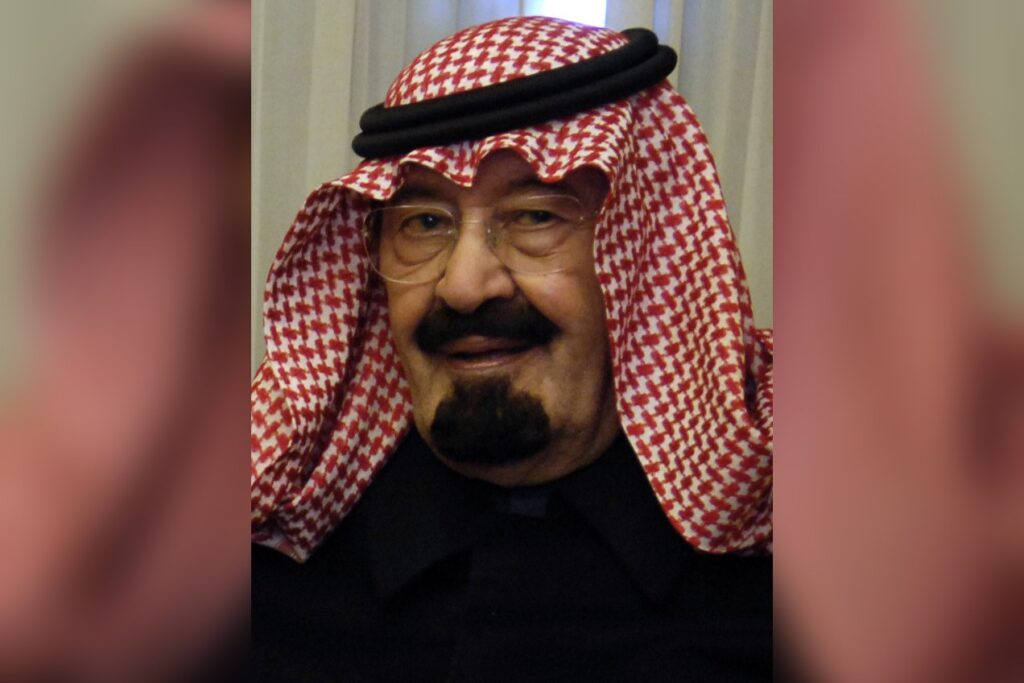
For a man who spent nearly two decades as the effective leader of Saudi Arabia before formally taking the throne, King Abdullah bin Abdulaziz Al Saud left behind a legacy defined as much by bold strategic gambles in global energy markets as by cautious steps toward social change at home. Born in Riyadh as the tenth son of King Abdulaziz, the founder of modern Saudi Arabia, Abdullah’s path to power was neither direct nor predictable.
His mother came from the Al Rashid dynasty, a family that had historically been rivals of the ruling Al Saud clan, a lineage that placed him outside the usual lines of succession but never diminished his ultimate influence.
Steering the World’s Energy Market
King Abdullah’s tenure at the helm of Saudi oil policy unfolded against a backdrop of tremendous volatility. Under his leadership, the kingdom navigated a period of sustained high crude prices and the severe disruptions of the 2008 global financial crisis. He oversaw a major infrastructure expansion that raised Saudi Arabia’s oil production capacity to 12 million barrels per day, a technical and logistical achievement that fundamentally enhanced the kingdom’s strategic flexibility in managing global supply. Then came the critical decision in 2014.
Within the OPEC cartel, King Abdullah led the kingdom’s move not to cut oil production even as prices began to slide. The result was a dramatic price collapse that sent shockwaves through energy markets worldwide.
Early analysis indicates this strategy was intended to pressure two key rivals: US shale oil producers, whose high-cost operations were vulnerable to lower prices, and Iran, a geopolitical adversary for which oil revenue was crucial. The decision’s consequences extended far beyond trading floors and drilling sites. The resulting budget constraints across the region affected everything from government program funding to healthcare infrastructure investments.
Conversely, the years of high oil revenue that preceded the downturn enabled substantial Saudi investment in education and public infrastructure, laying groundwork that outlasted the price collapse itself.
Cautious Social Change and Scientific Ambition
Alongside his aggressive oil policy, King Abdullah pursued a measured program of domestic reform that began to reshape the kingdom’s social fabric. In 2011, as protests swept the broader Arab world, he maintained the status quo at home but also authorized a landmark political change: granting women the right to vote and run in municipal elections. This was a cautious but notable step in a deeply conservative society, and one that carried broader implications beyond politics.
Research across multiple countries has shown that women’s participation in civic life often correlates with improved community health metrics, suggesting the move’s potential benefits extended into public health outcomes. That same year, King Abdullah’s ambition for scientific transformation was already visible.
In 2009, he launched the King Abdullah University of Science and Technology (KAUST), an institution conceived as a hub for advanced research and innovation. KAUST was designed to focus on critical fields including cancer biology and renewable energy, attracting international scientists to the kingdom. While the university has become a noted center for research collaboration, its long-term impact on Saudi Arabia’s health research infrastructure and its ability to inform future medical treatment protocols continues to unfold.
The king’s commitment to scientific development sat alongside his long-standing foreign policy orientation. Throughout his reign, he maintained close ties with the United States and Britain, ordering large defense purchases from both countries that underscored Saudi Arabia’s strategic alignment with Western powers.
A Long Path to the Throne and a Final Transition
King Abdullah’s journey to formal leadership was itself a story of patience and preparation. He began his public career in 1961 as mayor of Mecca, then served for decades as commander of the Saudi Arabian National Guard.
In 1982, when his half-brother King Fahd ascended the throne, Abdullah was named crown prince. He became the de facto ruler of the kingdom after King Fahd suffered a serious stroke in 1995, effectively governing for a decade before formally ascending the throne in 2005. During his reign, the succession line passed through three crown princes, all of them full brothers of King Fahd.
Ultimately, the succession settled on King Abdullah’s half-brother, Salman. When King Abdullah died in January 2015 at age 90, having ruled during a transformative period that included the 2008 financial crisis and the 2014 oil price war, Salman succeeded him, inheriting both the policies and the unresolved challenges the late king left behind.
The foundation King Abdullah laid for gradual social change continued to develop under his successors, even as the full effects of his reforms took shape in the years after his death. His legacy, complex and multifaceted, remains embedded in the kingdom’s oil strategy, its tentative social opening, and its ambitions for a future powered by scientific research.
{“@context”: “https://schema.org”, “@type”: “NewsArticle”, “headline”: “King Abdullah’s Energy Gambles and Social Reforms Shape Saudi Legacy”, “description”: “RIYADH, July 9 — For a man who spent nearly two decades as the effective leader of Saudi Arabia before formally taking the throne, King…”, “datePublished”: “2026-07-09T09:30:00+00:00”, “author”: {“@type”: “Person”, “name”: “Ava Anderson”}, “publisher”: {“@type”: “Organization”, “name”: “InfoPulse Today”, “url”: “https://newsfeed.2bme.xyz/”}}




