
The practice of pulling fresh water from the sea dates back to ancient Greek sailors who boiled seawater to quench their thirst. That rudimentary method has given way to a sophisticated global industry. In 2020, the worldwide desalination market was valued at $14.8 billion.
Projections put that figure at $26.8 billion by 2028, reflecting a trajectory that has drawn the attention of utilities, investors, and governments in water-stressed regions. The technology driving this growth has undergone a fundamental transformation over the past half-century.
The Evolution of Desalination Technology
The modern era of desalination began in the 1950s at the University of California, Los Angeles, where researchers Sidney Loeb and Srinivasa Sourirajan developed reverse osmosis technology. Their breakthrough laid the groundwork for an industry that today spans more than 20,000 plants worldwide, with a combined capacity of 95 million cubic meters per day as of 2020. The first large-scale desalination plant opened in 1965 in the U.S. Virgin Islands, marking the beginning of industrial-scale freshwater production from the sea.
Energy consumption has been the critical factor in making desalination economically viable. In the 1970s, reverse osmosis required 20 kilowatt-hours per 1,000 gallons of water produced.
Today, that figure has fallen to approximately 3 kilowatt-hours per 1,000 gallons. The 17 kilowatt-hour drop over five decades represents more than incremental improvement; it is a fundamental shift in the technology’s economics, bringing desalination closer to the energy requirements of conventional freshwater treatment. Lower energy costs improve the bottom line for plant operators and make new facilities more attractive to investors.
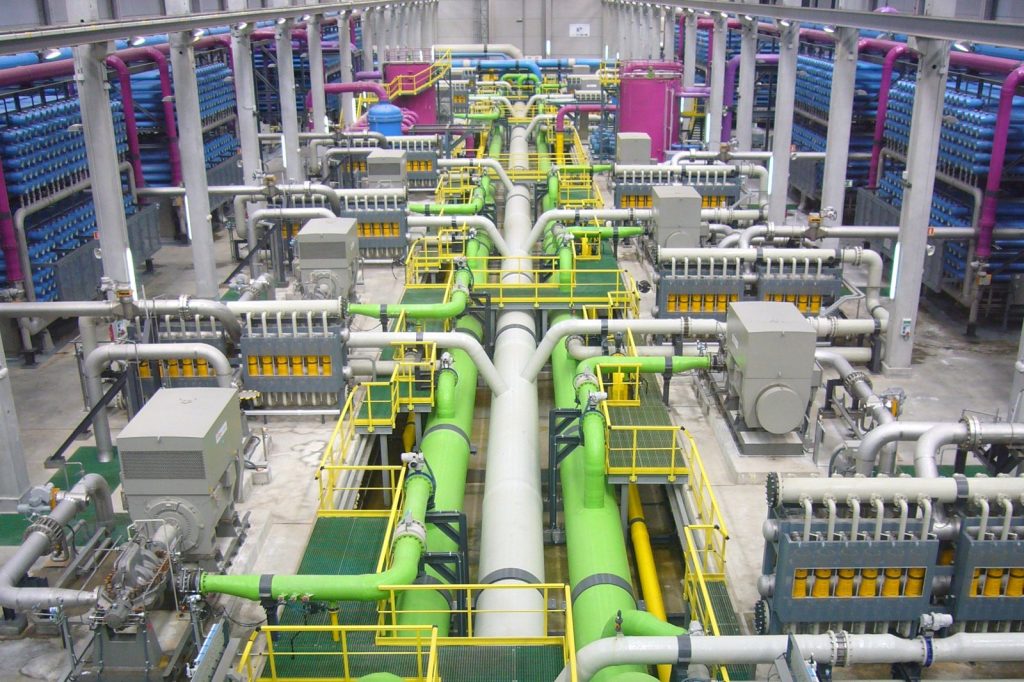
The technology mix varies by region. Reverse osmosis, which pushes seawater through membranes under pressure, has become the dominant method globally due to its declining energy demands.
Thermal distillation, which involves boiling water and condensing the vapor, is still used in some large facilities, often in combination with reverse osmosis. Saudi Arabia’s Ras Al-Khair plant, completed in 2014, is the world’s largest desalination facility, producing 1.025 million cubic meters per day using both thermal and reverse osmosis methods. Israel’s Sorek plant, which opened in 2013, produces 624,000 cubic meters per day and supplies about 20 percent of the country’s municipal water. In the Western Hemisphere, the largest facility is the Carlsbad Desalination Plant in San Diego County, California.
It opened in 2015 and produces 189,000 cubic meters per day.
Market Growth and Regional Impact
The projected increase from $14.8 billion to $26.8 billion from 2020 to 2028 represents growth that would catch the eye of any sector investor. That market expansion is underpinned by the energy efficiency gains already achieved and the expectation that costs will continue to decline.
The Sorek plant in Israel offers a case study in what large-scale desalination can achieve: a single facility meeting roughly one-fifth of a country’s municipal water demand. Such examples demonstrate the technology’s potential to address water scarcity, especially in arid regions where rainfall is unreliable. New facilities continue to come online in the Middle East, Asia, and the Americas.
The capacity figure of 95 million cubic meters per day, last measured in 2020, is likely higher today as construction proceeds in water-stressed regions. California’s Carlsbad plant shows domestic interest in desalination as a complement to other water sources, while the massive plants in Saudi Arabia and Israel highlight the technology’s central role in water security strategies abroad.
Challenges and Strategic Importance
Desalination is the artificial removal of salts and minerals from saltwater to create fresh water, producing brine as a byproduct. The process allows for water creation for irrigation or human consumption independent of rainfall.
Early understanding of the phenomenon dates back to Aristotle, who observed that seawater vapor condenses as fresh water. Ancient Chinese texts also describe early methods using bamboo mats. Today’s industrial methods rely on thermal distillation and membrane-based approaches like reverse osmosis.
The significance of desalination lies in its independence from weather patterns and groundwater reserves. As those reserves deplete, the technology helps close the global water supply gap.
However, the method remains more expensive than water conservation or recycling due to its high energy requirements. Despite that cost disadvantage, desalination remains a primary strategy for global water security when other alternatives are unavailable. The pace of new plant construction in water-stressed regions, particularly in California and the Middle East, and the potential for further reductions in energy costs will determine whether the market’s bet on continued growth pays off.
At $26.8 billion by 2028, the industry is betting that gap between cost and need will keep widening.




