
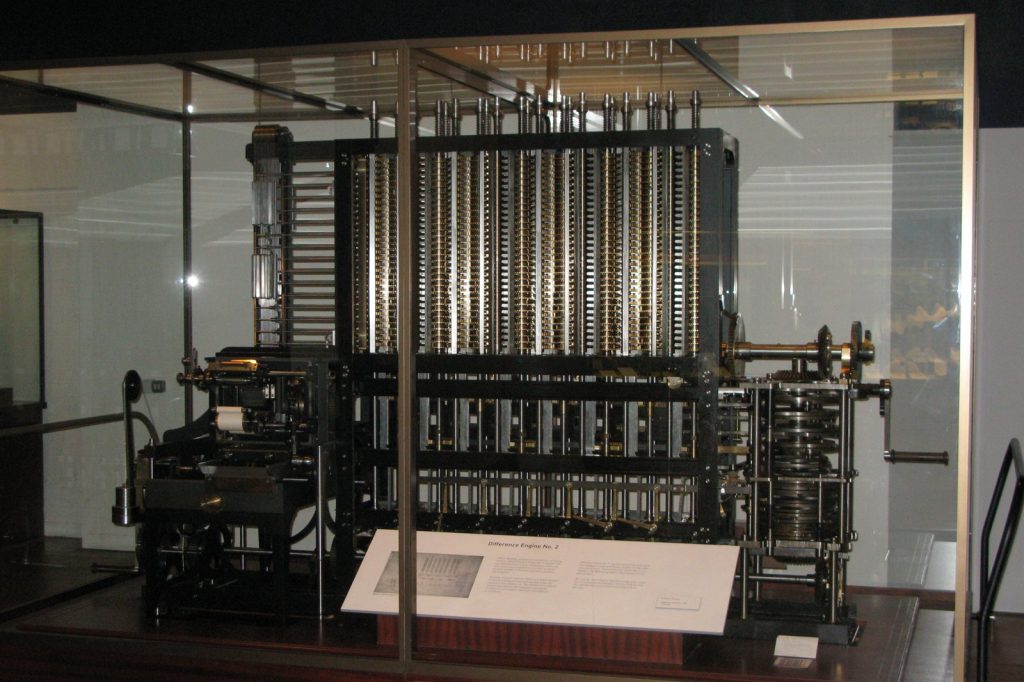
LONDON, September 17 — The history of computing spans nearly two centuries, from mechanical calculators to the microprocessors that power modern devices, and the through-line is a single stubborn idea: push the arithmetic out of the human head and into the machine. Charles Babbage, an English mathematician, proposed the Difference Engine in 1822, a machine designed to compute polynomial functions automatically. In 1837 he followed with designs for the Analytical Engine, which anticipated the stored-program concept with separate memory and processing units.
Ada Lovelace, working with Babbage in 1843, translated an article on the Analytical Engine and added extensive notes that included an algorithm for computing Bernoulli numbers — often cited as the first published computer program.
From punched cards to vacuum tubes
Herman Hollerith’s punched-card tabulating system was used for the US Census in 1890, cutting processing time from years to months. His company later became part of IBM, founded in 1911 as the Computing-Tabulating-Recording Company and renamed International Business Machines in 1924. The 1930s and 1940s saw the first electronic computers.
Konrad Zuse’s Z3, completed in 1941 in Germany, was the first programmable digital computer, though it was electromechanical. The Atanasoff-Berry Computer, built at Iowa State College between 1939 and 1942, was the first electronic digital computer, but it was not programmable.
ENIAC, completed in 1945 at the University of Pennsylvania by John Presper Eckert and John Mauchly, was the first general-purpose electronic digital computer, using 18,000 vacuum tubes and weighing 30 tons. Under the hood, the architectural question that mattered was where the program lived. In 1945, John von Neumann described the stored-program architecture in the First Draft of a Report on the EDVAC, which became the basis for most subsequent computers.
The Manchester Baby, in 1948, was the first stored-program computer to run a program.
The transistor, the chip, the microprocessor
The transistor, invented at Bell Labs in 1947 by John Bardeen, Walter Brattain, and William Shockley, replaced vacuum tubes, leading to smaller, more reliable machines. In 1958, Jack Kilby at Texas Instruments and Robert Noyce at Fairchild Semiconductor independently invented the integrated circuit, placing multiple transistors on a single chip. The microprocessor emerged in 1971 when Intel released the 4004, a 4-bit central processing unit designed by Federico Faggin, Ted Hoff, and Stanley Mazor.
It contained 2,300 transistors and ran at 740 kHz. The 4004 led to the 8008 in 1972 and the 8080 in 1974, which powered the Altair 8800, a 1975 kit computer that sparked the personal computer revolution.
In 1976, Steve Wozniak and Steve Jobs founded Apple Computer and released the Apple I; the Apple II followed in 1977. The IBM Personal Computer, introduced in 1981, used the Intel 8088 microprocessor and Microsoft’s MS-DOS, setting industry standards. The history of computing is a story of continuous innovation, from mechanical gears to silicon chips, that has transformed every aspect of modern life.
As ever, the detail that matters is the one that gets abstracted away — the gears became tubes, the tubes became transistors, and the transistors became something you no longer notice at all.




