
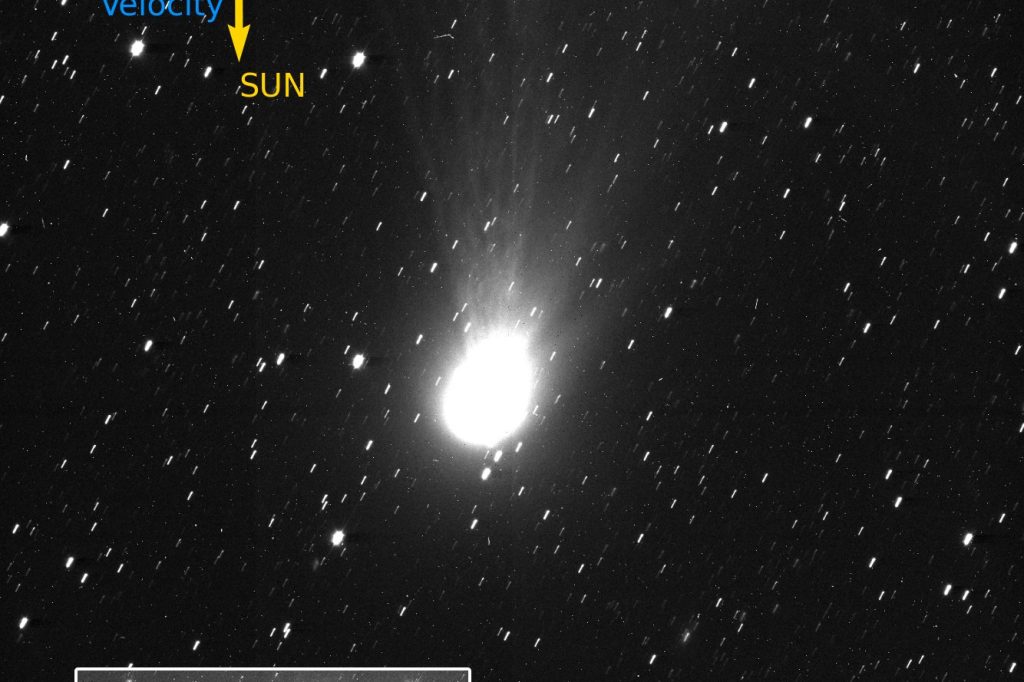
A spacecraft built to study the frozen moons of Jupiter spent a day in November 2025 staring at something else entirely. On 6 November, mission controllers turned the European Space Agency’s JUICE toward 3I/ATLAS, an interstellar comet that had just swung past the Sun and was heading back into the dark between the stars.
Using its JANUS camera, JUICE took more than 120 images in that single campaign, according to ESA. It was seven days after the comet’s closest approach to the Sun on 29 October 2025.
What the frames show
The released pictures show the small nucleus wrapped in a bright, fuzzy halo of gas and dust, the coma. A thin tail stretches out from it. ESA’s processed images carry arrows marking the comet’s motion relative to the Sun.
Mission scientists say the data hint at jets, rays, filaments and streams inside the coma and tail. Those patterns point to how the comet vents gas and how its dust is pushed around. JUICE did not rely on JANUS alone, since ESA confirmed that five of its instruments were aimed at the comet, each recording a different aspect of its behaviour and composition.
The raw measurements are back on Earth, and ESA teams are working through them. The agency said it would present first scientific results in late March. Until then, the reporting cautioned, the numbers should not be over-interpreted.
A rare third
Astronomers first picked out 3I/ATLAS in June 2025 in scans by the Asteroid Terrestrial-impact Last Alert System, a survey set up mainly to spot asteroids that could threaten Earth. The International Astronomical Union’s Minor Planet Center later verified that its path could not be explained by any orbit bound to the Sun, and designated it an interstellar comet. Only one interstellar asteroid and one interstellar comet had been firmly logged before it.
That makes it a chance to test whether other planetary nurseries build comets from the same ingredients as ours. An interstellar object crosses on a hyperbolic path once and leaves, carrying the frozen chemistry of the disc that formed its star.
By November the comet had passed behind the Sun from Earth’s view and was dimming, so ground telescopes were running out of time. JUICE, out in deep space, saw it against a dark background without glare or atmospheric interference.
A detour on a long trip
JUICE left Earth on 14 April 2023 to study the icy moons of Jupiter, several of which are counted among the most promising places in the Solar System to look for conditions that could support life. It reaches the Jovian system in 2031, and the long cruise leaves room for side observations. The comet is now drifting back toward interstellar space.




