
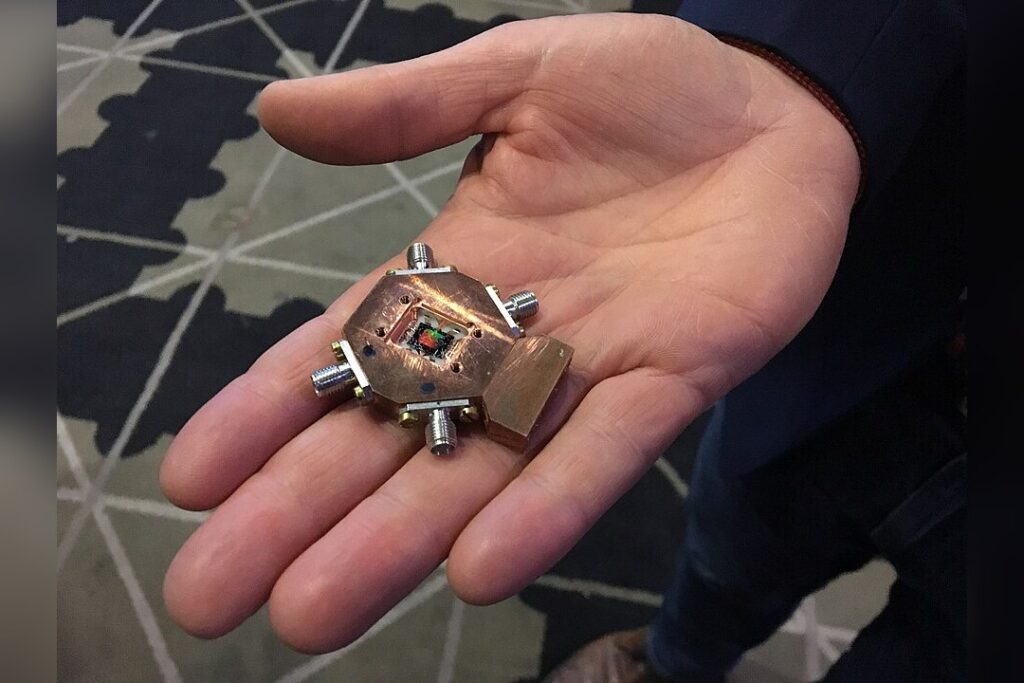
NEW YORK, July 19 — For all the excitement that quantum computing has generated, the machines have remained distant, housed in cryogenic chambers cooled to near absolute zero. That has placed them far from the everyday world of engineers, clinicians and business leaders who might one day put them to use. The reason is physics.
Today’s leading quantum platforms — superconducting qubits and trapped ions — achieve their delicate quantum states only at extreme cold. Superconducting qubits operate at about 15 millikelvin, a temperature colder than deep space.
To reach that, they require elaborate wiring, bulky dilution refrigerators and extensive magnetic shielding. The infrastructure is costly, energy-intensive and space-consuming.
A sudden shift in temperature
Now a group of physicists has announced a new material that can function at room temperature. The claim, if confirmed, would amount to a first-in-class breakthrough in the world of quantum computing. No longer would the dream of a practical quantum machine demand a specialized lab with cooling apparatus.
The architecture could become simpler, smaller and vastly more accessible. That is the hope.
The reality is more cautious. The physicists have not yet released the material’s coherence time, gate fidelity or scalability — the three metrics that determine whether a qubit can actually perform useful computation. Without this data, the practical advantages of the new material remain theoretical.
It is a promising step, but the science is not yet written in stone.
What competition looks like
Room-temperature quantum computing is not a new ambition. Photonic quantum computing also aims for room-temperature operation. But photonic systems face their own integration challenges.
The two approaches are different in architecture, yet both share the need for validation. The announcement positions this material as a first-of-its-kind achievement.
But verification is still to come. Peer-reviewed confirmation and independent replication are awaited before the field can say whether the material truly delivers on its promise. For now, it remains an extraordinary claim — and extraordinary claims demand extraordinary evidence.
What this means for the researchers working on quantum computing is a mix of hope and patience. If the material withstands scrutiny, it could accelerate the timeline for fault-tolerant quantum machines.
If it falters, the field will have learned something valuable about the design constraints of room-temperature quantum matter. For the public — and especially for those in health care and artificial intelligence, where quantum computing could one day simulate molecules or accelerate machine learning — the wait continues. The breakthroughs are real, but they are happening in steps.
The room-temperature material is the latest step, and it is a big one. But it is not yet the final stride.




