
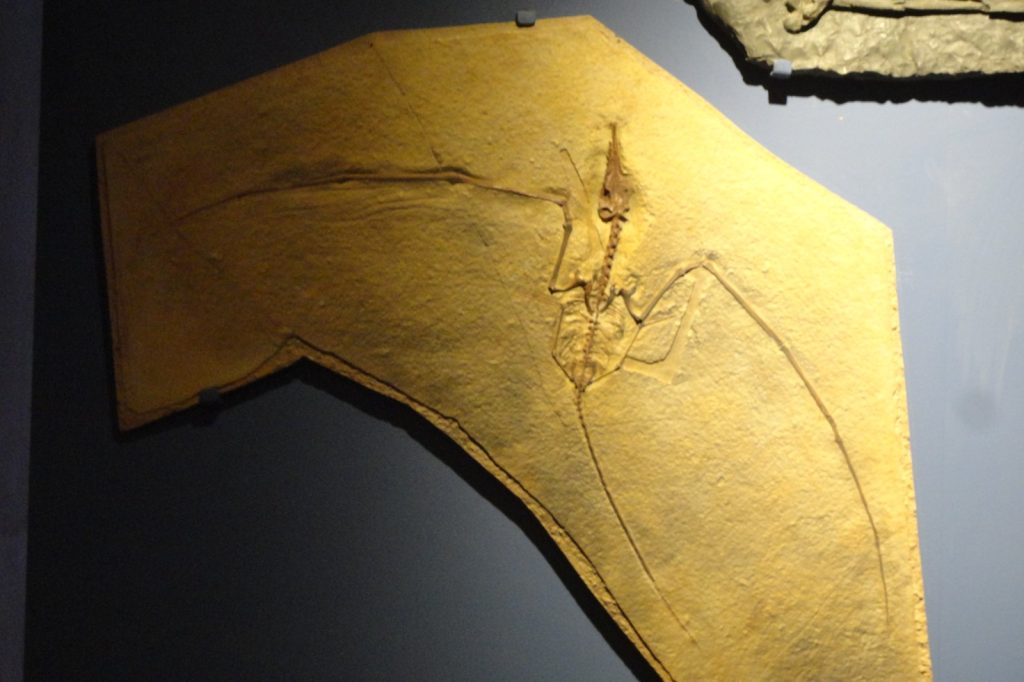
A fresh examination of a fossil from northeastern China has revealed that the pterosaur species Sinopterus dongi possessed microscopic features capable of producing shifting, iridescent colors. Researchers used scanning electron microscopy to study the creature’s hair‑like pycnofibers and identified layered arrays of melanosomes—pigment‑bearing organelles—embedded within those fibers.
The arrangement of these melanosomes closely mirrors the nanostructures that generate iridescence in modern bird feathers, such as those seen in starlings and pigeons. The preservation of these melanosome layers is exceptionally rare; they remained intact and undegraded, allowing a direct comparison with living analogues. Computer simulations based on the observed melanosome stacking predict that Sinopterus dongi would have displayed deep greens and magentas that changed with the viewing angle, producing a shimmer rather than a static sheen.
This visual effect would have varied as the animal moved, suggesting a dynamic color display.
Biological and Behavioral Implications
The organization of the melanosomes in the pycnofibers matches patterns found in warm‑blooded birds and mammals, hinting at an elevated metabolism and sophisticated thermoregulation in this pterosaur. For years paleontologists have debated whether pterosaurs were truly warm‑blooded; this fossil provides physical evidence that leans toward an affirmative answer.
A warm‑bodied metabolism would have required greater energy intake, more food, and more efficient respiration, prompting a reasspiration, which in turn would affect how the animal hunted, flew, and cared for its young. Beyond physiology, the iridescent hue likely served a social function. In extant birds, iridescent plumage is frequently used in courtship displays—think of peacocks, hummingbirds, and starlings.
By analogy, a male Sinopterus dongi flashing magenta and green from its pycnofibers could have attracted mates or signaled to rivals, indicating that these flying reptiles were visually active rather than dull, silent creatures. This insight reshapes interpretations of pterosaur social behavior and communication.
The discovery also underscores a broader point about the fossil record: soft‑tissue and color information are usually lost over time, but when they survive they open new windows into ancient life. The intact melanosomes in this specimen give researchers a concrete basis for reconstructing the appearance of at least one pterosaur species, moving beyond the traditional reliance on bone outlines and vague soft‑tissue impressions. For the first time, scientists can envision Sinopterus dongi not as a gray silhouette against a prehistoric sky, but as an iridescent, visually engaging animal whose colors shifted with light and movement.
In summary, the fossil from northeastern China provides concrete evidence that Sinopterus dongi possessed nanostructures capable of producing shimmering greens and magents, supports the hypothesis of a warm‑blooded metabolism, and suggests a role for color in social interaction. Together, these findings significantly alter our picture of pterosaur biology, appearance, and behavior.




