
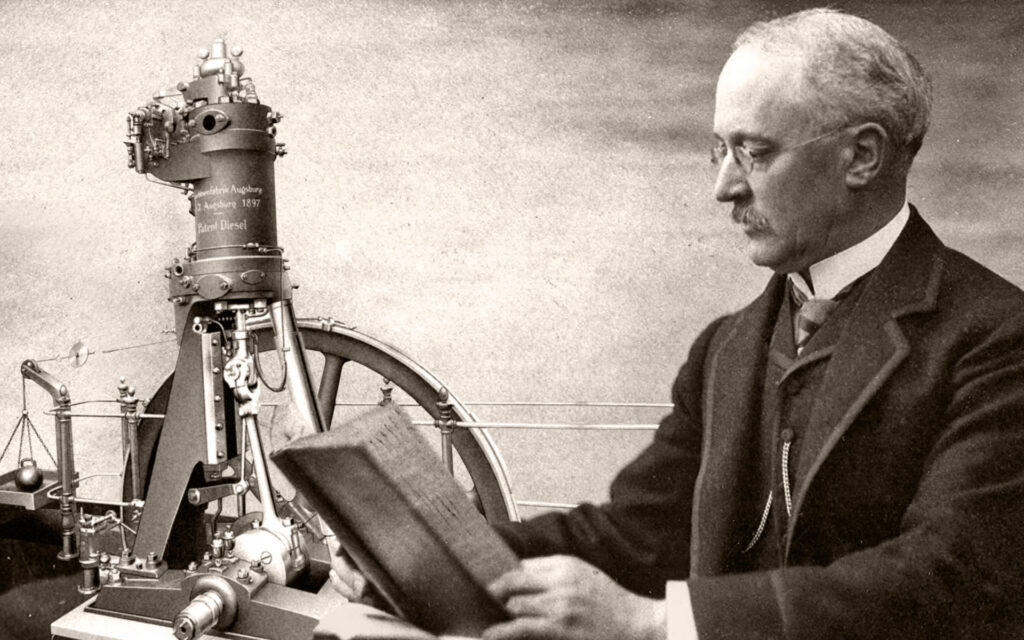
PARIS, July 6 — On a late summer evening in 1913, Rudolf Diesel boarded the steamship Dresden in Antwerp, bound for Harwich across the English Channel. He was never seen again. Against this backdrop of one of history’s great unsolved disappearances, it is worth remembering what the German inventor left behind.
Diesel, born in Paris in 1858 to German parents and educated at the Royal Bavarian Polytechnic of Munich, patented his engine in 1892. Five years later, in 1897, he demonstrated the first successful prototype.
The design was radical: compression ignition, no spark plug required. The thermal efficiency reached about 26%, a figure that left the steam engines of the day in the dust. What is at stake in this story is not merely a footnote in engineering history.
Diesel’s engine transformed transportation, agriculture, and industry. It powered ships, locomotives, trucks, and generators.
Today, more than 100 million diesel vehicles are on the road globally, and the engine remains a cornerstone of heavy machinery and power generation. Yet the man himself vanished. On September 29, 1913, Diesel disappeared from the Dresden while crossing the English Channel.
His body was never found. In the corridors of maritime history, speculation has long swirled between suicide and murder. No definitive answer ever emerged.
The wider picture, however, is one of enduring impact. Diesel’s invention did not die with him.
The engine that bears his name became the workhorse of global commerce, from container ships crossing oceans to generators lighting remote villages. Its efficiency, far beyond what steam could offer, reshaped the economics of industry. For European industry, the diesel engine has been both a blessing and a source of regulatory tension.
The continent that gave birth to Diesel’s innovation now grapples with its environmental legacy, even as the engine’s fundamental design remains unchanged in principle from that 1897 prototype. Diesel’s story is one of triumph and tragedy, a German inventor who died in the waters between France and England, leaving behind an invention that would define the 20th century.
His disappearance remains an open question, but the engine’s place in history is secure.




