
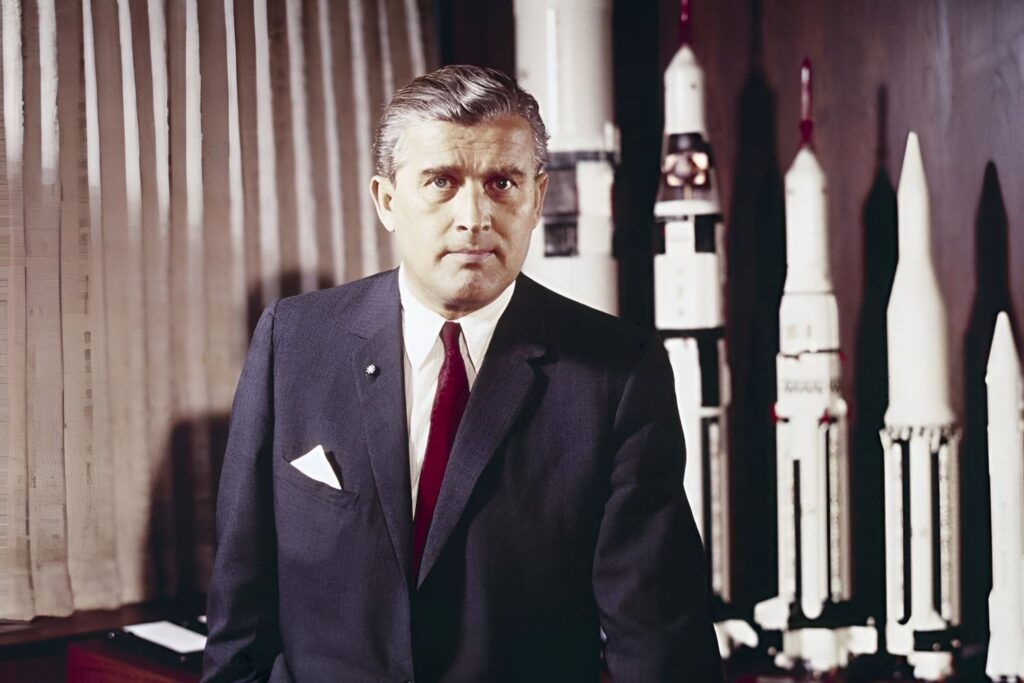
HUNTSVILLE, July 8 — The figure that matters: 363 feet. That is the height of the Saturn V rocket, the machine that sent Apollo astronauts to the Moon. The man who built it, Wernher von Braun, died in 1977.
His legacy remains one of the most complex calculations in the history of American science. The bottom line: von Braun gave the United States the rocket that won the Space Race.
He also designed the V-2 rocket for Nazi Germany, a weapon that killed an estimated 7,250 people. By the numbers, his career spans from the SS to the National Medal of Science. Investors in the business of history will note that the same engineering discipline produced both a terror weapon and a lunar launch vehicle.
Von Braun was born on March 23, 1912, in Germany. He became a member of the Nazi Party and the SS during World War II.
He led the development of the V-2 rocket, which the Nazi regime used to attack Allied cities. The death toll from those attacks: an estimated 7,250 people. After the war, the United States brought von Braun and about 1,600 other German scientists to America under Operation Paperclip.
That program ran from 1945 to 1959. The goal was straightforward: capture German rocket expertise before the Soviet Union could. Von Braun went to work for the U.S. Army.
He developed the Redstone rocket. On January 31, 1958, that rocket launched Explorer 1, the first American satellite.
The United States was finally in space. In 1960, von Braun’s team transferred to NASA. He became director of the Marshall Space Flight Center.
There, he led the development of the Saturn V. The rocket stood 363 feet tall.
It produced 7.5 million pounds of thrust. That machine carried men to the Moon. Von Braun also advocated for human missions to Mars.
He retired from NASA in 1972. He went to work for Fairchild Industries. In 1975, he received the National Medal of Science.
His legacy is not simple. The same man who designed a weapon that killed thousands also designed the vehicle that landed Americans on the lunar surface.
The United States government made a deliberate decision to use his talent. That decision produced results that are measurable in feet, pounds of thrust, and national achievement. The figure that matters for the Apollo program: 363 feet.
The figure that matters for the V-2: 7,250 dead. Both numbers belong to the same engineer.
Both are part of the same American story.




