
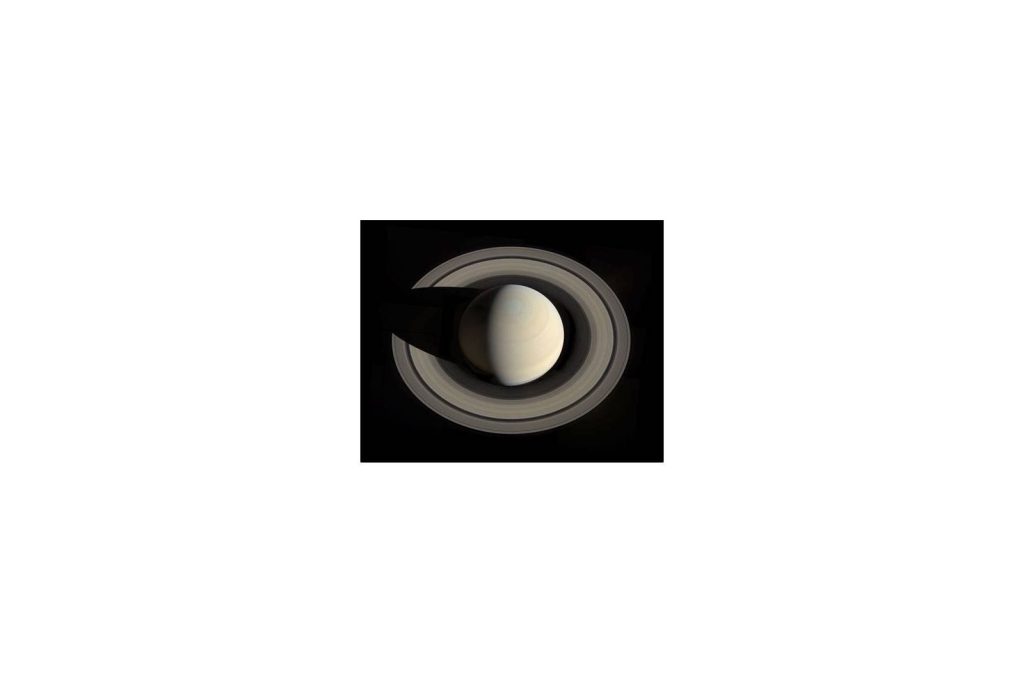
New analysis of data from the Cassini-Huygens mission has fundamentally altered the scientific understanding of Saturn’s atmosphere. Researchers have discovered that the planet’s famously powerful winds extend thousands of kilometers into its interior, marking a significant shift in how giant gas planets are perceived. Previously, scientists debated whether Saturn’s jet streams were shallow atmospheric phenomena or something far more substantial.
The latest findings provide a definitive answer: the winds are not merely a surface-level weather pattern but a deep, structural characteristic of the planet itself.
Measuring Gravity to Find the Wind’s Depth
The breakthrough came from analyzing minuscule variations in Saturn’s gravitational field. As the Cassini spacecraft made close passes to the planet, its instruments detected these subtle changes, allowing researchers to effectively peer beneath the visible cloud tops.
This technique revealed the true scale of the atmospheric motion. The data shows that equatorial wind flows on Saturn may reach depths of approximately 10,000 kilometers. While high-latitude winds are shallower, they still extend to vast depths. Below the visible cloud layer, winds can become even more intense than those observed at the surface.
A Planet-Scale Engine of Motion
Several factors combine to create this continuous, deep-seated motion. Saturn has no solid surface and possesses a dense interior. This unique composition, combined with the planet’s intense internal heat and rapid rotation, creates a planet-scale engine that drives the winds to extraordinary depths.
This discovery reshapes the scientific understanding of giant gas planets. It suggests that weather on such worlds is not a thin, isolated layer but a phenomenon deeply intertwined with the planet’s entire body.
The implications extend beyond Saturn, offering new perspectives for studying Jupiter and distant exoplanets.
New Avenues for Research and Refined Models
The finding opens significant new avenues for research. Scientists can now work to understand the complex dynamics at play on Saturn and compare them to other gas giants in the solar system and beyond. This deeper understanding of Saturn’s internal dynamics may lead to breakthroughs in knowledge about planetary formation and evolution.
With this new data, researchers will refine their models of giant gas planets. These improved models will allow for more accurate predictions about the behavior of these complex worlds, paving the way for future discoveries and a more comprehensive understanding of planetary systems throughout the universe.




