
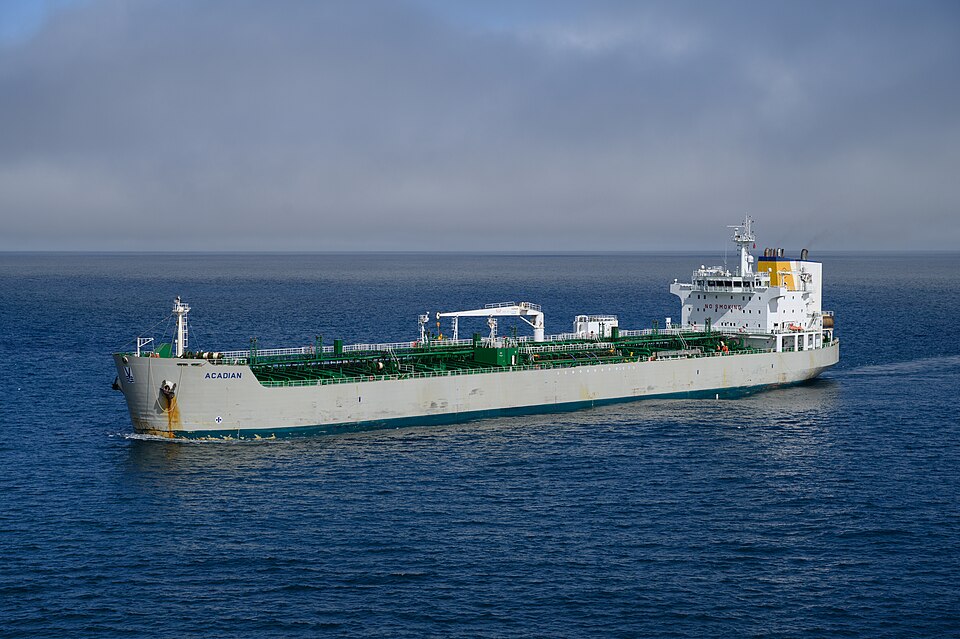
A new confrontation over the Strait of Hormuz is set to ripple through global energy markets after former President Donald Trump announced from his campaign headquarters a 20% toll on all cargo transiting the narrow waterway and a renewed naval blockade against Iran. The policy targets the Persian Gulf chokepoint through which roughly 21 million barrels of oil — about 20% of global consumption — moved each day in 2023.
For families in Japan, India, and South Korea, the price of petrol and heating costs are now directly tied to this strategic passage.
A Regime of Blockades and Patrols
The announced blockade mirrors the 2019-2020 maximum pressure campaign conducted under the Trump administration, when the U.S. Navy’s Fifth Fleet, headquartered in Bahrain, enforced sanctions against Iran. Sailors and crews of the Fifth Fleet will once again be tasked with intercepting vessels and collecting the new toll. On the other side of the confrontation stands Iran’s Islamic Revolutionary Guard Corps (IRGC), a key stakeholder that has repeatedly threatened to close the strait. Iran has made such threats during past standoffs, including the Iran-Iraq War of 1980-1988 and in 2019 following U.S. drone strikes.
Although the waterway had never been closed for an extended period during previous Middle East conflicts, the new policy raises the risk of a sustained disruption. The Strait of Hormuz forms the only sea passage from the Persian Gulf to the open ocean.
Its north coast belongs to Iran; the south coast is the Musandam Peninsula, part of Oman with a small portion under the United Arab Emirates. For decades, this narrow channel has been one of the world’s most strategically important chokepoints, handling a large share of global seaborne oil trade and also serving as a major route for liquefied natural gas moving toward Europe and Asia. Several Gulf countries have no other maritime outlet for their exports, meaning any blockage can cause severe supply shortages.
Economic Shockwaves Across Asia
The 20% toll threatens to raise global oil prices. On April 21, 2025, the day before the announcement, Brent crude was trading at $85 per barrel. For oil-dependent Asian economies such as Japan, India, and South Korea, which rely heavily on crude that transits the strait, even small changes in shipping costs can lead to higher prices at the pump and increased heating expenses. The policy directly affects the energy budgets of millions of households in those nations.
Meanwhile, the price of Brent crude serves as a global benchmark, meaning the toll’s impact could extend well beyond Asia to fuel markets worldwide. The announcement comes amid ongoing negotiations in Vienna over the Joint Comprehensive Plan of Action (JCPOA), the nuclear agreement from which the United States withdrew in 2018.
No further details on implementation of the toll or blockade have been released, and no international reaction has been made public. The silence leaves uncertainty about how key allies and adversaries will respond.
What to Watch in the Weeks Ahead
For the families of sailors in the Fifth Fleet, the new policy means a return to the tense patrols of the 2019-2020 campaign. For households in Japan, India, and South Korea, it means watching global oil prices closely.
The confrontation also heightens military tension in a region already dealing with nuclear negotiations and shifting alliances. The outcome of this standoff could show up directly in monthly energy bills and in the stability of global fuel markets. All eyes remain on the narrow stretch of water that connects the Persian Gulf to the Gulf of Oman, where the price of a tank of petrol or the cost of heating a home is once again tied to geopolitics.




