
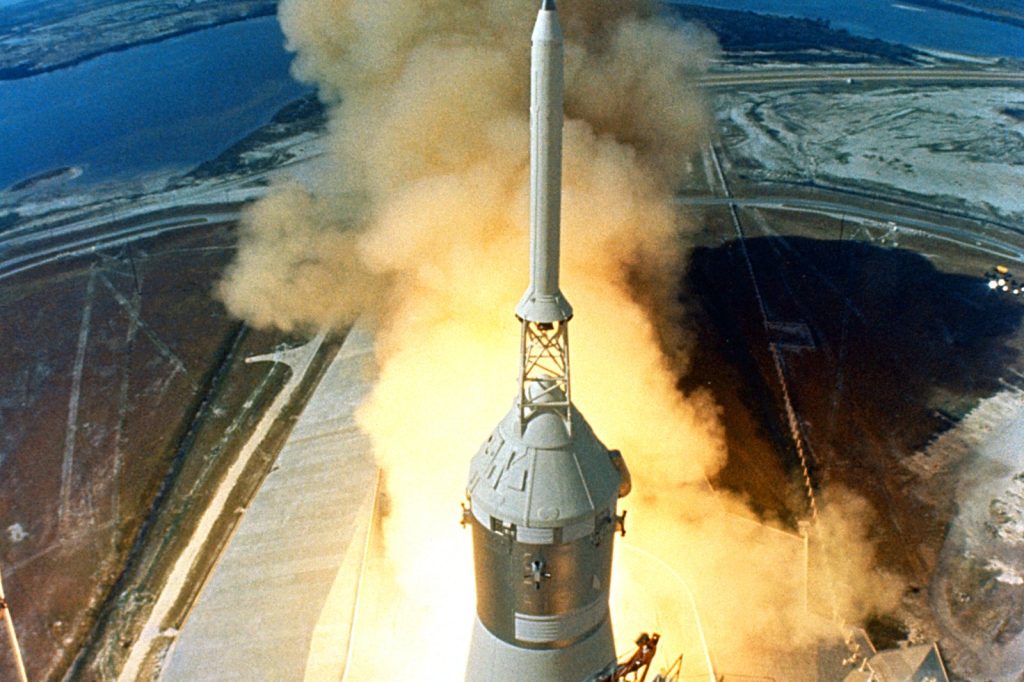
CAPE CANAVERAL, July 8 — As the world reflects on the Apollo program more than five decades after its conclusion, the story remains one of immense national effort, tragic loss, and extraordinary scientific achievement. Operated by NASA from 1961 to 1972, it was the third U.S. human spaceflight program, born from a singular political challenge. President John F.
Kennedy set the goal in a May 25, 1961 speech to Congress: land a man on the Moon and return him safely to Earth before the decade was out. The program ultimately cost approximately $25.4 billion, a figure that translates to roughly $200 billion in 2023 dollars.
The human cost was real and early. On January 27, 1967, during a test for Apollo 1, a cabin fire killed astronauts Gus Grissom, Ed White, and Roger Chaffee. It was a devastating setback, but the program pressed forward.
The first successful crewed test came with Apollo 7 in October 1968. Then, in December of that year, Apollo 8 became the first crewed spacecraft to orbit the Moon, a monumental step that captured the world’s imagination.
The defining moment arrived with Apollo 11, which launched July 16, 1969. Four days later, on July 20, Neil Armstrong and Buzz Aldrin landed on the lunar surface while Michael Collins remained in orbit. The image of Armstrong stepping onto the Moon remains one of the most powerful in modern history.
Not every mission went smoothly. Apollo 13, in April 1970, suffered an oxygen tank explosion that forced an abort of the landing. The crew returned safely, a testament to quick thinking and ground control expertise.
The program concluded with Apollo 17 in December 1972, the final Moon landing. In total, twelve people walked on the Moon across six landings.
At its peak, the Apollo program employed over 400,000 people and involved 20,000 industrial firms and universities. The scale of the undertaking is difficult to overstate. Beyond the lunar missions, the program produced technological spin-offs that have quietly shaped modern life.
These include integrated circuits, freeze-dried food, and improved water purification systems.
{“@context”: “https://schema.org”, “@type”: “NewsArticle”, “headline”: “Apollo Program: The $25 Billion Effort That Put Humans on the Moon”, “description”: “CAPE CANAVERAL, July 8 — As the world reflects on the Apollo program more than five decades after its conclusion, the story remains one of…”, “datePublished”: “2026-07-08T09:30:00+00:00”, “author”: {“@type”: “Person”, “name”: “Muhammad Asim”}, “publisher”: {“@type”: “Organization”, “name”: “InfoPulse Today”, “url”: “https://newsfeed.infopulsetoday.com/”}}




