
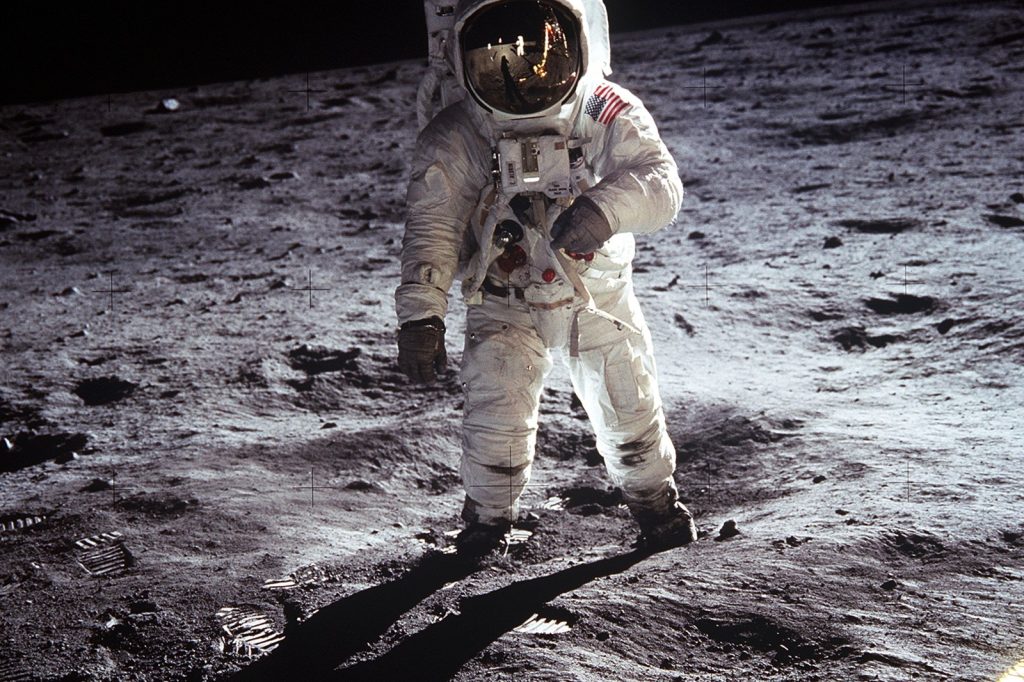
HOUSTON, July 13 — Fifty-seven years after a Saturn V rocket thundered off the launch pad, the strategic calculus of the Apollo 11 mission still reverberates through the geopolitical chessboard of space exploration. The flight that first landed humans on the Moon was never merely a technological achievement; it was a decisive move in the Cold War contest between superpowers. Launched from Kennedy Space Center in Merritt Island, Florida, on July 16, 1969, at 13:32 UTC, the mission fundamentally altered the broader stakes of human ambition beyond Earth.
The crew represented a careful alignment of military discipline and scientific precision. Commander Neil Armstrong, Command Module Pilot Michael Collins, and Lunar Module Pilot Buzz Aldrin constituted the human element of a machine that would spend 8 days, 3 hours, 18 minutes, and 35 seconds in flight.
When the lunar module Eagle touched down on the Moon on July 20, 1969, at 20:17 UTC, it did so in the Sea of Tranquility—a landing site chosen for its relative flatness and safety, not its dramatic scenery. What this signals is a mission designed for success, not spectacle. Armstrong became the first person to step onto the lunar surface at 02:56 UTC on July 21, 1969.
His words—”That’s one small step for a man, one giant leap for mankind”—were broadcast to a waiting global audience. Aldrin joined him 19 minutes later.
Strategically, the timing of the moonwalk was calculated to maximize live television viewership in the United States and allied nations, reinforcing American technological leadership at the height of the space race.
The Material and Scientific Calculus
The astronauts spent approximately 2.25 hours outside the spacecraft. During that time, they collected 21.5 kilograms—47.5 pounds—of lunar material. This geological bounty was not a symbolic gesture; it was a strategic asset.
The samples would be distributed to laboratories across the globe, allowing scientists to analyze the Moon’s composition and history. The astronauts also deployed scientific instruments that continued transmitting data long after the crew departed.
The broader stakes here extended beyond national pride into genuine scientific discovery. The mission was the fifth crewed flight of the Apollo program and the third human spaceflight to leave Earth orbit. Each previous flight had tested systems, navigational techniques, and life-support protocols.
Apollo 11 was the culmination of a calculated series of steps, each building on the last. The command module Columbia splashed down in the Pacific Ocean on July 24, 1969, at 16:50 UTC, completing a mission that had lasted precisely 8 days, 3 hours, 18 minutes, and 35 seconds.
The Geopolitical Chessboard
What this signals for the current era is a reminder that space exploration has always been a domain of strategic competition. In 1969, the United States was locked in a struggle with the Soviet Union for technological and ideological supremacy. The Moon landing was a demonstration of capability that no rival could match.
Today, as new powers emerge and private industry reshapes the calculus of access to orbit, the Apollo 11 legacy serves as both a benchmark and a warning. The mission was not inevitable; it required sustained political will, massive industrial mobilization, and a clear strategic objective.
The broader stakes of that July 1969 mission were not lost on contemporary observers. Nations aligned with the United States celebrated the achievement as a validation of democratic, free-market systems. Adversaries were forced to reassess their own space programs.
The calculus of international prestige shifted overnight. For a brief moment, the world looked to the Moon and saw what organized human effort could accomplish.
Looking forward, the Apollo 11 anniversary invites a sober assessment of where space strategy stands today. The infrastructure that enabled the Saturn V launch—the test stands, the launch pads, the mission control systems—was built for a specific geopolitical purpose. That purpose was achieved.
The question now is whether the current generation of leaders can articulate a similarly compelling vision for the next phase of human expansion beyond Earth. The strategic chessboard has changed, but the pieces remain in play.
Sources
{“@context”: “https://schema.org”, “@type”: “NewsArticle”, “headline”: “Apollo 11: The Historic First Moon Landing in July 1969”, “description”: “HOUSTON, July 13 — Fifty-seven years after a Saturn V rocket thundered off the launch pad, the strategic calculus of the Apollo 11 mission still…”, “datePublished”: “2026-07-13T09:30:00+00:00”, “author”: {“@type”: “Person”, “name”: “Noah King”}, “publisher”: {“@type”: “Organization”, “name”: “InfoPulse Today”, “url”: “https://newsfeed.infopulsetoday.com/”}, “citation”: [{“@type”: “CreativeWork”, “url”: “https://en.wikipedia.org/wiki/Apollo_11”}]}




