
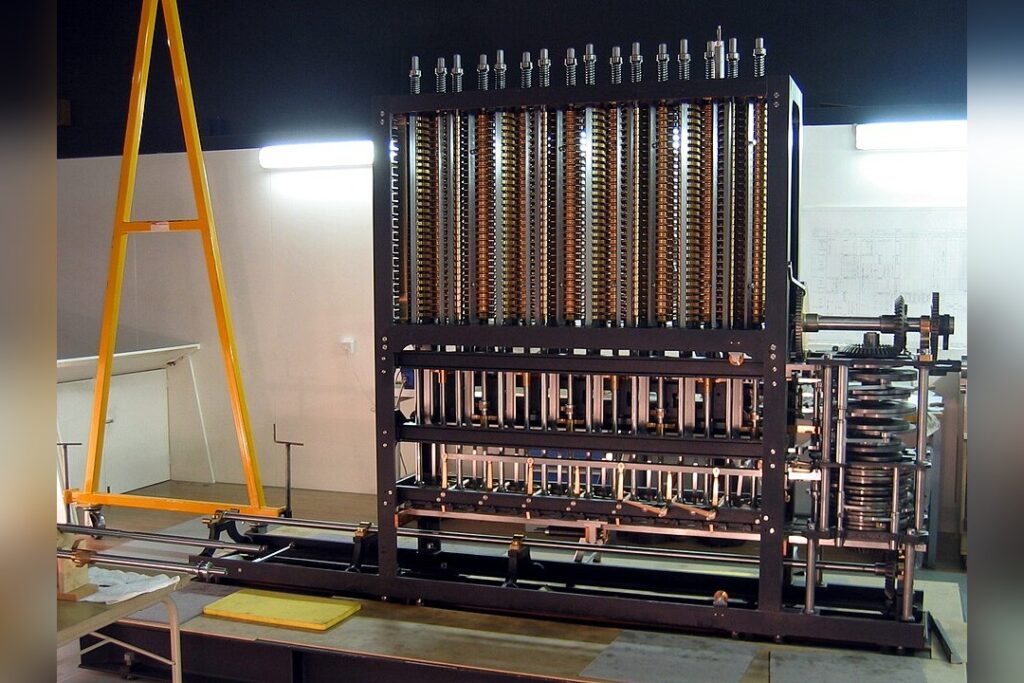
LONDON, July 11 — Against the backdrop of the Science Museum in South Kensington, a gleaming brass-and-steel contraption clicks and whirs with the precision of a Victorian clockmaker’s dream. It is a working Difference Engine No. 2, completed in 1991 from the original designs of Charles Babbage, an English mathematician and inventor. The machine proves what Babbage insisted all along: his designs were sound.
Babbage first designed the Difference Engine in 1822. Its purpose was to automatically calculate and print mathematical tables, removing human error.
A portion of that engine was built by 1832, but full funding was never secured. The project stalled, and Babbage turned his restless mind to something far more ambitious. In 1837, he proposed the Analytical Engine.
This was not merely a calculator. It was a general-purpose mechanical computer, featuring an arithmetic logic unit, control flow directed by punched cards inspired by the Jacquard loom, and memory.
It was, in concept, a complete programmable machine. Yet it was never built in his lifetime. Babbage died in 1871, his engines unrealised.
The Poet’s Daughter and the First Program
What is at stake in Babbage’s story is not just the hardware. It is the vision of what a machine could do. That vision found its most profound expression in Ada Lovelace, daughter of the poet Lord Byron.
In 1843, Lovelace translated and annotated an Italian article on the Analytical Engine. Her notes went far beyond translation.
In those notes, she included an algorithm for calculating Bernoulli numbers. It is now recognised as the first computer program. Lovelace also theorised that such a machine could manipulate symbols beyond numbers.
She saw, in the corridors of Babbage’s workshop, a future that would take more than a century to arrive. The wider picture is that Babbage and Lovelace, working in the 19th century, laid the intellectual foundations for the digital age.
Their engines were never built, but their logic was sound. The Science Museum’s completed Difference Engine No. 2, built to Babbage’s exact specifications, clatters into life and prints error-free tables. It is a vindication.
A Legacy in Brass and Code
For a journalist covering international technology from a European perspective, there is something poignant in this story. The Industrial Revolution was Britain’s great transformation. Babbage stood at its edge, trying to push it further, to make machines not just for power but for thought.
He failed to secure funding. He failed to see his engines built.
But he succeeded in designing them. And Lovelace, writing in her notes, saw the machine as a universal symbol-manipulator. That insight, more than any single piece of hardware, is what connects Babbage’s workshop to the smartphones and servers of today.
What to watch next is the continued recognition of these two figures. Babbage’s designs, long dismissed as impractical, are now celebrated as visionary.
Lovelace’s algorithm is taught in computer science courses. The Science Museum’s working engine is a permanent reminder that the future sometimes arrives late, but it does arrive.
Sources
{“@context”: “https://schema.org”, “@type”: “NewsArticle”, “headline”: “Babbage’s Engines: The Mechanical Origins of Modern Computing”, “description”: “LONDON, July 11 — Against the backdrop of the Science Museum in South Kensington, a gleaming brass-and-steel contraption clicks and whirs with the precision of…”, “datePublished”: “2026-07-11T09:30:00+00:00”, “author”: {“@type”: “Person”, “name”: “Beatrice Bianchi”}, “publisher”: {“@type”: “Organization”, “name”: “InfoPulse Today”, “url”: “https://newsfeed.2bme.xyz/”}, “citation”: [{“@type”: “CreativeWork”, “url”: “https://en.wikipedia.org/wiki/Charles_Babbage”}]}




