
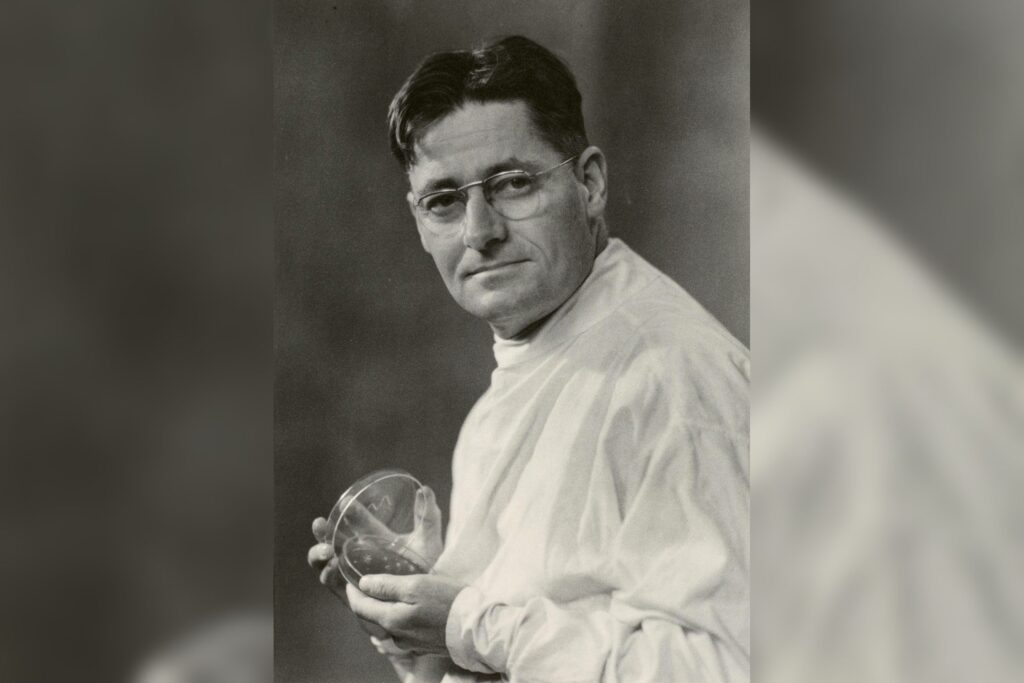
OXFORD, July 11 — The record shows that in 1940, a team at the University of Oxford achieved the first purification and stabilization of penicillin, a breakthrough that would transform battlefield medicine and civilian healthcare alike. Howard Florey, Ernst Boris Chain, and Norman Heatley developed the methods to turn Alexander Fleming’s discovery into a usable drug. The first animal trial that year involved eight mice infected with Streptococcus.
All of the treated mice survived. All of the controls died.
The results were stark. The first human trial began in 1941. The patient was Albert Alexander, a policeman suffering from a life-threatening infection.
He improved under treatment. But when the penicillin supplies ran out, he died.
The Oxford team had not yet solved mass production. That changed through collaboration with U.S. pharmaceutical companies. According to the historical record, Pfizer and Merck were among the firms that worked with the Oxford scientists.
They used deep-tank fermentation, a technique that allowed large-scale production. By D-Day in June 1944, enough penicillin had been produced to treat every wounded Allied soldier.
From 18% to less than 1%
The impact on survival rates was dramatic. The source material states that penicillin reduced deaths from bacterial infections in wounded soldiers from 18% in World War I to less than 1% in World War II. That is a documented shift in the lethality of combat wounds.
The Oxford team’s work earned Florey, Chain, and Fleming the 1945 Nobel Prize. Fleming had discovered the mold but had not been able to purify or stabilize it.
The Nobel committee recognized the full chain of discovery and development. Heatley’s contributions were not initially honored by the Nobel committee. That changed decades later.
In 1990, he received an honorary degree and was invited to stand on the Nobel stage. Sources familiar with the history note that Heatley had been the one who devised the key extraction and purification methods that made the animal and human trials possible.
A quiet legacy
For a journalist who covers conflict and defense, the penicillin story is a reminder that medical breakthroughs often emerge from university laboratories, not military programs. Florey and his team worked under wartime conditions, with limited resources and pressure to deliver results. The collaboration with American pharmaceutical companies illustrates how wartime necessity drove innovation.
Deep-tank fermentation, a technique originally developed for other purposes, became the method that allowed penicillin to be produced in the quantities needed for the D-Day landings. The record shows that the reduction in infection deaths from 18% to under 1% is one of the most significant statistical shifts in military medicine.
It changed how armies planned for casualties and how surgeons approached wound care. Today, penicillin and its derivatives remain frontline antibiotics. The story of Florey’s team is a case study in how basic research, combined with industrial partnership, can produce results that save lives on a massive scale.
The 1945 Nobel Prize recognized the work, but the full story includes Heatley’s belated acknowledgment. His appearance on the Nobel stage in 1990 closed a gap that had existed for 45 years.
For those tracking the intersection of research and real-world impact, the Oxford penicillin project remains a benchmark. It shows what can happen when a university team, a government need, and private industry align around a single goal. Consult your doctor for medical advice.




