
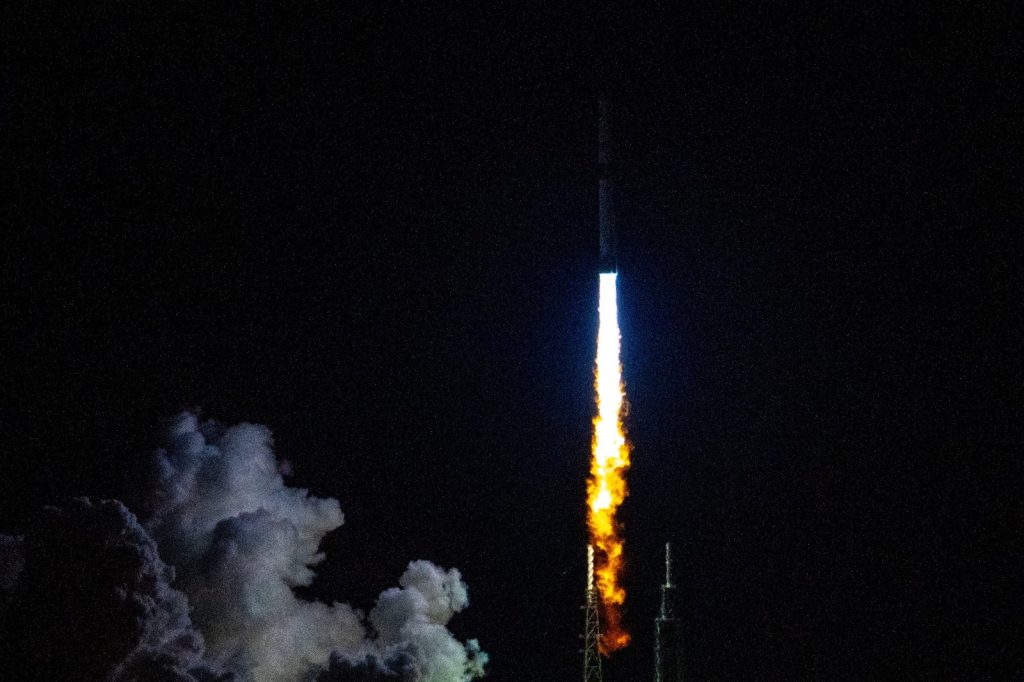
CAPE CANAVERAL, July 14 — Blue Origin’s New Glenn rocket has quietly reshaped the heavy-lift launch market since its first full success in early 2025, and the strategic calculus for the company now hinges on scaling up operations at a pace that would have seemed improbable just two years ago. The vehicle, named for astronaut John Glenn and first announced in 2012, stands 98 meters tall with a 7-meter diameter. Its first stage is powered by seven BE-4 engines, each producing 2,400 kilonewtons of thrust.
Those engines, which burn liquefied natural gas and liquid oxygen, were developed in-house by Blue Origin beginning in 2011. The rocket can lift 45 metric tons to low Earth orbit and 13 metric tons to geostationary transfer orbit — figures that place it in direct competition with SpaceX’s Falcon Heavy, which lifts 63.8 metric tons to LEO.
From maiden flight to reusability
New Glenn’s maiden flight took place on January 10, 2025, from Launch Complex 36 at Cape Canaveral Space Force Station in Florida. That initial mission successfully placed a prototype satellite into geostationary orbit, but the first-stage booster was lost during the landing attempt. The broader stakes for Blue Origin were clear: without reusability, the economics of the program would not hold.
The second flight, on February 19, 2025, changed that calculus. The booster landed on the drone ship “Jacklyn” — named after Jeff Bezos’s mother — in the Atlantic Ocean.
The payload fairing, made of composite materials, was also recovered for reuse. With that flight, Blue Origin achieved full reusability, matching a capability that had been SpaceX’s signature advantage. Blue Origin has invested over $10 billion in New Glenn development since 2012, according to company filings.
That figure signals the depth of commitment from Bezos’s space venture, and what this means for the broader launch market is a new competitor with a fully reusable heavy-lift vehicle.
Scaling the launch cadence
Blue Origin’s CEO, Dave Limp, has stated that the company aims to launch New Glenn 12 times in 2025, up from 2 in 2024. That target represents a sixfold increase in a single year — a pace that, if achieved, would put New Glenn on a trajectory toward regular operational service. Strategically, the company is betting that demand for heavy lift will continue to grow, driven by both commercial satellite constellations and government contracts.
The broader stakes for the US launch industry are significant. With two fully reusable heavy-lift vehicles now operational — New Glenn and Falcon Heavy — the United States has secured redundant capability for lifting large payloads to orbit.
That redundancy has geopolitical implications, particularly as space-based infrastructure becomes increasingly central to both military and civilian communications, navigation, and reconnaissance. What this signals for the remainder of 2026 is a ramp-up in launch activity from Florida’s Space Coast. Blue Origin’s ability to deliver on the 12-launch target will be closely watched.
If the company sustains that cadence, New Glenn will have moved from a developmental program to a mature operational asset. If not, the questions will turn to manufacturing bottlenecks and supply-chain constraints.
For now, the rocket that failed its first landing attempt now stands as a fully reusable heavy lifter with a growing manifest. The next move on this particular chessboard belongs to Blue Origin’s launch team.
Sources
{“@context”: “https://schema.org”, “@type”: “NewsArticle”, “headline”: “Blue Origin’s New Glenn rocket shakes up space market”, “description”: “CAPE CANAVERAL, July 14 — Blue Origin’s New Glenn rocket has quietly reshaped the heavy-lift launch market since its first full success in early 2025,…”, “datePublished”: “2026-07-14T09:30:00+00:00”, “author”: {“@type”: “Person”, “name”: “Noah King”}, “publisher”: {“@type”: “Organization”, “name”: “InfoPulse Today”, “url”: “https://newsfeed.infopulsetoday.com/”}, “citation”: [{“@type”: “CreativeWork”, “url”: “https://en.wikipedia.org/wiki/New_Glenn”}]}




