
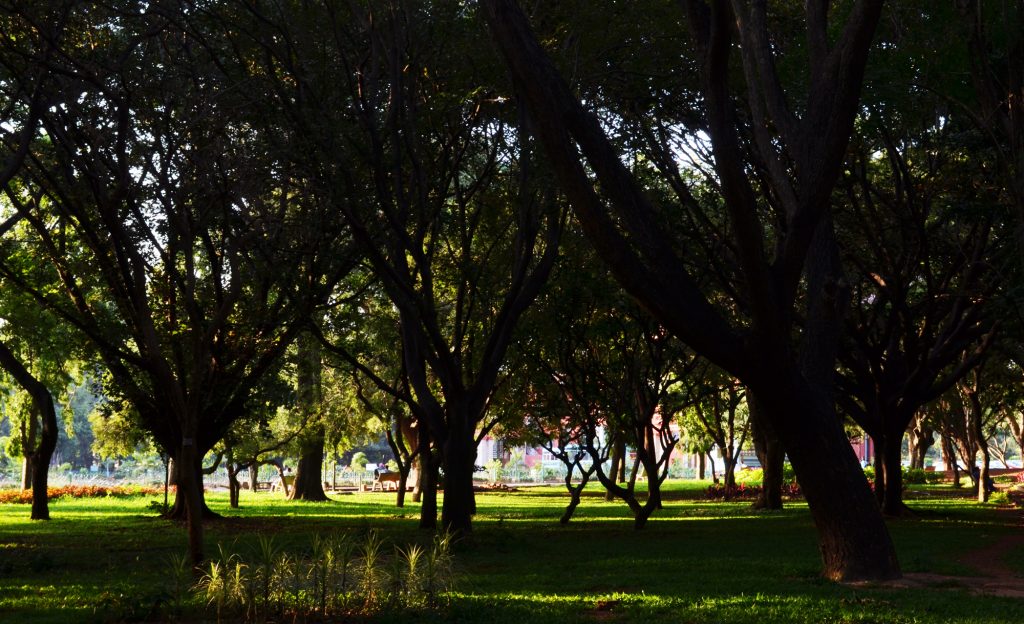
BENGALURU — The new book on Cubbon Park is not a guidebook. It does not map walking trails or list the species of trees. Instead, it collects voices.
Twenty-six of them, all from people who use the park, see it, feel it. The author, Suresh Jayaram, calls himself a conductor or a sutradhar — the narrator who strings a story together from others’ words.
His book, Cubbon Park: Citizens’ Perspectives and Many Visions for the Future, lands at a specific moment. Bengaluru is choking. Its lakes foam.
Its roads are gridlocked. Its remaining green spaces face constant pressure — from development, from bureaucracy, from the idea that parks must be “regimented,” as Jayaram puts it.
The book pushes back against that regimentation. It argues the park belongs to everyone, not just to the government that manages it. Jayaram sees the park as a palimpsest.
That is a term from manuscripts — a page scraped clean and written over, but with earlier writing still faintly visible underneath. Cubbon Park, he says, carries pre-colonial, colonial and post-colonial layers in its soil and its paths. It holds the city’s history in plain sight.
The book treats that history as living, not archived. It uses interviews, factoids, photographs.
An ethnographic document, Jayaram calls it. Contemporary but also archival. The choice of format matters.
A book of interviews is inherently democratic. It does not elevate one expert’s voice above others.
It lets a gardener, a jogger, a retired professor, a student speak alongside each other. Jayaram collected these voices and strung them together. The result is a portrait of a public space as its public actually experiences it — messy, layered, personal.
The park has long been an axis of the city. That is Jayaram’s phrase. An axis is a line something rotates around.
Cubbon Park, for Bengaluru, is that line. It is where people go to develop desire and love, to find a quiet corner, to simply be.
Those are not trivial functions. In a city of 12 million, spaces that allow people to simply be are scarce. The book documents that scarcity by documenting what the park provides.
It also questions the government’s role. Not aggressively.
The book is not a polemic. But it gives officials an idea, Jayaram says: parks need not be regimented. They can be looser, more organic, more responsive to what citizens actually want.
That is a quiet political argument, embedded in interviews and photographs rather than manifestos. Where this leads is uncertain. The book is out now.
It will be read by the people it features — the 26 Bengalureans who spoke for it. It may be read by city planners, by activists, by casual readers who love the park.
Its real impact will depend on whether those readers carry its ideas into the debates that already surround Cubbon Park. Debates about fencing, about commercial events, about who gets to decide what a park is for. Jayaram’s book does not answer those debates.
It does not try to. What it does is provide evidence that the park belongs to its citizens.
That is a fact, not an argument. The book collects the testimony. What happens next is up to the city.




