
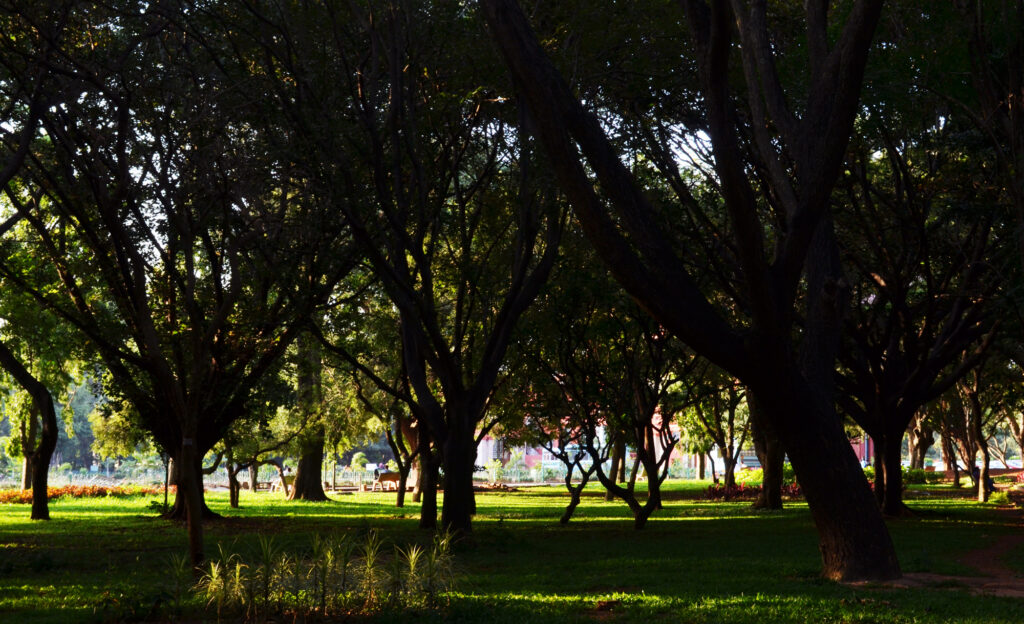
BENGALURU — The book itself is an unusual object. Not a straight history, not a guidebook, not a photo album. It is a collection of 26 interviews with people who use Cubbon Park, threaded together with facts and photographs.
The author, Suresh Jayaram, calls it a citizens’ perspective. He calls himself a sutradhar — the narrator who strings the story together in traditional Indian theatre.
Jayaram is a writer and visual artist. He founded 1Shanthiroad Studio/Gallery in Bengaluru. His new book is titled Cubbon Park: Citizens’ Perspectives and Many Visions for the Future.
It treats the park as belonging to everyone. The park itself is old.
Colonial-era. Pre-colonial land beneath it. Post-colonial additions on top.
Jayaram describes it as a palimpsest — layers of history written over each other. The book covers the built environment and the natural one. The ecology.
The trees. The paths.
But the core of the book is not about monuments or plants. It is about people. Jayaram wanted to collect different voices.
He wanted to show that the park has been a space where community happens. Where memories are made.
Where artistic inclinations grow. “It is a very eclectic, secular space that has been, for a long time, an axis of the city,” Jayaram says. The book questions how the government manages such spaces.
Jayaram says it gives the authorities an idea that parks need not be regimented. That they can be looser. More open to how people actually use them.
The interviews are with fellow Bengalureans. The book presents the park as a place where people develop desire and love.
Where they find a quiet corner in a busy city. Where they simply are. Jayaram thinks of this work as a contemporary ethnographic document.
Archival material. It reflects a Bengaluru-specific identity.
The identity of the citizens and stakeholders it features. The park is 300 acres in the centre of the city. It has been called the lung of Bengaluru.
It has bandstands and statues and a library and a museum. But Jayaram’s book argues it is more than that. It is a democratic space.
A people’s place. The timing of the book matters.
Bengaluru is growing fast. Concrete is rising. Green spaces are shrinking.
The park is under pressure from development, from traffic, from competing demands. The book is a document of what exists now, and a argument for what should remain.
Jayaram does not pretend to speak for everyone. He collected 26 voices. That is not a census.
It is a sample. A set of perspectives. He strung them together.
The result is not a single story but many. The park belongs to all of them.
The book uses factoids. Short bits of information. Photographs.
The format is part of the argument. The park cannot be captured in one narrative.
It needs fragments. Pieces. Different angles.
Jayaram says the park has “a kind of palimpsest of history from pre-colonial, colonial, post-colonial times.” Within those layers, he notes, there is also a certain environment and ecology that is part of the park. The book is published now. It is available.
It is a physical object about a physical place. A place that people walk through every day.
A place that holds their memories. A place that Jayaram says belongs to everyone.




