
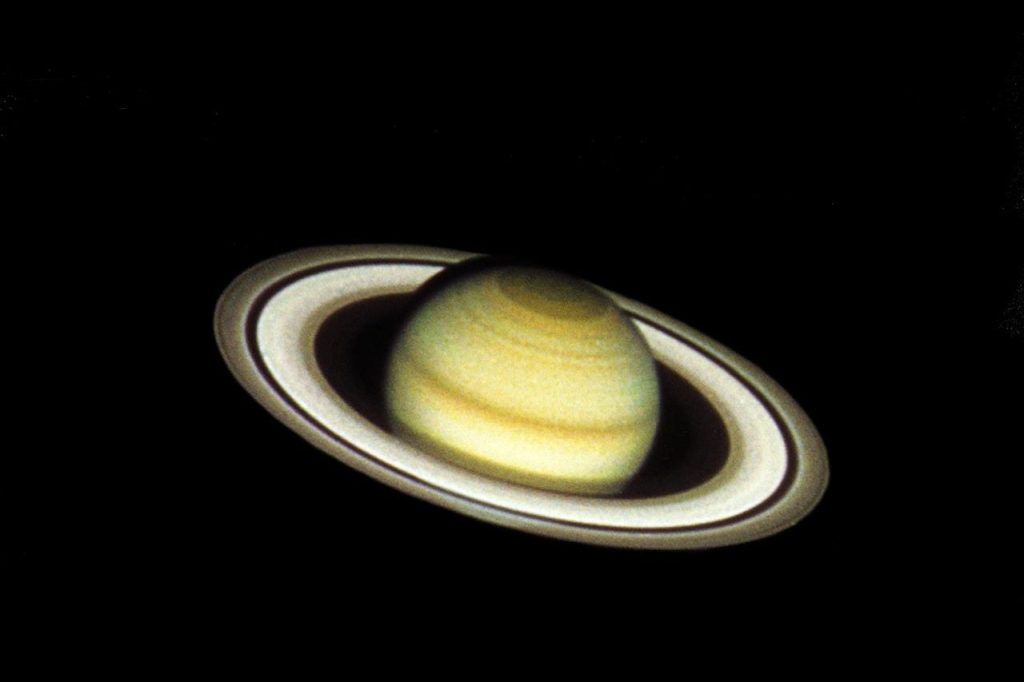
A new analysis of data from the Cassini spacecraft has revealed a significant finding about Saturn’s winds, changing the way scientists understand giant planets. The data, collected during Cassini’s final dives, shows that Saturn’s winds are not a weather phenomenon, but rather a structural feature of the planet itself, extending thousands of kilometers into its interior. This discovery has far-reaching implications for the study of gas giants, including Jupiter and exoplanets.
The key to this finding lies in the tiny variations in Saturn’s gravitational field, which Cassini measured during its close passes. These variations are a result of mass moving deep within the planet, and they provide a fingerprint of the winds’ depth. According to the report, the equatorial jet stream likely reaches around 10,000 kilometers down, while higher-latitude winds are shallower but still vast. This means that the winds are not a thin surface skin, but rather a deep-seated engine that drives the planet’s atmosphere.
Saturn’s interior is dense, and the combination of intense internal heat and rapid rotation creates a planet-scale machine of continuous motion. This machine is responsible for the deep winds, which can become even stronger below the visible clouds than at the surface. The lack of a solid ground on Saturn also plays a crucial role in the formation of these deep winds. Before this discovery, scientists had two competing ideas about Saturn’s jet streams: one held that they were shallow weather patterns, like those on Earth, while the other suspected they went deep. The gravity data from Cassini has settled this argument, revealing that the winds are fundamental to the planet’s atmosphere and not a passing storm.
Implications for Jupiter and Beyond
The discovery of Saturn’s deep winds has significant implications for the study of Jupiter, the other gas giant in our solar system. Jupiter is larger and rotates faster than Saturn, and it is likely that its winds also run deep. However, studying Jupiter is more challenging than studying Saturn, as the Juno spacecraft, which is currently orbiting Jupiter, has not duplicated the close, grazing dives that Cassini made around Saturn. Scientists will have to wait for a future mission that can repeat this feat or re-analyze existing Juno data with new techniques to confirm the depth of Jupiter’s winds.
The implications of this discovery stretch far beyond our solar system, as thousands of exoplanets have been discovered, many of which are gas giants. Astronomers can measure the surface temperatures of these exoplanets and sometimes detect wind speeds from cloud movements, but they have had no way to know how deep these winds go. The discovery of Saturn’s deep winds provides a reference point, allowing scientists to assume that similar wind patterns on exoplanets may also extend deep into their interiors. This changes the energy budget of the planet, how heat moves from the interior to the surface, and how the planet evolves over billions of years.
The discovery also raises practical questions for future missions, as a probe sent into a gas giant’s atmosphere will not encounter a calm interior, but rather winds that may be stronger below the clouds than at the visible surface. This changes the engineering requirements for such missions, as heat shields and parachutes may not be sufficient to survive the intense winds. Researchers will now try to model the deep dynamics of Saturn’s winds, explaining how internal heat and rotation produce flows that extend 10,000 kilometers and understanding why equatorial winds are so much deeper than polar ones.




