
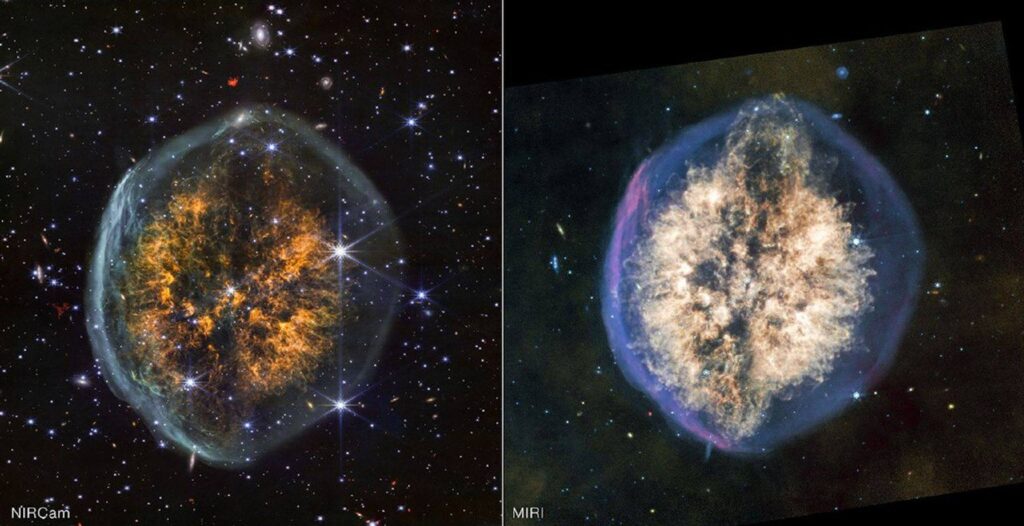
WASHINGTON, June 7 — The James Webb Space Telescope has delivered its most detailed observations yet of the planetary nebula designated PMR 1, commonly known as the Cranium nebula due to its striking resemblance to a human brain encased within a transparent skull. These newly released images, captured in near- and mid-infrared wavelengths, reveal features that were previously beyond the reach of earlier instruments.
Planetary nebulas form when a dying star exhausts the nuclear fuel in its core, ejecting an expanding shell of ionized gas and dust into space. The Cranium nebula stands out as a particularly vivid example of this phenomenon. A dark band cuts vertically through its center, splitting the structure into two distinct lobes that mirror the hemispheres of a brain.
The central star of this nebula is several times more massive than the Sun and is estimated to be only a few thousand years away from its demise. At that point, it will either collapse into a white dwarf or explode as a supernova. This impending transformation is what makes the Cranium nebula a subject of intense scientific interest, as it offers a window into the final chapters of stellar evolution.
First detected by the Spitzer Space Telescope in 2013, the Cranium nebula now displays details that were invisible in earlier observations. The advanced capabilities of the James Webb Space Telescope have enabled astronomers to examine the nebula’s structure with unprecedented clarity. Scientists believe the nebula’s distinctive shape is sculpted by twin polar jets blasting outward from the central star, though the exact mechanisms driving this process remain poorly understood.
The new data are expected to provide fresh insights into the forces that shape planetary nebulas. By analyzing the intricate patterns of gas and dust revealed in these images, researchers hope to deepen their understanding of how dying stars influence their surroundings during their final stages.
As the James Webb Space Telescope continues its mission to explore the cosmos, it is anticipated to uncover further secrets about the life cycles of stars and the formation of galaxies. The release of these images marks a significant advancement in the study of planetary nebulas and underscores the role of cutting-edge technology in expanding humanity’s knowledge of the universe. With Webb leading the way, the future of space exploration holds promise for many more discoveries about the mysteries that lie beyond Earth.




