
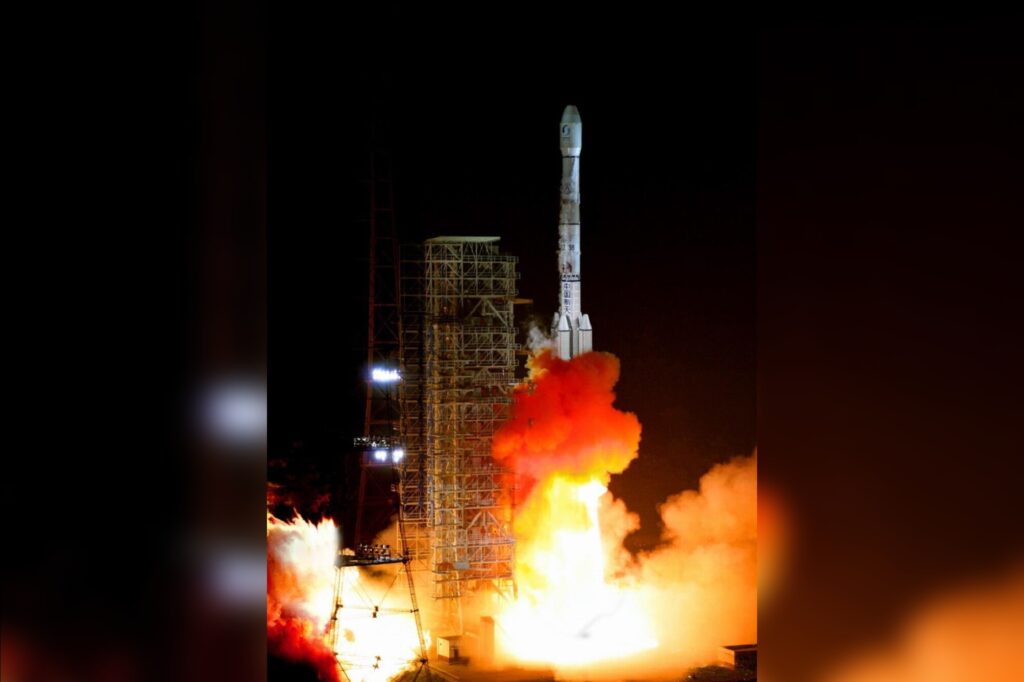
China has become the second nation to successfully land a reusable orbital-class rocket booster on a maritime platform, a feat previously accomplished only by the United States through SpaceX. The landing, conducted on a barge positioned in the South China Sea, marks a significant step in Beijing’s long-standing effort to reduce launch costs and increase flight cadence through vertical takeoff and vertical landing (VTVL) technology.
The booster that executed the landing is a stage of the Long March 10B, a variant of China’s next-generation crew-rated launch vehicle. During its descent, the rocket employed grid fins—aerodynamic surfaces that steer the stage during high-speed flight—and throttleable YF-100K engines capable of reducing thrust to approximately 40 percent of maximum. This throttling ability allows for controlled deceleration as the booster approaches its landing target.
The landing sequence itself follows a now-familiar choreography: after stage separation, the booster performs a boostback burn to reverse its trajectory, a reentry burn to slow its fall through the atmosphere, and finally a landing burn just before touchdown. Landing legs deploy to absorb the impact.
Officials confirmed the sequence is similar to that used by the Falcon 9 rocket built by SpaceX, which first achieved a successful landing in December 2015. The technology underlying the landing requires precise GPS and inertial navigation, as well as real-time computer control to manage the split-second adjustments needed during descent. The choice of a barge in the South China Sea as the landing platform reflects both operational necessity and strategic geography, giving China a domestic recovery site within its claimed waters.
For observers of the region’s space programs, the development carries historical weight: China has long pursued independent access to space, and reusable rocket technology has been a stated goal for its aerospace establishment for years. The ability to recover and reuse boosters is widely seen as the key to reducing launch costs and increasing flight cadence, making space more accessible for both government and commercial missions.
Technical Achievement and Global Context
The success adds a second nation to what had been a club of one. The United States, through SpaceX, has been landing Falcon 9 boosters since 2015 and has since expanded that capability to the larger Falcon Heavy.
China’s entry into this small group signals that the technological gap in reusable rocketry is narrowing. SpaceX, an American aerospace company founded in 2002, pioneered the operational use of VTVL for orbital-class boosters. The company began with early setbacks—including three failed launches of its first rocket, the Falcon 1—before achieving orbit in 2008.
It then developed the Falcon 9, which became the first privately built liquid-fueled rocket to reach orbit and later the first to deliver cargo to the International Space Station under NASA contracts. SpaceX is a private enterprise that designs, manufactures, and operates advanced rockets and spacecraft.
Its work in reusable launch vehicles marked a major shift in how rockets could be recovered and reused rather than discarded after a single flight. The concept of VTVL dates back to early space programs, including the Apollo Lunar Module, but SpaceX adapted it for large, orbital-class boosters. This approach was first tested in the 1990s with smaller demonstrators before SpaceX scaled it up for operational use.
The company’s success with reusable rockets has influenced global spaceflight, pushing other nations to pursue similar capabilities.
Implications for China’s Human Spaceflight Program
What remains to be seen is how quickly China will move from this test to operational reuse. The Long March 10B is designed for crewed missions, and its reusability could reshape the economics of China’s human spaceflight program.
Reusable rocket technology reduces the cost of access to space by allowing the same hardware to fly multiple missions. As more countries and companies adopt these methods, the competitive and strategic implications for space exploration and satellite deployment continue to grow. For now, the landing in the South China Sea stands as a confirmed milestone in the country’s ascent in orbital rocketry.
The achievement places China in a select group of nations capable of recovering and reusing orbital-class boosters, a capability that both lowers costs and increases the tempo of launches. With the United States already demonstrating this technology for nearly a decade, the successful test signals that the global landscape of space access is evolving, with China emerging as a key player in the drive toward cost-efficient, reusable launch systems.




