
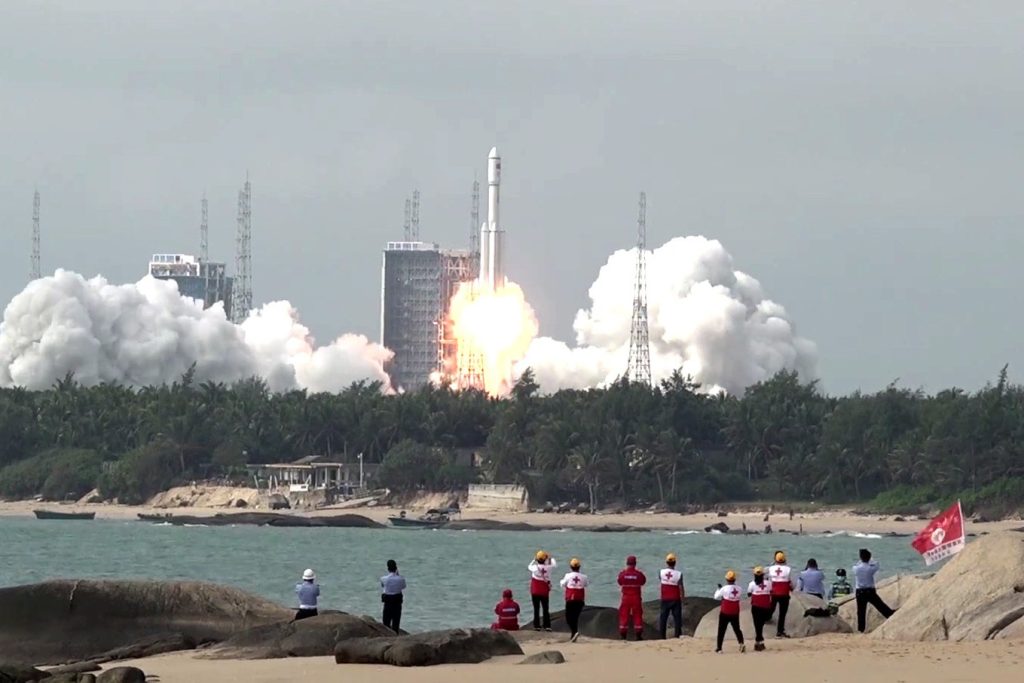
WENCHANG, July 10 — The story begins not with a dramatic explosion or a triumphant flag-planting, but with a controlled descent over the South China Sea. On July 12, 2024, nearly two years ago to the day, China’s space program achieved something it had never done before: it brought a liquid-fueled rocket booster home. For those involved at the China Aerospace Science and Technology Corporation (CASC), what unfolded that morning at the Wenchang Space Launch Site on Hainan island was a quiet revolution.
At 9:00 a.m. local time, the Long March 10B rocket lifted off on its maiden flight. Approximately ten minutes later, its first stage performed a controlled vertical landing at a designated recovery zone in the sea.
The booster did not crash. It did not burn up. It landed.
That single act places China in a very small club. SpaceX first landed a Falcon 9 booster in December 2015.
Blue Origin’s New Shepard achieved its first landing the month before, in November 2015. Now, with this test flight, China has joined those ranks. The Long March 10B is a two-stage-to-orbit vehicle, designed to carry up to 27 metric tons to low Earth orbit.
At its heart, it is a machine built for people: crewed missions to China’s Tiangong space station, and, eventually, lunar flights. The rocket burns a new engine, the YF-100K, which uses kerosene and liquid oxygen. It can be throttled and reignited, which is what made that controlled landing possible.
The test flight carried no payload, but it collected extensive telemetry data. For CASC officials, the numbers tell a compelling story.
They project that the successful recovery could reduce launch costs by up to 80% per flight.
The economics of reuse
That cost reduction matters. The global commercial launch market was valued at $12.4 billion in 2023. China has long been a player in that market, but mostly with expendable rockets.
Reusable technology changes the calculus. It positions China to compete more directly with American and European launch providers, at a time when the market is growing and the demand for satellite deployment, space station resupply, and deep-space missions is accelerating.
For the engineers at CASC, the July 2024 test was proof of concept. The booster landed in the sea, not on a drone ship or a landing pad, but the controlled descent and vertical landing demonstrated that the YF-100K engine could handle the throttling and reignition required. The recovery zone was designated in advance, and the telemetry data confirmed that the trajectory, the burn, and the landing sequence all performed as intended.
China now plans to conduct at least three more recovery tests before attempting a crewed launch with a reusable booster. That crewed flight is currently scheduled for 2026.
The timeline is ambitious. The stakes are high.
What comes next
The Long March 10B is not just a rocket. It is a statement of intent. China’s space station, Tiangong, is operational.
The country has landed rovers on the Moon and Mars. Now, it is building the infrastructure for reusability, which is the key to lowering costs and increasing launch frequency.
For the astronauts who will one day ride this rocket to orbit, the successful recovery of that first stage means that the path to space is becoming more routine, more reliable, and more affordable. The test flight in July 2024 was a single step, but it was a large one.
For the engineers who watched that booster settle onto the water, for the mission controllers who monitored every data stream, and for the industry analysts who track the shifting balance of space power, what unfolded that morning was a clear signal. China is no longer just a participant in the reusable rocket race.
It is a contender.




