
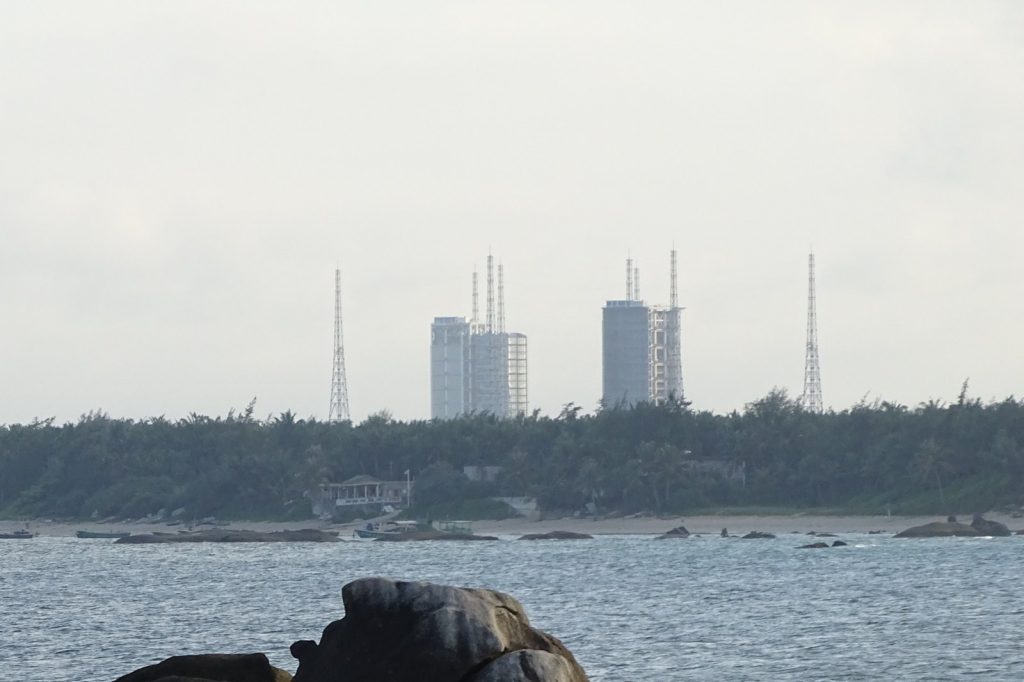
WENCHANG, July 10 — For all the noise surrounding China’s space ambitions, the salient point is that its only coastal launch site has a director who has been quietly overseeing an expansion of capabilities. Li Hong, a senior colonel in the People’s Liberation Army, has managed over 30 launches from the Wenchang Space Launch Site on Hainan Island since becoming its director in 2019. The site, which became operational in 2014, hosted the maiden flight of the Long March 10B on June 23, 2024.
Li was born in 1968 in Hainan province and graduated from the Harbin Institute of Technology in 1990 with a degree in mechanical engineering. He joined the PLA Strategic Support Force that same year, the branch that oversees China’s space launch facilities.
He was appointed deputy director of Wenchang in 2014, when the site first became operational, and took over as director in 2019. The Wenchang site covers 20 square kilometers and includes two launch pads, a mission control center, and a rocket assembly building. Its location at 19.6°N latitude provides advantages for geostationary launches, given its proximity to the equator.
It remains China’s only coastal launch facility. Under Li’s tenure, notable missions have included the Long March 5, which launched the Chang’e-5 lunar sample return mission in 2020, and the Long March 7, which launched Tianzhou cargo spacecraft.
He oversaw the construction of a new landing pad for reusable rockets, completed in 2023, and the modification of the drone ship ‘Bohai Bay’ for recovery operations. Li has received multiple commendations for his work.
A coastal advantage
The site’s coastal position is not merely geographic trivia. Launching closer to the equator gives rockets a greater share of the Earth’s rotational speed, which can increase payload capacity for geostationary orbits. It also means spent rocket stages fall over the South China Sea rather than over populated areas, a practical consideration that simplifies range safety.
The new landing pad and the refitted drone ship point to a shift toward reusable rocket technology, a domain where China has been playing catch-up with Western private companies. The modifications to the ‘Bohai Bay’ suggest sea-based recovery of rocket stages is part of the plan.
A military career in space
Li’s career path is notably tied to the PLA. After joining the Strategic Support Force in 1990, he worked his way up through the ranks of China’s military space establishment. The Strategic Support Force, created in 2015, consolidates China’s space, cyber, electronic warfare, and psychological operations under a single command.
It oversees the country’s space launch facilities, including Wenchang. Li’s rank of senior colonel places him in the upper tier of PLA officers.
His appointment as director of Wenchang in 2019 came as China accelerated its launch cadence, with the site handling an increasing number of missions for both civilian and military payloads. The Long March 10B maiden flight in June 2024 was a notable milestone, though the rocket’s intended role and payload capacity remain subjects of external analysis.
Looking ahead
With over 30 launches under his management and infrastructure upgrades now in place, Li’s Wenchang appears positioned for a higher tempo of operations. The landing pad and drone ship modifications suggest China intends to recover and reuse rocket hardware, a practice that would reduce costs and increase launch frequency. Whether the site will host crewed missions or larger heavy-lift vehicles remains to be seen, but the physical plant and the personnel are now in place for an expanded role.




