
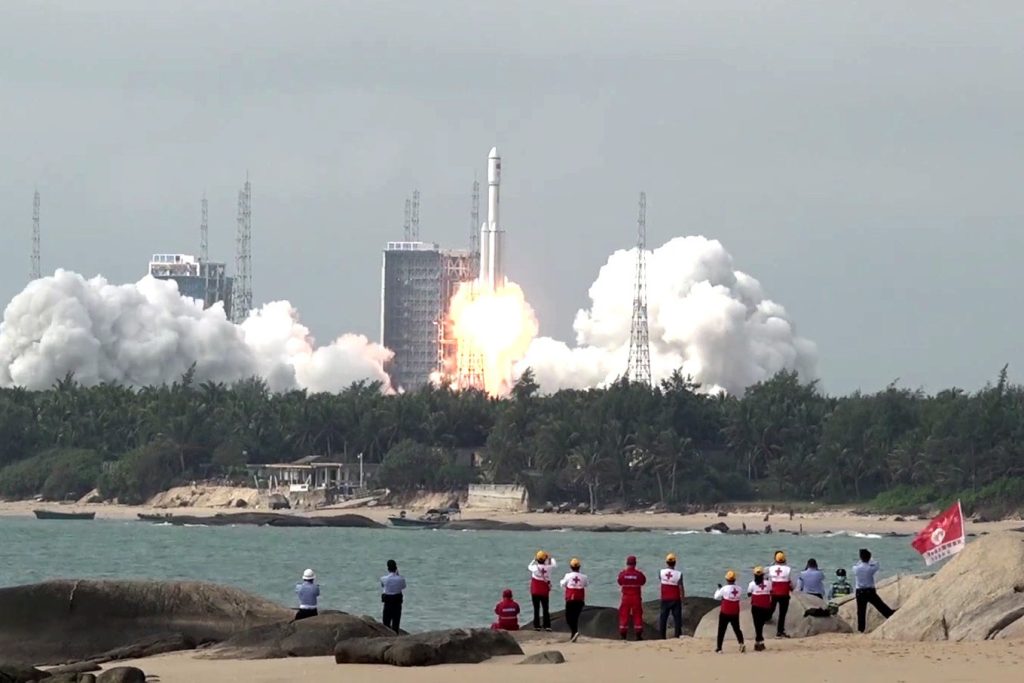
BEIJING, July 10 — The successful maiden flight of China’s Long March 10B rocket carries implications that extend well beyond Beijing’s space ambitions, landing directly in the competitive landscape that India and other Asian spacefaring nations now navigate. The rocket, developed by the state-owned China Aerospace Science and Technology Corporation (CASC), lifted off from the Wenchang Space Launch Site in Hainan Province. The coastal facility, which opened in 2014, is China’s only launch site with direct ocean access.
According to officials, the recovery zone for the rocket’s first stage was located in the South China Sea, approximately 200 kilometers from the launch site. For observers in New Delhi and across Asia, the flight marks a significant operational milestone.
CASC is China’s primary space contractor, employing over 170,000 people. The corporation is responsible for the Long March rocket family, the Shenzhou crewed spacecraft, the Tiangong space station, and the Chang’e lunar missions. Its annual revenue in 2023 was approximately $45 billion, with a substantial portion allocated to space programs.
The Technical Architecture
The Long March 10 series is designed under the direction of chief designer Li Dong, a senior engineer at CASC’s China Academy of Launch Vehicle Technology (CALT). The rocket’s propulsion system was developed by the Academy of Aerospace Propulsion Technology (AAPT), which designed the YF-100K engine. The YF-100K is a variant of the YF-100, delivering a thrust of 120 tons.
The landing guidance system was developed by the Beijing Institute of Control Engineering. Analysts note that the recovery of the first stage in the South China Sea signals China’s growing confidence in reusable rocket technology, a domain where U.S. private companies like SpaceX have long held a lead.
CASC was founded in 1999 and is headquartered in Beijing. It remains China’s sole primary space contractor, a position that gives the state direct control over the country’s orbital launch capacity and deep-space exploration programs.
Market and Regional Implications
For India, which operates its own robust space program through the Indian Space Research Organisation (ISRO), the Long March 10B’s debut adds pressure on the commercial launch market. ISRO’s workhorse rockets, including the Polar Satellite Launch Vehicle (PSLV) and the Geosynchronous Satellite Launch Vehicle (GSLV), compete for international satellite contracts. A reusable Chinese launcher with a 120-ton-thrust engine could undercut pricing in a market where cost per kilogram to orbit remains the decisive factor.
Across Asia, space agencies and private launch firms in Japan, South Korea, and Southeast Asia are watching the same trajectory. Japan’s H3 rocket, developed by Mitsubishi Heavy Industries, and South Korea’s Nuri program both target medium-to-heavy lift capability.
The Long March 10B’s successful flight suggests China is moving toward operational reusability faster than some regional competitors anticipated. The South China Sea recovery zone also carries geopolitical weight. The area has been a flashpoint for territorial disputes involving China, Vietnam, the Philippines, Malaysia, and Brunei.
A permanent recovery infrastructure in those waters could give China a sustained naval and logistical presence tied directly to its space program.
What to Watch Next
The next milestones for the Long March 10 series will likely involve crew-rating the vehicle for human spaceflight and demonstrating multiple reuse cycles. CASC has not disclosed a timeline for commercial service. For India and its Asian neighbors, the pace of that transition will determine how quickly the competitive dynamics in the regional launch market shift.




