
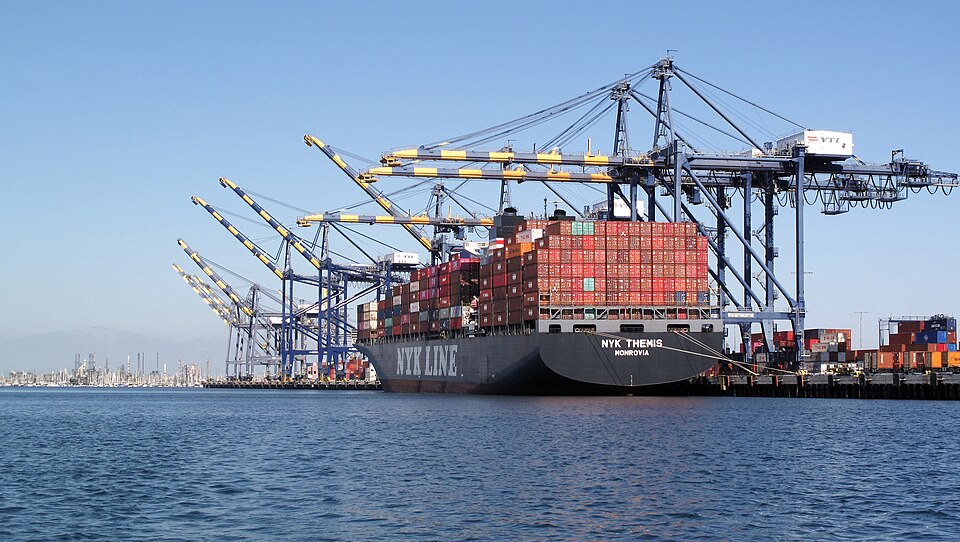
Container ships carry an estimated $14 trillion worth of goods, and the sea accounts for more than 80% of world merchandise trade by volume. Those are the opening numbers in a whitepaper from DP World, “Navigating the Future of Maritime Trade,” which Food Business Middle East reported on September 28, 2026. The port operator’s argument: trade is moving away from single-route, cost-first supply chains and toward resilient, linked networks, with the Gulf in the middle of that shift.
Corridors instead of lanes
DP World describes a Middle East that acts as an interconnector between Asia, Africa and Europe. The paper calls the model “Connected Trade Corridors,” a mix of deep-sea shipping, shortsea feeder services, ports, inland transport and digital tools.
It gives a UAE example. In 2026 DP World activated Khorfakkan and Fujairah as alternative gateways while keeping Jebel Ali as its main commercial and customs hub. Inland bonded transport, better rail links and a regional trucking fleet enlarged by 700 vehicles back the arrangement. The trucks add capacity for up to 35,000 more trips a month.
Other corridors the report lists run from Jeddah to the GCC, from Asia to the GCC through Oman, and from Europe to the Gulf via Türkiye.
South-South trade
The whitepaper leans on UNCTAD estimates. Merchandise exports among developing economies rose from about $0.5 trillion in 1995 to $6.8 trillion in 2025, and about 57% of developing-country exports now go to other developing markets. Chinese exports to Africa came to $225 billion in 2025, against $123 billion in imports from the continent. Tariff-free market access covers 53 African nations.
Executives and AI
The report also cites DP World’s Global Trade Observatory. According to that research, 95% of supply chain and logistics executives use artificial intelligence somewhere in their operations. Asked why they are rethinking routes, executives named better transport connectivity (36%), improved customs procedures (35%) and avoiding geopolitical chokepoints (27%).
Digital platforms such as the India-UAE MAITRI platform and the Virtual Trade Corridor are laying groundwork for data exchange along the India-Middle East-Europe Economic Corridor.
Of more than 3,500 executives surveyed for DP World’s 2026 Global Trade Observatory Annual Outlook Report, 94% expect trade growth this year to match or beat 2025.




