
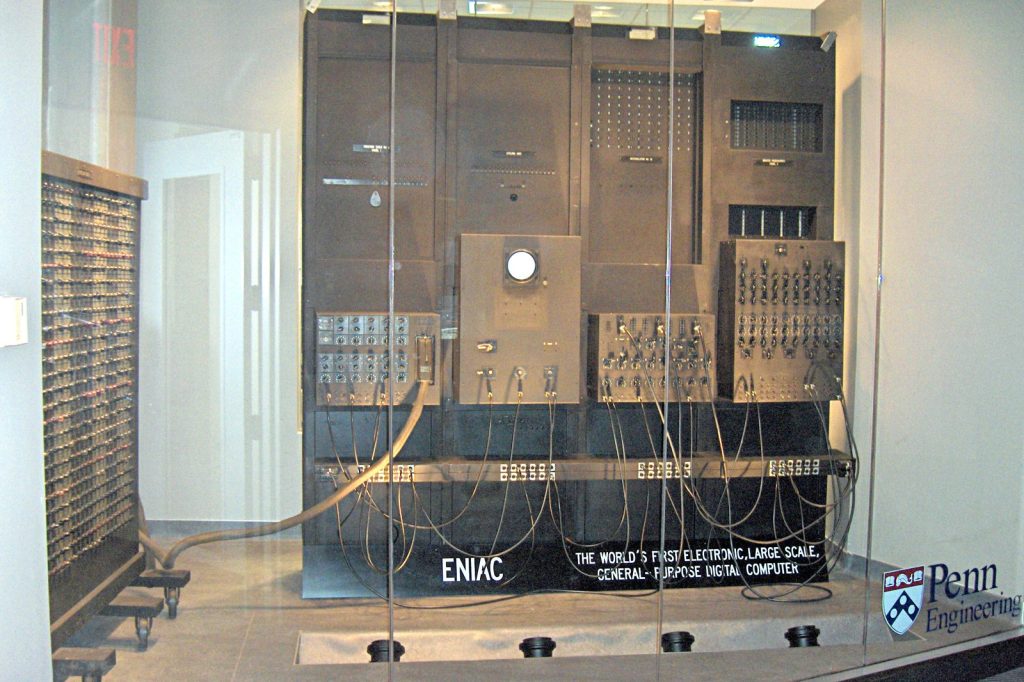
The record begins with a date: February 14, 1946, when the Electronic Numerical Integrator and Computer was unveiled at the Moore School of Electrical Engineering in Philadelphia. The New York Times called it “an amazing machine which applies electronic speeds for the first time to mathematical tasks hitherto too difficult and cumbersome for solution”. On the timeline of computing, nothing general-purpose and electronic had existed before it.
The machine was born of a wartime backlog. At Penn, a Differential Analyser was run by secret human “computors”, women employed to grind out ballistics calculations for the Army, and the queue of firing tables kept growing. John Mauchly, a physics professor who arrived via a war-training course, and J. Presper Eckert, the Penn graduate hired to run its laboratory, shared an interest in speed. In August 1942 Mauchly wrote a confidential memorandum on “The Use of High Speed Vacuum Tube Devices for Calculating”, and in April 1943 the pair proposed the machine to the Army’s Ballistic Research Laboratory at the Aberdeen Proving Ground. Construction began on May 31, 1943. For security, the Army let stand the rumor that the project was a “white elephant”.
What emerged was less a computer than a roomful of one. The finished ENIAC filled a space 30 by 50 feet, its 40 panels set in a U-shape 80 feet long, and weighed 30 tons. Its 18,000 vacuum tubes, more than 20 times the electronics carried aboard a wartime B-29 bomber, ran on 150 kilowatts of electricity from dedicated power lines; Eckert coaxed reliability out of them by holding the tubes to one-quarter of their rated power. Behind the panels sat 70,000 resistors, 10,000 capacitors and half a million soldered joints. A firing-table problem that occupied a human calculator for 12 hours finished in 30 seconds, a factor of 1,440.
The record shows who actually ran it. A team of six women programmed and operated the machine, and two of them built the demonstration that wowed the press at the unveiling. The coverage of the day photographed only men; the “ENIAC Six” were restored to the record decades later and were honored in 1997 with induction into a hall of fame for women in technology.
The paper trail is precise. The paper trail is precise: on November 30, 1945 came the first confidential report on the completed machine, written by Eckert and Mauchly with John Brainerd and Herman Goldstine, titled “Description of the ENIAC and Comments on Electronic Digital Computing Machines”, 91 restricted copies for military and research offices. From May 1945 until June 1948 no other electronic general-purpose digital computer was working anywhere in the world, and none arrived until the Manchester “Baby” prototype switched on. Shipped to Aberdeen, it produced firing tables and then weather prediction, atomic-energy calculations and cosmic-ray studies, wind-tunnel design; no electronic computer touched a commercial problem until about 1951. In 1947 it was rewired into an elementary stored-program machine, the direction computing took next.
The service record closed on the night of October 2, 1955, at 11:45 p.m., when power to the ENIAC was cut for the last time after roughly ten years of continuous operation. One estimate from the record: in that decade the single machine did more computation than the entire human race had managed before its invention. Four of its original 40 panels sit today on the Penn campus, in a ground-floor room of the Moore School, about one-tenth of the machine, where students now work at its descendants.




