
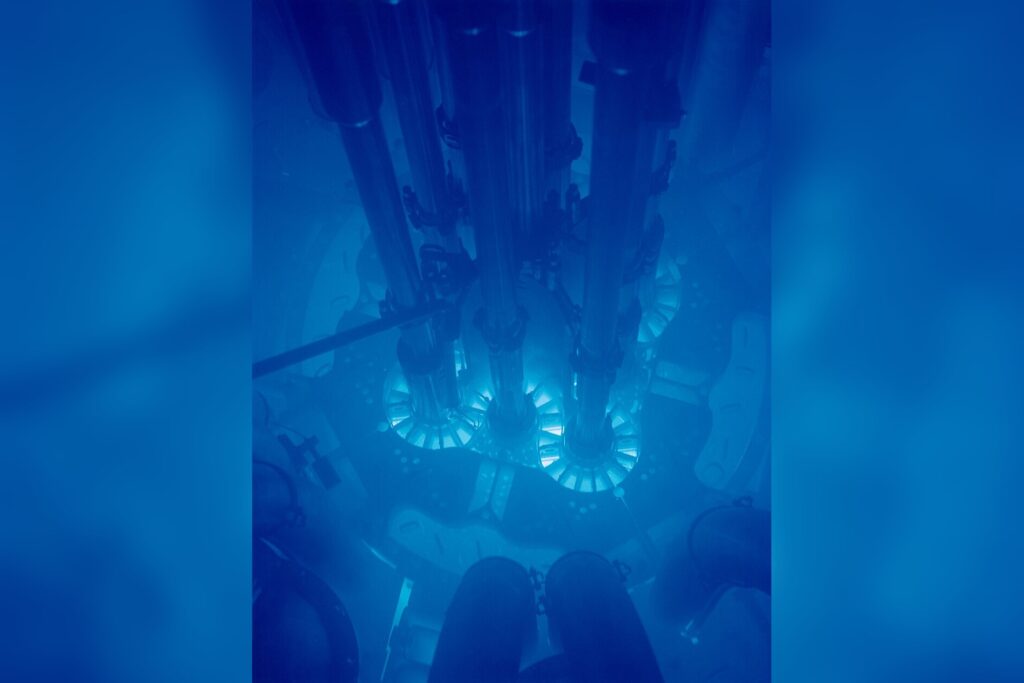
“This is a great day.” Energy Secretary Jennifer Granholm said that at a Washington news conference on Tuesday, December 13, 2022, as the Department of Energy announced that scientists at Lawrence Livermore National Laboratory in California had made a fusion reaction release more energy than the lasers put in. She said the result “will go down in the history books.” ABC News carried the report.
The shot
The experiment ran on December 5 at the National Ignition Facility, which ABC described as the world’s largest laser system. Its 192 lasers fired at a container holding a fuel pellet the size of a peppercorn, made of deuterium and tritium, both isotopes of hydrogen. The lasers delivered 2.05 megajoules of energy to the container. The pellet briefly heated to over 3 million degrees Celsius, conditions like those inside a star, and the reaction gave back 3.15 megajoules.
That gap is why the experiment is being called a success. Producing more energy than went in shows the approach could, in principle, become a power source if it can be scaled up and made far more efficient outside a lab. The lab’s director, Kim Budil, joked that the letters LLNL stand for “lasers, lasers, nothing but lasers.”
The catch
The lasers themselves needed 300 megajoules to run, a figure Budil attributed partly to their older technology. So the accounting counts only the energy that reached the target, not the energy drawn from the grid. The team believes better lasers could yield much more power, but that would take decades more research and significant private investment.
Granholm said crossing the threshold “demonstrates it can be done” and lets researchers work on more efficient lasers and better containment capsules, the things needed to modularize the technology and take it to commercial scale. Officials stressed that the work also serves national security. The reaction is a controlled version of what happens in nuclear weapons, so it could help the government study deterrents without real-world weapons testing.
Paul Dabbar, a visiting fellow at Columbia University and a former Energy Department undersecretary for science, told ABC News the basic physics has been understood for decades. The obstacle was keeping the reaction going, which takes tremendous heat and pressure. He said the hardest step is behind, but a lot remains: scientists must work out how to contain and sustain the reaction outside a lab, and design a plant that can withstand that heat and last at least 10 or 20 years.
If that works, Dabbar said, a single fusion plant could produce large amounts of power with no carbon, no air pollution and very little waste compared with today’s nuclear plants. The fuel, hydrogen, is abundant. The announcement came with a clear caveat: the technology is still decades away from large-scale use.
Sources
- Scientific 'breakthrough' in nuclear fusion could launch new era of clean energy – 6abc Philadelphia




