
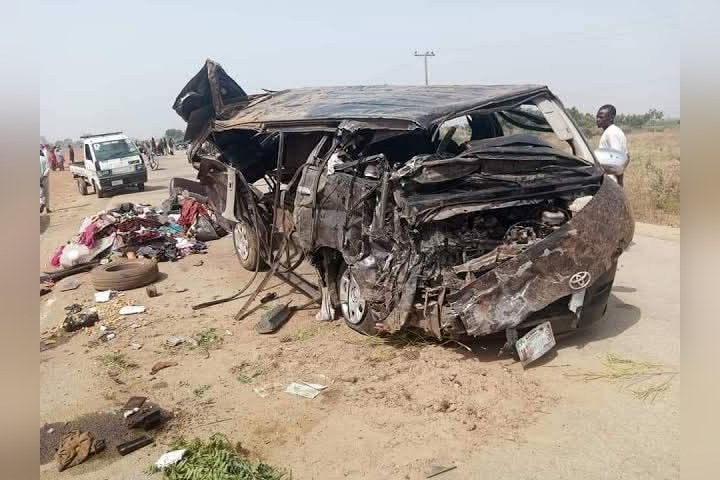
Gezawa, Kano State — The death toll from the February 8 highway crash here has surpassed 30, with many more injured. But the numbers alone don’t capture what this means for a Local Government Area of 282,069 people, where every ward — from Jogana to Tsamiya-Babba — now knows someone lost or hurt. The accident happened on a road that serves eleven wards.
Those wards are not abstract administrative units. They are Jogana, Gezawa, Mesar-Tudu, Gawo, Zango, Danzaki, Tumbau, Wangara, Sararin-Gezawa, Babawa, Ketawa, and Tsamiya-Babba.
Each has a council member. Each now has families waiting for news that may not come. What is at stake is basic: the ability to travel without dying.
In a region where the Hausa and Fulani are the majority, and Fulfulde and Hausa are the languages of daily life, the road is how people reach markets, schools, clinics. When that road becomes a death trap, the whole community is trapped with it.
The Gezawa government council heads public administration here. It will face questions — hard ones — about what was done before this crash and what will be done now. The council oversees 340 square kilometers of territory.
That is not a small area to patrol or maintain. But the question is whether the roads were safe enough, and whether the council knew they were not. More than 30 dead.
That is not a statistic. It is multiple generations of families erased in a single moment.
It is breadwinners, mothers, children gone. The injured face a different kind of loss — months of recovery, medical bills, lost income. For a community that is predominantly Muslim, burial rites and mourning will stretch across all eleven wards.
The focus now is on aid. The families of the victims and the injured need support.
That means money, medical care, food, shelter. It also means someone to tell them what happened and why. That is the council’s job.
It is also the job of state and federal authorities who set road safety standards. This crash did not happen in a vacuum. Road accidents in Nigeria are frequent and deadly.
What makes this one different is the scale — more than 30 dead — and the location. Gezawa is not a major city.
It is a Local Government Area with a population that, even in the 2006 census, was under 300,000. The town of Gezawa itself is the administrative headquarters. It is not built for mass casualty events.
The wards will all be affected. That is not speculation.
When a crash kills more than 30 people in a community of this size, the social fabric tears. Every ward loses someone. Every council member has constituents who are grieving or hospitalized.
The healing will take years, and it will require resources the local government may not have. Road safety measures are the obvious answer. Better signage, speed bumps, enforcement of traffic laws, vehicle inspections.
But those measures cost money. They require political will.
They require the council to prioritize prevention over reaction. Whether that happens remains to be seen. For now, the people of Gezawa are left with the aftermath.
The dead are being buried. The injured are being treated.
The families are asking questions. The council is under pressure. And the road is still there, waiting for the next traveler.




