
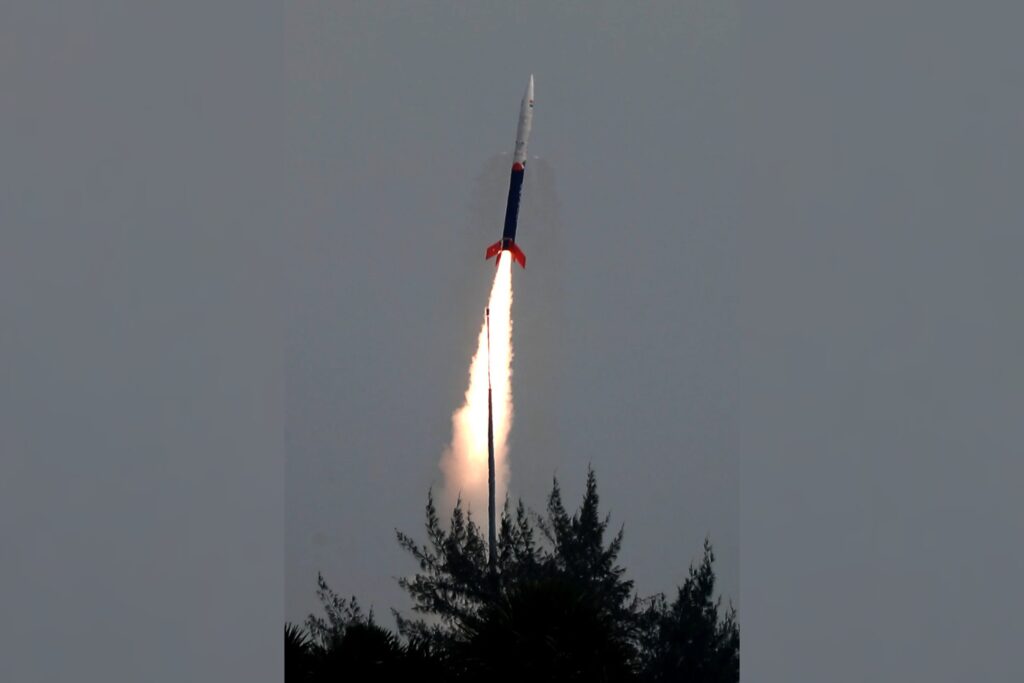
HYDERABAD, July 17 — India’s private space sector is set to cross a critical threshold tomorrow. Skyroot Aerospace, the Hyderabad-based startup, will launch its Vikram-1 rocket on July 18, carrying a commercial payload and marking the country’s first private orbital launch. For India, the event signals a shift from state monopoly to private enterprise in a market that is itself accelerating.
According to industry projections, the global small satellite launch market is expected to grow from $3.5 billion in 2024 to $7.5 billion by 2030. The demand is being driven by Earth observation, communications, and scientific missions.
The competitive field
Vikram-1 enters a crowded but evolving field. Its competitors include Rocket Lab’s Electron, which can carry up to 300 kg to low Earth orbit (LEO), and Astra’s Rocket 3, which can lift up to 150 kg to LEO. Virgin Orbit’s LauncherOne, which had a 500 kg capacity, ceased operations in 2023, removing one player from the market.
Skyroot is positioning on price. The company aims to offer launches at under $10 million per mission, a figure that undercuts some competitors.
The company has signed agreements with international customers, though specific contracts have not been publicly detailed.
What the Vikram-1 launch means
The July 18 launch will carry a commercial payload, marking India’s entry into the private orbital launch market. The mission is the culmination of years of development and follows a suborbital test flight in 2022. For India, the stakes extend beyond one company.
The Indian Space Research Organisation (ISRO) has long dominated the country’s launch sector, but the government has been actively opening the door to private players.
Asia’s small satellite calculus
The market projection — from $3.5 billion to $7.5 billion by 2030 — is not just a global number. Asian operators are significant contributors. Earth observation constellations for agriculture, disaster monitoring, and urban planning are being developed by Indian, Chinese, Japanese, and Southeast Asian firms.
Communications satellites for remote connectivity are in demand across the Pacific island states and the Himalayas. Launch availability has been the bottleneck.
Rideshare missions on larger rockets impose schedule and orbit constraints. Dedicated small launchers offer flexibility, but until now, Asian customers have had limited options. Rocket Lab launches from New Zealand and the United States.
Astra launches from the U.S. Virgin Orbit is gone. A reliable Indian option, at lower cost, changes the arithmetic.
The July 18 flight is therefore being watched closely by more than just space enthusiasts. It is a business event — a test of whether India can become a cost-effective hub for small satellite launch, and whether Skyroot can deliver on its promises. Tomorrow’s launch will carry the weight of that expectation.
The payload is commercial. The market is growing. And for the first time, a private Indian rocket will attempt to put it all into orbit.




