
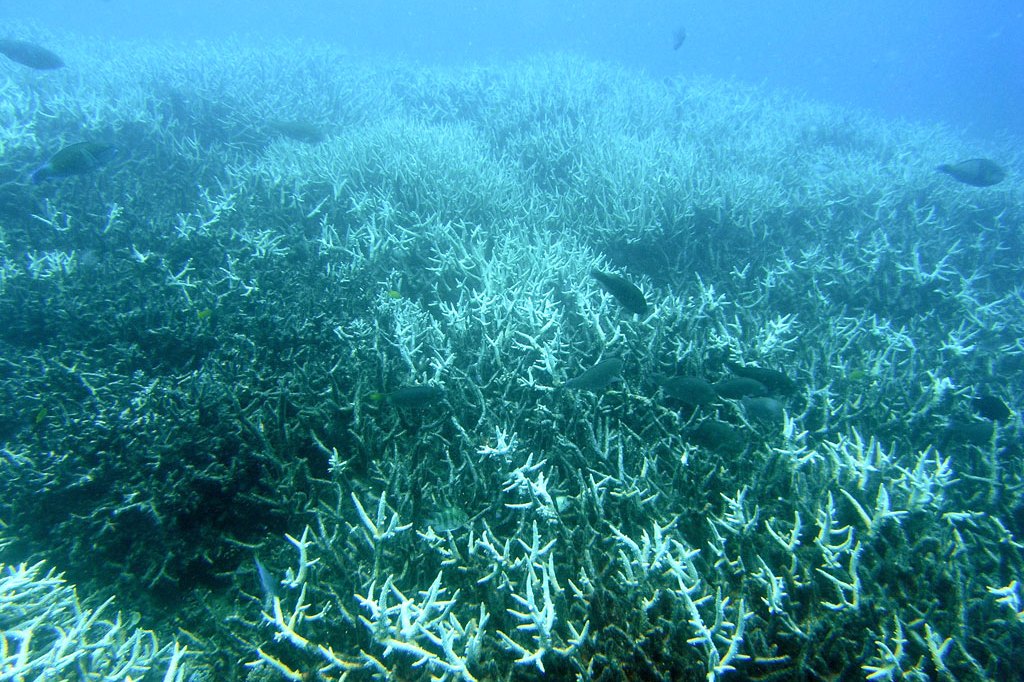
Scientists have measured sea‑surface temperatures surrounding the Great Barrier Reef at levels not seen in the past 400 years, according to data compiled in Queensland. The figures are not forecasts but actual observations, and they illustrate a cumulative heat stress that is now overwhelming the world’s largest coral system.
The reef stretches over 2,300 km, comprises roughly 2,900 individual reefs and includes about 900 islands. Its vastness does not protect it from a step‑by‑step breakdown. When water temperatures rise beyond a narrow tolerance, the symbiotic algae that live inside coral polyps are expelled.
The loss of these algae—responsible for the reef’s colour and most of its energy—causes the corals to bleach, turning white. Prolonged exposure to the elevated heat starves the corals, leading to death and the loss of habitat for fish, crustaceans and the broader food web.
Dr Emma Kennedy, a coral‑reef specialist, has described the present situation as a “major concern.” While the reef has survived natural climate fluctuations for millennia, it now faces a human‑induced warming pulse that leaves little recovery time between bleaching episodes. Dr David Wachenfeld, chief scientist for the Great Barrier Reef Marine Park Authority, stresses the reef’s value for scientific research, yet acknowledges that the ecosystem is deteriorating even as it is studied. Because the reef’s structure results from billions of tiny coral polyps and supports an intricate array of species, it is difficult to model and even harder to restore.
Replanting a 2,300‑km‑long ecosystem is not a practical solution. Researchers are exploring several mitigation ideas, including breeding heat‑tolerant coral strains, deploying shading or localized cooling techniques, and hoping for a series of cooler years.
To date, none of these approaches have succeeded on a scale large enough to reverse the trend. Coral‑reef biologist Dr Ruth Gates has expressed optimism that recovery remains possible if research and conservation efforts continue. While hope is a necessary component, experts agree that concrete plans are required to address the ongoing heat increase that drives bleaching.
The reef’s location in the Coral Sea off Queensland subjects it to the same oceanic physics as reefs worldwide; temperature is the primary driver of stress. The 400‑year temperature record functions as a warning that has been flashing for decades and is now red.
Although the reef’s sheer size—longer than the distance from London to Moscow—has historically offered a degree of resilience, each bleaching event erodes that mass, killing coral and weakening the remaining structure. Recovery can take years, but the intervals between bleaching incidents are shrinking. If sea temperatures continue to stay high, scientists predict a fundamental ecological shift: coral‑dominated habitats could be replaced by algae‑dominated ones, fish populations would decline sharply, and the tourism industry that depends on the reef’s vibrant appearance would suffer.
The scientific consensus is clear on the direction of change; uncertainty remains only around the speed at which it will occur. The Great Barrier Reef is not a single organism but a federation of billions of tiny animals, each vulnerable to heat.
Their loss means the collapse of the massive structure they collectively build. At present, the reef sits at a 400‑year temperature high with no indication of cooling in the near future.




