
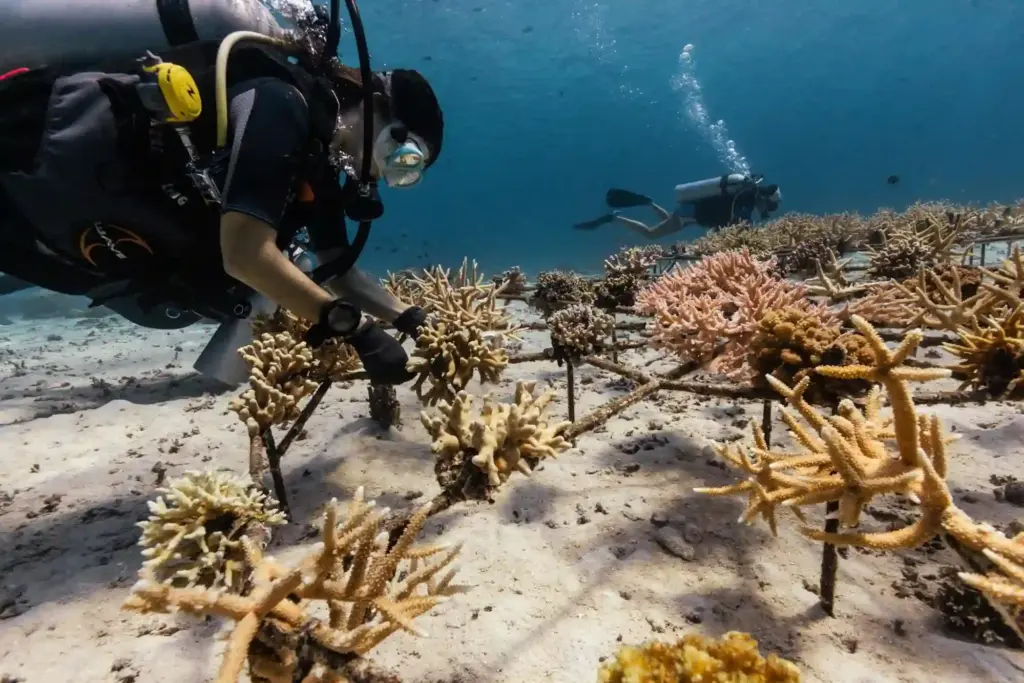
Almaty, October 7 — Coral reef restoration strategies are gaining traction globally as a combination of marine protected areas, assisted evolution techniques, and community-led monitoring seeks to counter widespread coral loss driven by ocean warming and acidification. According to the Intergovernmental Panel on Climate Change Sixth Assessment Report published in 2022, approximately 70 to 90 percent of warm-water coral reefs are projected to be lost even if global warming is limited to 1.5°C above pre-industrial levels, with near-total loss likely at 2°C.
In response, scientists and conservation groups have expanded marine protected areas, which now cover over 8 percent of the global ocean as of 2023, according to the UN Environment Programme World Conservation Monitoring Centre. Notable expansions include the Papahānaumokuākea Marine National Monument in the Pacific, which was expanded in 2016 to 582,578 square miles — about 1.5 million square kilometers — making it one of the largest marine protected areas in the world.
Assisted evolution techniques are being tested in locations like Hawaii and Australia’s Great Barrier Reef. Researchers at the Australian Institute of Marine Science have identified coral strains capable of surviving temperatures up to 31°C, compared to the typical bleaching threshold of 29–30°C. These techniques include selective breeding for heat tolerance and algal symbiont manipulation, aiming to enhance coral resilience under rising sea temperatures.
Community-led monitoring programs are active in Indonesia, the Philippines, and Fiji, training local fishers and residents to conduct regular reef surveys using standardized methods like Reef Check. In Fiji, over 400 locally managed marine areas cover approximately 12,000 square kilometers of coastal waters as of 2021, according to the Fiji Locally Managed Marine Area Network.
These programs contribute data to national databases and inform adaptive management decisions at the local and national levels. Healthy coral reefs provide significant economic value, estimated at $36 billion annually in ecosystem services globally, according to the Coral Reef Alliance. This includes shoreline protection valued at over $10,000 per hectare per year in storm-prone regions, underscoring the role of reefs in coastal defense and fisheries sustainability.
The integrated approach — combining spatial protection, biological innovation, and grassroots engagement — aims to preserve biodiversity while sustaining livelihoods dependent on reef ecosystems. Looking ahead, scaling these efforts will depend on funding, policy support, and continued collaboration between scientists, governments, and coastal communities. Monitoring outcomes from assisted evolution trials and locally managed areas will be critical in determining long-term effectiveness.




