
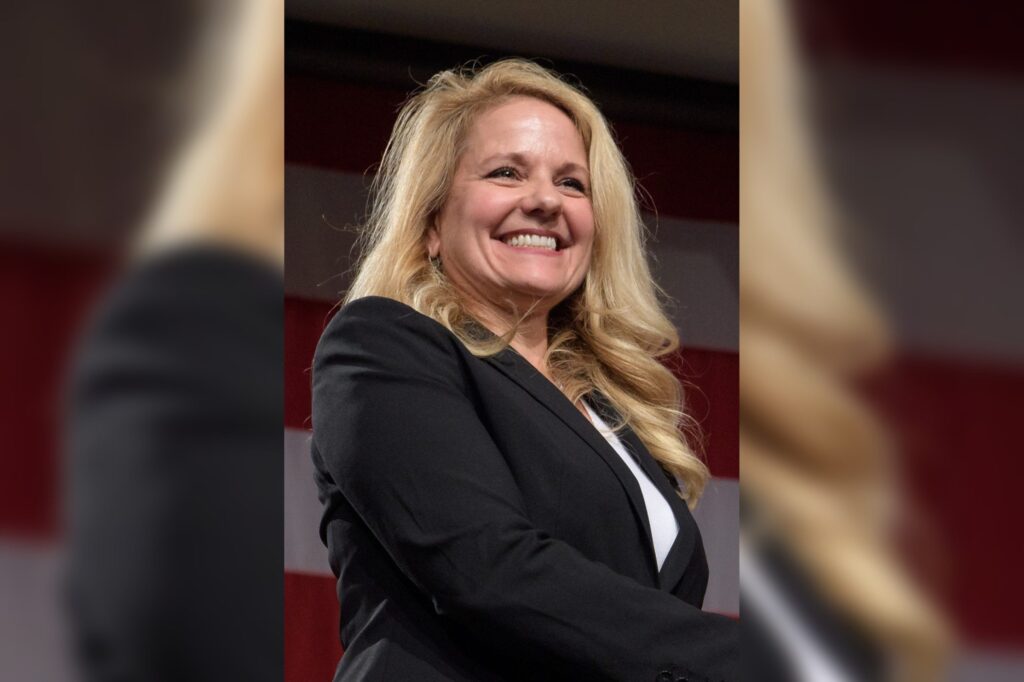
The figure that matters, stated the way she would state it: Forbes’s real-time tracker put Gwynne Shotwell’s fortune at $1.7B as of 11/3/26, good for #2329 in the world, and the company she runs as president and COO, SpaceX, listed in June under the ticker SPCX at a valuation Fortune put at roughly $1.77 trillion. Fortune, reporting on June 15, tallied her holding at 12.6 million shares, a stake worth more than $2 billion at the first close. Investors will note the drift between those two marks in the months since, and note too that the trackers do not agree on the position itself: Fortune counts the shares, while Forbes pegs an estimated stake of 0.11% against its own $1.25 trillion valuation for a company that now employs over 13,000 people.
The ritual behind the riches predates the listing by nearly two decades. In September 2008, Shotwell stood in a hotel bathroom in Glasgow with the shower going so her husband could sleep, on the phone pricing SpaceX’s $1.6 billion bid for the NASA resupply contract while the company’s fourth Falcon 1 countdown ran half a world away, a flight Musk believed was the final launch the company’s cash could carry. The rocket reached orbit. She told a Stanford Business School podcast she ran down the hotel hallway “in my yoga pants and jammy top,” and the team “kind of” broke into the hotel bar around two in the morning for warm Champagne. The sticky-note ritual dates from that night: “Scotland” written on two notes, one per shoe, every launch day since, so that on paper she never leaves the country.
Her route into the industry is a study in accident. Born in 1963 in Libertyville, Illinois, a high-school cheerleader who graduated first in her class, she found the Apollo 11 broadcast, watched at age five, dull; what turned her was a Society of Women Engineers panel her mother steered her to, where one poised engineer made the trade sound suddenly within reach: “Her shoes were marvelous, her bag matched, and she just made mechanical engineering accessible to me,” she told Marie Claire in 2017. “I left that event saying, ‘Okay, I’ll be a mechanical engineer,’ because I thought she was cool.” Northwestern put her among three women in a class of 36; an IBM interview fell on the day the shuttle Challenger exploded and produced no offer; Chrysler’s management program, a master’s in applied math, a decade of thermal analysis at the Aerospace Corp. and four years running space systems at Microcosm followed. Then 2002: a lunch, a tour, a three-minute conversation with Musk. “I wasn’t looking for a job. I didn’t have a résumé,” she said, and after a month of hesitation that ended pulled over on a Los Angeles freeway she took the business development job as employee No. 11, walking away from a 3% stake in a stable firm, telling Stanford she’d said “‘[I’m] an idiot,’” to Musk on the phone and drawing the reply “Welcome to the team.” Her fallback had the company failed: “I’d rather sell real estate or be a barista.”
What shareholders bought at the listing is a conversion story, the founder’s impossible ambitions turned into a shippable calendar. “I need more data than Elon does to make a decision” is how she split the labor at Stanford, and on missed dates she is unapologetic: “We fail on timeline, but that feels like the right fail to make.” Musk’s own formulation, which she reprised for investors on CNBC before the IPO, runs “We make the impossible, we just make it late.” The prospectus promised orbiting AI data centers by 2028, a million-person Mars colony, and a Starship quick-turning “like an airplane,”; asked when to expect the colony, she guessed 2035, then allowed that she is “so bad at predicting timelines.” The balance sheet behind those promises is the part the bottom line cannot skip: since absorbing xAI in February 2026, the company has taken on $29 billion in debt and become, in Fortune’s telling, deeply unprofitable, with OpenAI and Anthropic now queuing for public debuts of their own. Shotwell’s own accounting of the cost curve, from “from those penurious Falcon 9 Dragon days to the more expensive capital-intensive Starship, and then to AI, because it is next-level expensive,” comes with a defense of the burn: “If a launch goes perfectly, all you’ve learned is that that launch vehicle on that day worked,” while “When you have failure, you actually get this treasure trove of data.” The forward order book is real all the same: NASA has picked SpaceX to carry astronauts to the lunar surface on Artemis IV, planned for 2028.
The hedge the market prices, though, is not on any manifest. Fortune casts Shotwell as the answer to key-man risk: when Musk feuded publicly with President Donald Trump in June 2025 and threatened to switch off the Dragon capsule, she quietly reassured NASA that the row would blow over. She has defended him closer to home, sending a companywide letter in 2022, against her press team’s advice, after harassment allegations surfaced: “I don’t believe he could have done what he was accused of. But he is imperfect. I’m imperfect.” She calls him “probably the best CEO in history, in my opinion, humble opinion,” and on succession allows only that “the company would not collapse obviously without Elon, but it would by no means be the same.” Her own destination, given a Starship and anywhere to go, is not Mars but the moon, six months out being a long trip for a woman whose idea of roughing it is precise: “I don’t like to camp.” The rest of the file rounds out the COO: platform heels and black skinny jeans, Chardonnay, Outlander novels at bedtime, a 1,000-acre Texas ranch being prepped as a vineyard. “I drink a lot of wine,” she joked to Marie Claire, adding, “Actually, reading is probably the thing that calms me the most.” The bottom line for anyone weighing SPCX: the founder sells the future, and the $1.7B president is the one who has to land it, on a schedule she has already told you will slip.
Sources
- Meet Gwynne Shotwell, the $2B engineer-turned-COO who runs SpaceX in platform heels | Fortune
- Gwynne Shotwell




