
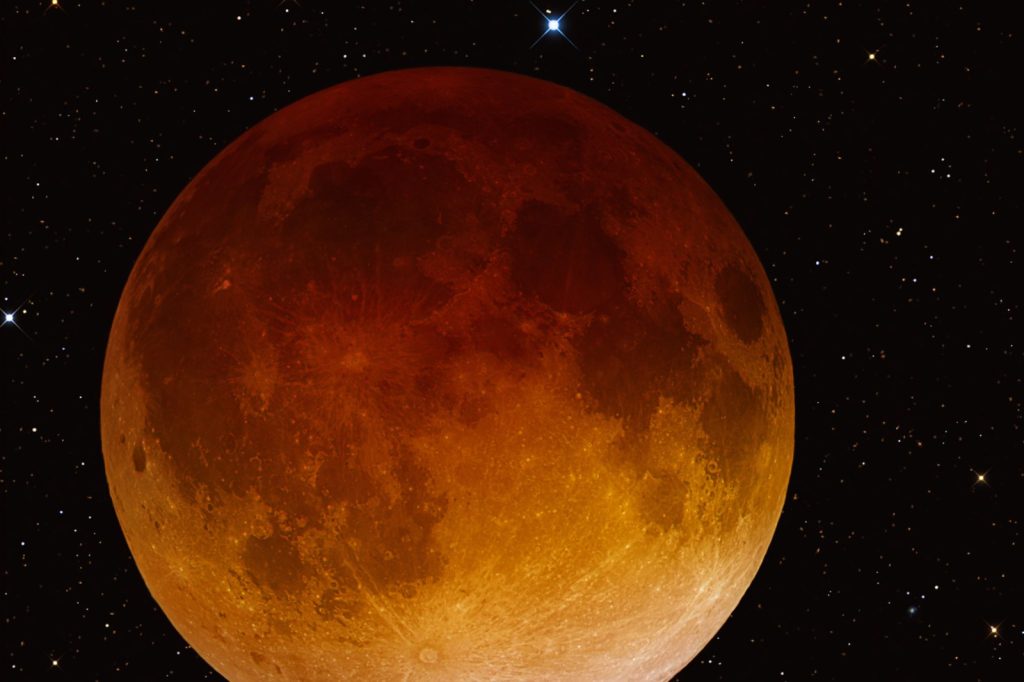
The essential element behind this morning’s total lunar eclipse is not advanced telescopes or specialized camera equipment. It is the patient passage of time. While observers across the Western Hemisphere witnessed the Moon transform into a deep reddish-orange, the underlying mechanics had been operating for hours.
The alignment required for this event is not instantaneous; it is a gradual, exact geometric convergence. For a lunar eclipse to occur, the Moon’s orbital plane must align almost perfectly with Earth and the Sun.
Astronomers continuously track this movement, focusing on the Moon’s proximity to the lunar node—the point where its orbit crosses Earth’s orbital plane around the Sun. A deviation of even a fraction of a degree prevents the eclipse, resulting in an ordinary full Moon. The notable feature of this event is not the color but the duration.
Lunar eclipses can last an hour or longer, a significant contrast to solar eclipses, which last only minutes and require eye protection. Viewers can step outside, look up, and observe the entire process without any risk.
No special glasses or filters are needed. The long viewing window makes this eclipse popular among astronomy enthusiasts, who can set up chairs and watch the Moon’s gradual transformation. The Earth’s umbra—the innermost, darkest part of its shadow—drives this change. As the Moon drifts into this shadow, it does not turn black but red.
This phenomenon results from the same physics that creates red sunsets. Earth’s atmosphere scatters shorter wavelengths of light and bends longer red wavelengths into the shadow cone, which then reaches the Moon’s surface.
The “blood moon” nickname thus reflects physics, not poetry. The mechanics involve the intricate dance of the Sun, Earth, and Moon, governed by orbits and inclinations. The Moon’s orbit is tilted about five degrees relative to Earth’s orbit around the Sun.
Most months, the Moon passes above or below Earth’s shadow. Only when it swings through the node at the correct time does the alignment lock in.
This is why total lunar eclipses are not monthly events; they are spaced out, sometimes by years. When they do occur, they are not fleeting. The Moon takes its time crossing through the umbra.
The shadow creeps across the lunar surface, and the color deepens. The process is slow enough that a person can step outside, watch for a few minutes, go back inside for coffee, and return to see the Moon still half-shrouded.
This patient event does not demand immediate attention. For those in the Western Hemisphere, the overnight hours offered that opportunity. The Moon, the shadow, and the mechanics worked exactly as predicted.
For anyone who looked up, the payoff was a Moon that glowed a deep, ancient red.




